Grade 9 math puzzles — free practice & printable teacher quizzes
Free grade 9 math puzzles that teach abstract thinking — competition and Olympiad style,
with instant hints, full solutions and a named thinking strategy for every task. Cumulative: grade 9 problems also test everything needed up to this grade.
Try each one first — the hint and the full solution open when you are ready.
Or solve them in the app with read-aloud and instant feedback.
Problem 1 · Check zero factors before canceling · 3 points
What is the sum of all real values of x that make (x − 4)(x + 2) = (x − 4)(2x − 4) true?
4
10
-2
6
2
Show a hint
A matching expression on both sides is not always safe to cancel. What if it equals zero?
Move everything to one side and factor before finding the solutions.
Show the answer and solution
Answer: B — 10
Subtract the right side to get (x − 4)[(x + 2) − (2x − 4)] = (x − 4)(6 − x) = 0. So x = 4 or x = 6, and their sum is 10. The tempting answer 6 comes from canceling x − 4 and losing the valid solution x = 4.
Problem 2 · Compare trips to find a unit rate · 3 points
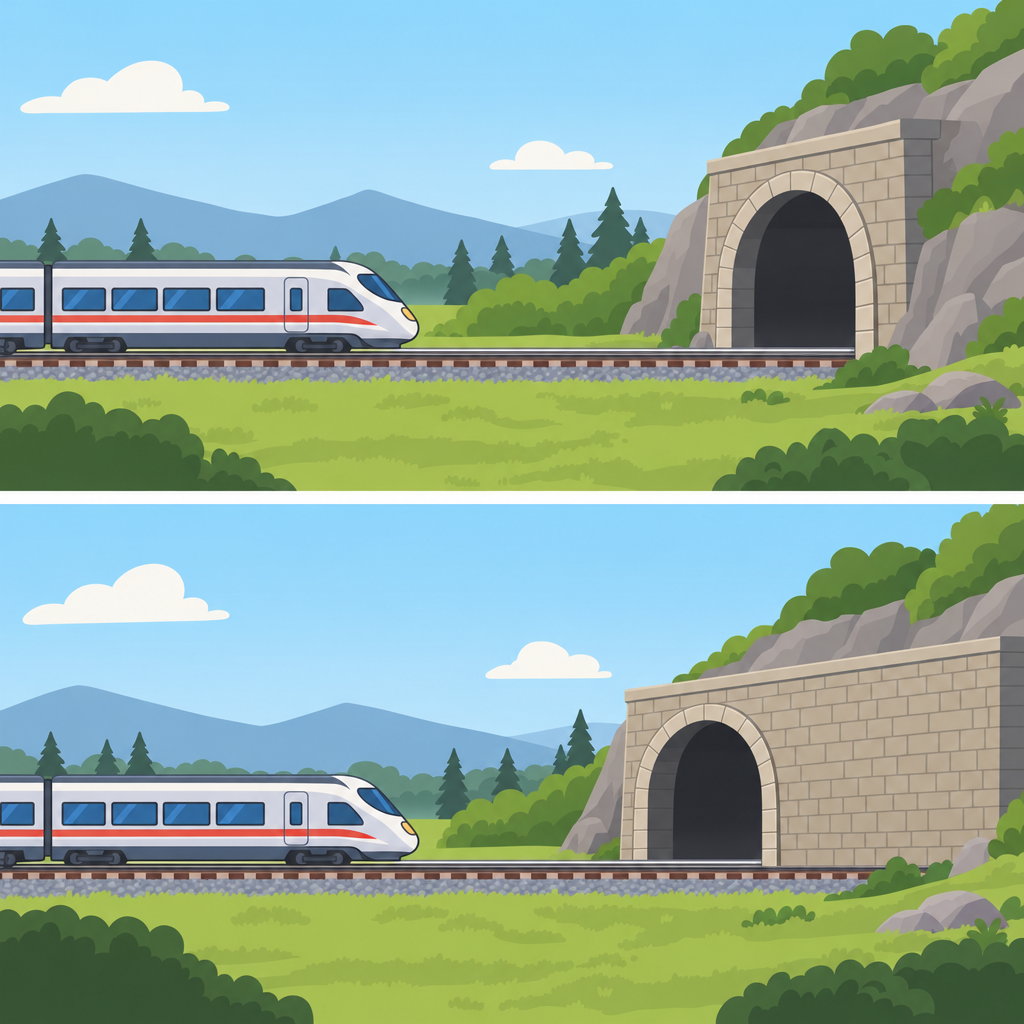
A train travels at a constant speed. It takes 24 seconds to clear a 280 m tunnel and 32 seconds to clear a 440 m tunnel, each timed from when the train’s front enters to when its back exits. How long is the train?
480 m
280 m
200 m
330 m
160 m
Show a hint
Compare the two crossings: what extra distance accounts for the extra time?
In each crossing, the train travels the tunnel’s length plus its own length.
Show the answer and solution
Answer: C — 200 m
The longer tunnel adds 440 − 280 = 160 m to the train’s travel distance and 32 − 24 = 8 seconds to its time, so its speed is 20 m/s. In 24 seconds it travels 480 m; subtracting the 280 m tunnel gives a train length of 200 m. The tempting 480 m is the whole crossing distance, not the train’s length.
Problem 3 · Cancel even terms at opposite inputs · 3 points
A quadratic function gives f(−2)=10 and f(2)=−2. What is f(−3)−f(3)?
0
−18
12
−12
18
Show a hint
Compare the outputs at opposite inputs: which parts of a quadratic stay the same, and which change sign?
Write f(x)=ax²+bx+c. Subtracting the outputs at opposite inputs makes two terms disappear.
Show the answer and solution
Answer: E — 18
For f(x)=ax²+bx+c, we have f(−2)−f(2)=−4b=10−(−2)=12, so b=−3. Thus f(−3)−f(3)=−6b=18. The tempting −18 reverses the subtraction or loses a negative sign.
Problem 4 · Concurrency with a distinctness check · 4 points
For which value of k do y = kx + 1, y = 2x + k − 1, and y = x + 3 form three distinct lines through one point?
1
-1
4
2
3
Show a hint
Two of the lines always have different slopes. Find where they meet, then check whether the third line passes through that point.
The lines with slopes 2 and 1 meet at x = 4 − k. After finding possible values of k, check that the lines really are distinct.
Show the answer and solution
Answer: E — 3
Setting 2x + k − 1 = x + 3 gives x = 4 − k. For the first line to pass through that point, k(4 − k) + 1 = (4 − k) + 3, which simplifies to (k − 2)(k − 3) = 0. The tempting value 2 makes the first two lines identical, not distinct. At k = 3, the three lines have different slopes and all pass through (1, 4), so the answer is 3.
What is the remainder when 1 + 2 + 2² + ··· + 2²⁰²⁶ is divided by 2¹⁰¹³ + 3?
8
18
0
1
17
Show a hint
Look for a shorter way to describe the entire sum before doing any division.
Let x = 2¹⁰¹³. What could you subtract from x² to make x + 3 a factor?
Show the answer and solution
Answer: E — 17
The sum is 2²⁰²⁷ − 1 = 2x² − 1, where x = 2¹⁰¹³. Since x² − 9 = (x − 3)(x + 3), we get 2x² − 1 = 2(x − 3)(x + 3) + 17. Because 17 is smaller than x + 3, the remainder is 17. The tempting answer 8 comes from using x² − 9 but forgetting the factor of 2.
Problem 6 · Factor a difference of squares · 4 points
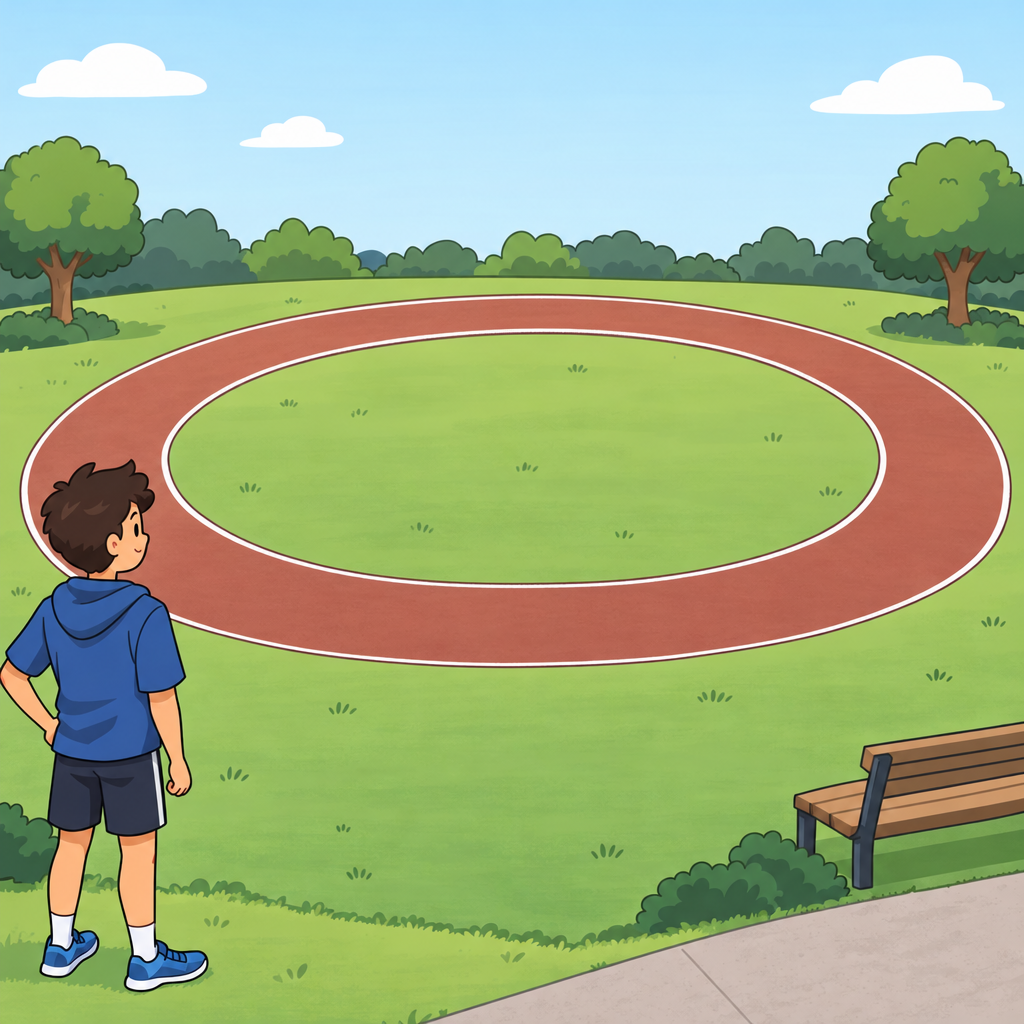
A circular track has two concentric edges. Their circumferences add to 34π metres, and the track’s area is 51π square metres. What is the inner edge’s circumference?
14π metres
17π metres
6π metres
28π metres
20π metres
Show a hint
The two radii appear in both pieces of information. Can you connect what you know without finding either radius first?
Write the track’s area as the difference of two circle areas, then factor.
Show the answer and solution
Answer: A — 14π metres
Let the outer and inner radii be R and r. The combined circumference gives R + r = 17, while the area gives (R − r)(R + r) = 51. Thus R − r = 3 and r = 7, so the inner circumference is 14π metres. The tempting 6π metres is the difference between the two circumferences, not the inner circumference.
Problem 7 · Factor a difference of squares and count symmetric solutions · 5 points
How many integers n make n² + 30n + 81 the square of an integer?
8
9
5
10
3
Show a hint
There’s a square hiding in the quadratic. What happens if you compare it with the square you’re looking for?
Rewrite the expression as (n + 15)² − 144, then factor the difference of two squares. Check the parity of the factors and both signs of n + 15.
Show the answer and solution
Answer: D — 10
Suppose n² + 30n + 81 = m². Then (n + 15 − m)(n + 15 + m) = 144. The two factors have the same parity, so they must both be even. Their positive factor pairs are (2, 72), (4, 36), (6, 24), (8, 18), and (12, 12). Each pair gives one value of n + 15 and its negative, hence two values of n, for 10 altogether. The tempting answer 5 counts only one sign of n + 15; the negative sign also gives valid integers.
Problem 8 · Link symmetric expressions through identities · 5 points
Three real numbers x, y, and z satisfy x+y+z=9 and (x−y)²+(y−z)²+(z−x)²=18. What is (x+y)(y+z)(z+x)+xyz?
162
200
189
243
216
Show a hint
The clues don't determine each number, but they might determine a symmetric combination that appears in the expression you want.
Let P=xy+yz+zx. Rewrite the squared differences using P, then expand the product and see what happens to xyz.
Show the answer and solution
Answer: E — 216
Let S=x+y+z=9 and P=xy+yz+zx. Expanding gives (x−y)²+(y−z)²+(z−x)²=2(S²−3P), so 18=2(81−3P) and P=24. Also, (x+y)(y+z)(z+x)+xyz=SP, giving 9·24=216. The tempting 189 comes from missing the factor of 2 in the squared-differences identity.
Problem 9 · Place-value equations and divisibility · 5 points
A six-digit lock code has distinct, nonzero digits. Multiplying it by 5 moves its last digit to the front while keeping the other digits in order; what is the sum of the original code’s first and last digits?
7
8
12
6
9
Show a hint
Write the code as a five-digit prefix followed by its final digit, then compare the place values before and after multiplication.
Eliminate the prefix and use divisibility to narrow down the final digit.
Show the answer and solution
Answer: B — 8
Let N be the code and d its final digit. Moving d to the front gives 5N = 100000d + (N−d)/10, so 49N = 999999d. Now 999999 = 7×142857, and 142857 leaves remainder 1 when divided by 7. Thus d must be a multiple of 7; as a nonzero digit, it is 7. The equation gives N = 142857, and indeed 5×142857 = 714285. The requested sum is 1+7 = 8. The tempting answer 7 is only the final digit, not the sum.
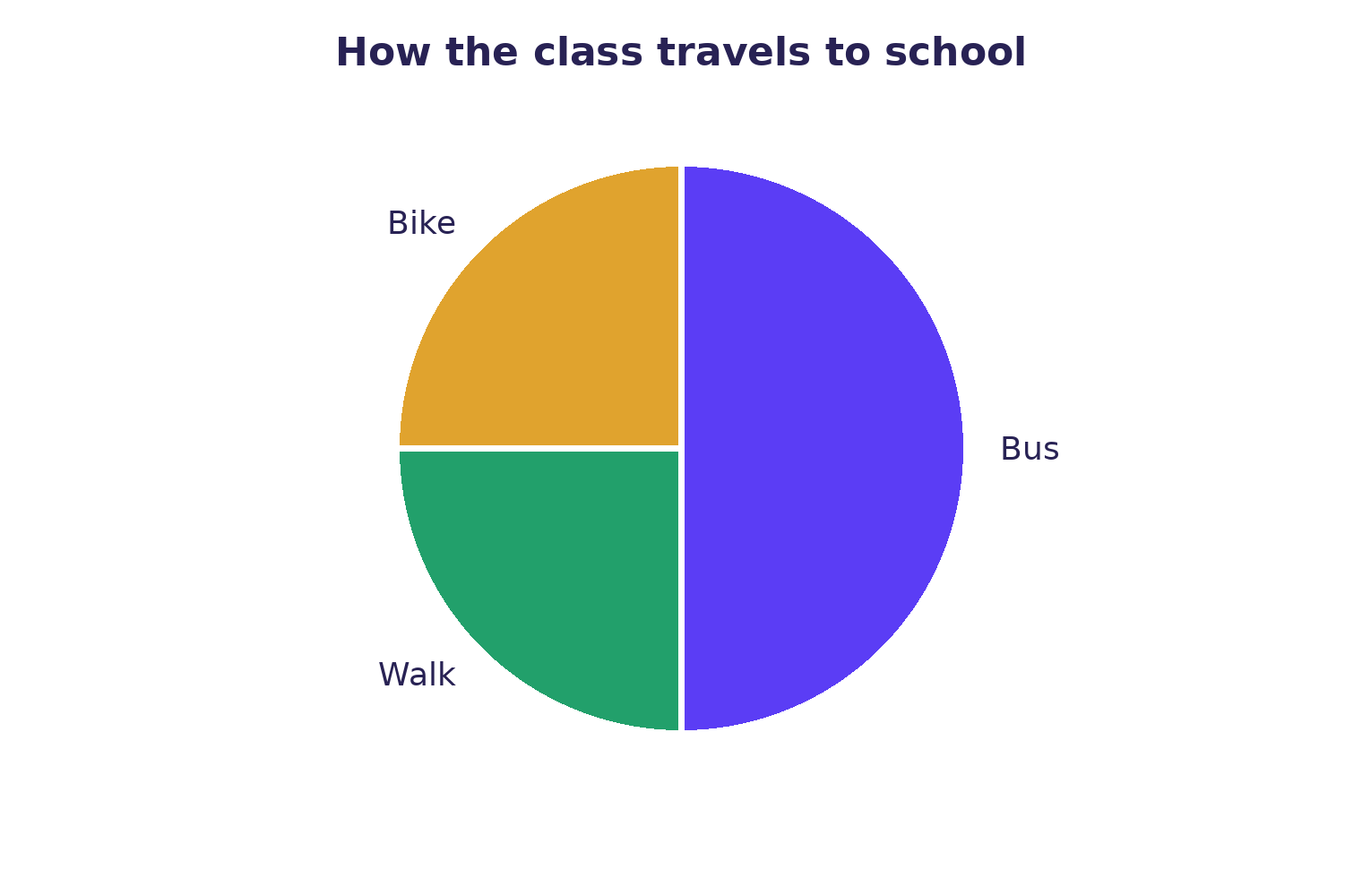
Choose any 20 students from this class of 40, then list every possible three-person team with one bus rider, one walker, and one cyclist. Students may appear on several teams. What is the greatest possible number of teams on the list?
343
280
288
294
250
Show a hint
Think about what happens to the list if you swap a chosen student for an unchosen student who travels differently.
Let b, w, and c be the chosen numbers from each travel group. Count the possible teams, then compare what happens when you move one place from a larger group to a smaller one.
Show the answer and solution
Answer: D — 294
The chart gives 20 bus riders, 10 walkers, and 10 cyclists. If the chosen group has b, w, and c students of each type, then b+w+c=20 and the list has bwc teams. When two of these numbers differ by at least 2, moving one place from the larger to the smaller increases their product, so the greatest product uses 7, 7, and 6. Each of those counts is available in the class, giving 7×7×6=294 teams. The tempting 250 comes from choosing 10 bus riders, 5 walkers, and 5 cyclists to match the class’s proportions, but the chosen group does not have to keep those proportions.
Fourteen lily pads sit in a row. A frog paints exactly seven gold, forming exactly three groups of consecutive gold pads, each with at least two pads. How many paintings are possible?
168
105
56
360
120
Show a hint
Think about the lengths of the gold groups, then about the blank spaces around and between them.
Two blank pads are needed to separate the three gold groups. How can the remaining blanks be shared among the four spaces before, between, and after the groups?
Show the answer and solution
Answer: A — 168
The gold groups must have lengths 3, 2, and 2, in any of three orders. Of the seven blank pads, reserve one for each gap between groups. The other five can be distributed among the four spaces before, between, and after the groups in C(8,3) = 56 ways. Thus there are 3 × 56 = 168 paintings. The answer 56 misses the three possible positions of the longer gold group.
Problem 12 · Pairing odd-degree vertices · 4 points
A robot walks on a 3-by-4 grid of intersections, with streets only between horizontal or vertical neighbors. If it must walk every street and return to its start, what is the fewest street segments it can walk?
20
24
22
23
21
Show a hint
On a walk that returns to its start, every arrival at an intersection needs a departure. Which intersections have an odd number of streets?
Think of the extra walks as paths pairing those intersections. How far apart could the paired intersections be?
Show the answer and solution
Answer: C — 22
The grid has 9 horizontal and 8 vertical streets, for 17 in all. Six intersections have three streets each, so the robot must repeat streets to make their total numbers of visits even. The odd intersections at the middle of the left and right edges are 3 segments apart; if paired with each other, the other four odd intersections need at least 2 more segments. If paired separately, each needs a path of at least 2 segments, and the remaining pair needs at least 1. Either way, at least 5 segments must be repeated. This is possible: repeat all 3 streets across the middle row and the central street in each of the top and bottom rows. Every intersection then has an even number of traversals, allowing a closed walk of 17 + 5 = 22 segments. The tempting 20 counts one repeated segment per pair, overlooking the distances between them.