Grade 11 math puzzles — free practice & printable teacher quizzes
Free grade 11 math puzzles that teach abstract thinking — competition and Olympiad style,
with instant hints, full solutions and a named thinking strategy for every task. Cumulative: grade 11 problems also test everything needed up to this grade.
Try each one first — the hint and the full solution open when you are ready.
Or solve them in the app with read-aloud and instant feedback.
Problem 1 · Use equal spacing to recover exponential growth · 3 points
An increasing exponential function f has f(0) + f(2) = 25 and f(1) = 10. What is f(3)?
30
5/2
35
20
40
Show a hint
Look at the three equally spaced inputs 0, 1, and 2. How does the middle value relate to the two outer values?
For an exponential function, f(1)² = f(0)f(2). Use that with the given sum, then decide which outer value is larger.
Show the answer and solution
Answer: E — 40
The outer values have sum 25 and product f(1)² = 100, so they are 5 and 20. Since f is increasing, f(0) = 5 and f(2) = 20. Each step therefore doubles the value, giving f(3) = 40. The tempting 5/2 comes from reversing 5 and 20, which would make f decrease.
Problem 2 · Translate logarithms into exponents · 3 points
For x > 0 with x ≠ 1, suppose logₓ 16 = log₂ x. What is the sum of all possible values of x?
1
4
0
17/4
1/4
Show a hint
Rewrite each logarithm as an exponential statement. Remember that a logarithm’s base can lie between 0 and 1.
Let t = log₂ x. Then x = 2^t, and the given equation also says x^t = 16.
Show the answer and solution
Answer: D — 17/4
Let t = log₂ x. Since x = 2^t and x^t = 16, we have 2^(t²) = 2⁴. Thus t = ±2, giving x = 4 or x = 1/4. Their sum is 17/4. The tempting answer 4 misses the valid base 1/4, for which both logarithms are negative.
Problem 3 · Quadratic finite differences · 3 points
Twenty dots lie on the graph of a quadratic function, with equally spaced x-coordinates from left to right. The first three are (5, 41), (8, 110), and (11, 215); what is the height of the 20th dot?
1352
7508
7502
8261
6791
Show a hint
How does a quadratic’s change in height behave across successive equal-width jumps?
The height gains form an arithmetic sequence. Find its common difference, then count the gaps from the first dot to the twentieth.
Show the answer and solution
Answer: B — 7508
The first two height gains are 110 − 41 = 69 and 215 − 110 = 105. Because the x-coordinates are equally spaced and the graph is quadratic, each successive gain increases by 36. There are 19 gains from dot 1 to dot 20, so the last gain is 69 + 18 × 36 = 717. The 20th height is 41 + 19(69 + 717)/2 = 7508. The tempting 8261 counts 20 gains, which reaches dot 21 instead.
Problem 4 · Compare discriminants and count distinct roots · 4 points
For which real value of t does (x² − 2tx + 1)(x² − 2x + t²) = 0 have exactly one distinct real solution for x?
t = −1 or t = 1
No real value of t
t = 1
−1 < t < 1
t = −1
Show a hint
The product collects solutions from both quadratics. Compare when each can have two real roots before counting the solutions together.
The two discriminants have opposite signs unless both are zero. In that special case, check whether the repeated roots coincide.
Show the answer and solution
Answer: C — t = 1
The discriminants are 4(t² − 1) and 4(1 − t²). Unless t² = 1, one is positive, so the product has at least two distinct real solutions. At t = 1, both factors are (x − 1)², giving just x = 1. At t = −1, the factors are (x + 1)² and (x − 1)², giving two solutions. Thus t = 1; the tempting answer t = −1 or t = 1 overlooks that the repeated roots differ when t = −1.
Problem 5 · Geometric series with overlapping sets · 4 points
Cups numbered 1, 2, 3, ... hold 2, 1, 1/2, 1/4, ... in order. Ada marks every even-numbered cup, and Ben marks every cup numbered by a multiple of 3; what is the sum in cups marked by exactly one of them?
4/7
16/9
116/63
4/3
40/21
Show a hint
Find the total Ada marks and the total Ben marks separately, then think about the cups they both mark.
The shared cups are numbered by multiples of 6. Each of the three groups has a geometric sum.
Show the answer and solution
Answer: B — 16/9
The sums in Ada’s and Ben’s cups are 1 + 1/4 + ... = 4/3 and 1/2 + 1/16 + ... = 4/7. Cups they both mark have numbers divisible by 6 and sum to 1/16 + 1/1024 + ... = 4/63. To keep only cups marked by exactly one person, subtract that shared sum twice: 4/3 + 4/7 − 2(4/63) = 16/9. Subtracting it just once gives 116/63, which incorrectly includes the shared cups.
Problem 6 · Complete the random order and use symmetry · 4 points
A bag holds 5 red and 5 blue marbles. You draw without replacement until all the marbles of one color have been drawn. What is the expected number of marbles left in the bag?
3/2
5/6
1
5/3
2
Show a hint
Imagine continuing the draws until the bag is empty. How could the end of that complete sequence describe what was left when you stopped?
Count reds after the last blue and blues after the last red separately. Think about the six gaps around the five marbles of the opposite color.
Show the answer and solution
Answer: D — 5/3
In a complete draw order, the marbles left when you stop are either the reds after the last blue or the blues after the last red. The five blues create six gaps for the reds. By symmetry, each gap contains an expected 5/6 reds, so an expected 5/6 reds follow the last blue. Likewise, an expected 5/6 blues follow the last red. The expected number left is therefore 5/6 + 5/6 = 5/3. The tempting answer 5/6 counts only the cases where reds are left behind.
Problem 7 · Inclusion–exclusion with rotational symmetry · 5 points
How many circular arrangements of the letters AABBCCDD have no identical letters next to each other? Count rotations as the same, but do not identify mirror images.
96
744
315
93
318
Show a hint
First count arrangements on eight numbered seats. Then ask whether every valid arrangement produces eight different rotations.
To count on numbered seats, use inclusion–exclusion: temporarily glue together any equal-letter pairs that are required to be adjacent.
Show the answer and solution
Answer: A — 96
Choose k of the four equal-letter pairs to be adjacent. Gluing those pairs into blocks gives 8(7−k)!/2^(4−k) arrangements on numbered seats. Inclusion–exclusion therefore gives 2520−2880+1440−384+48=744 valid arrangements. Of these, 4!=24 repeat after a half-turn: their first four letters contain A, B, C and D once each. Every other valid arrangement has eight distinct rotations, while these 24 have only four. The answer is (744−24)/8+24/4=96. The tempting answer 93 comes from dividing all 744 by eight, overlooking the half-turn arrangements.
Problem 8 · Bridge between symmetric identities and an attainable bound · 5 points
Real numbers a, b, and c satisfy a+b+c=0 and a²+b²+c²=6. What is the greatest possible value of a⁶+b⁶+c⁶?
72
64
78
54
66
Show a hint
Treat a², b², and c² as three new numbers, and look for what their sum and pairwise products tell you.
To check whether a bound can actually be reached, set c=t and use (a−b)²≥0 to restrict t.
Show the answer and solution
Answer: E — 66
Since a+b+c=0, we have ab+bc+ca=−3. Also, a²b²+b²c²+c²a²=(ab+bc+ca)²−2abc(a+b+c)=9. The sum-of-cubes identity applied to a², b², c² gives a⁶+b⁶+c⁶=6³−3·6·9+3a²b²c²=54+3a²b²c². Now let c=t. Then a+b=−t and ab=t²−3, so (a−b)²=12−3t²≥0 and t²≤4. Thus 4−a²b²c²=4−t²(t²−3)²=(4−t²)(t²−1)²≥0. The maximum is 54+3·4=66, reached at (a,b,c)=(−1,−1,2). The tempting 78 comes from treating a², b², c² as if all three could equal 2; their square roots cannot then sum to zero.
Problem 9 · Factor an integer polynomial using known roots · 5 points
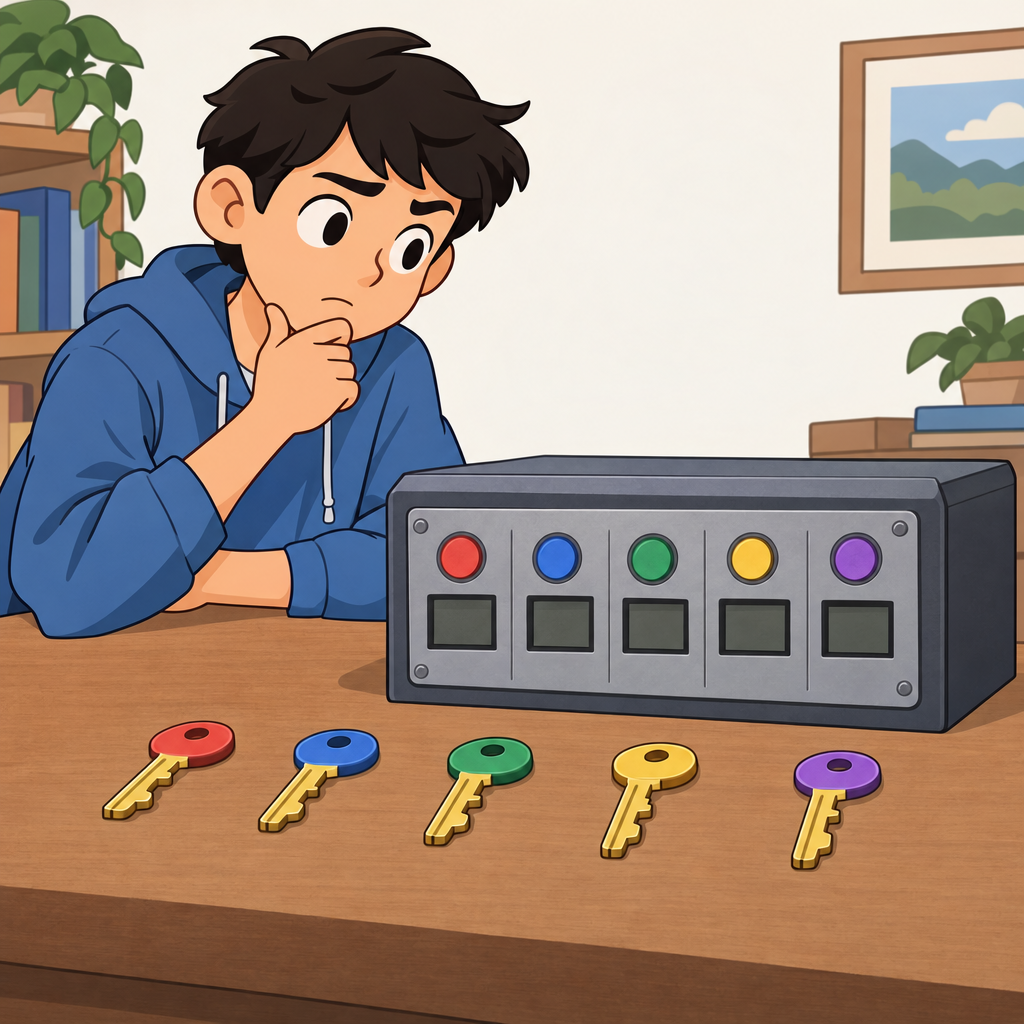
A lock shows codes 3, 10, 23, 42, 67 for keys 1, 2, 3, 4, 5. Its hidden program is a polynomial with integer coefficients, but its degree is unknown; which code could key 6 show?
138
158
122
128
218
Show a hint
The simplest formula fitting the five codes need not be the hidden program. What must every possible change to that formula have in common?
Find a small polynomial that fits, then consider the roots of the difference between it and the hidden polynomial.
Show the answer and solution
Answer: E — 218
The five codes fit B(x)=3x²−2x+2, which gives B(6)=98. For any permitted program P, the integer-coefficient polynomial P−B has roots 1, 2, 3, 4, 5. Hence P(x)−B(x)=(x−1)(x−2)(x−3)(x−4)(x−5)Q(x) for an integer-coefficient polynomial Q. At key 6, the code must therefore be 98+120Q(6). Only 218 fits, and taking Q(x)=1 shows it is possible. The tempting 158 differs from 98 by 60, which passes separate divisibility checks against the five earlier keys, but those checks miss the required factor of 120.
Problem 10 · Combine modular cycles with exponent divisibility · 5 points
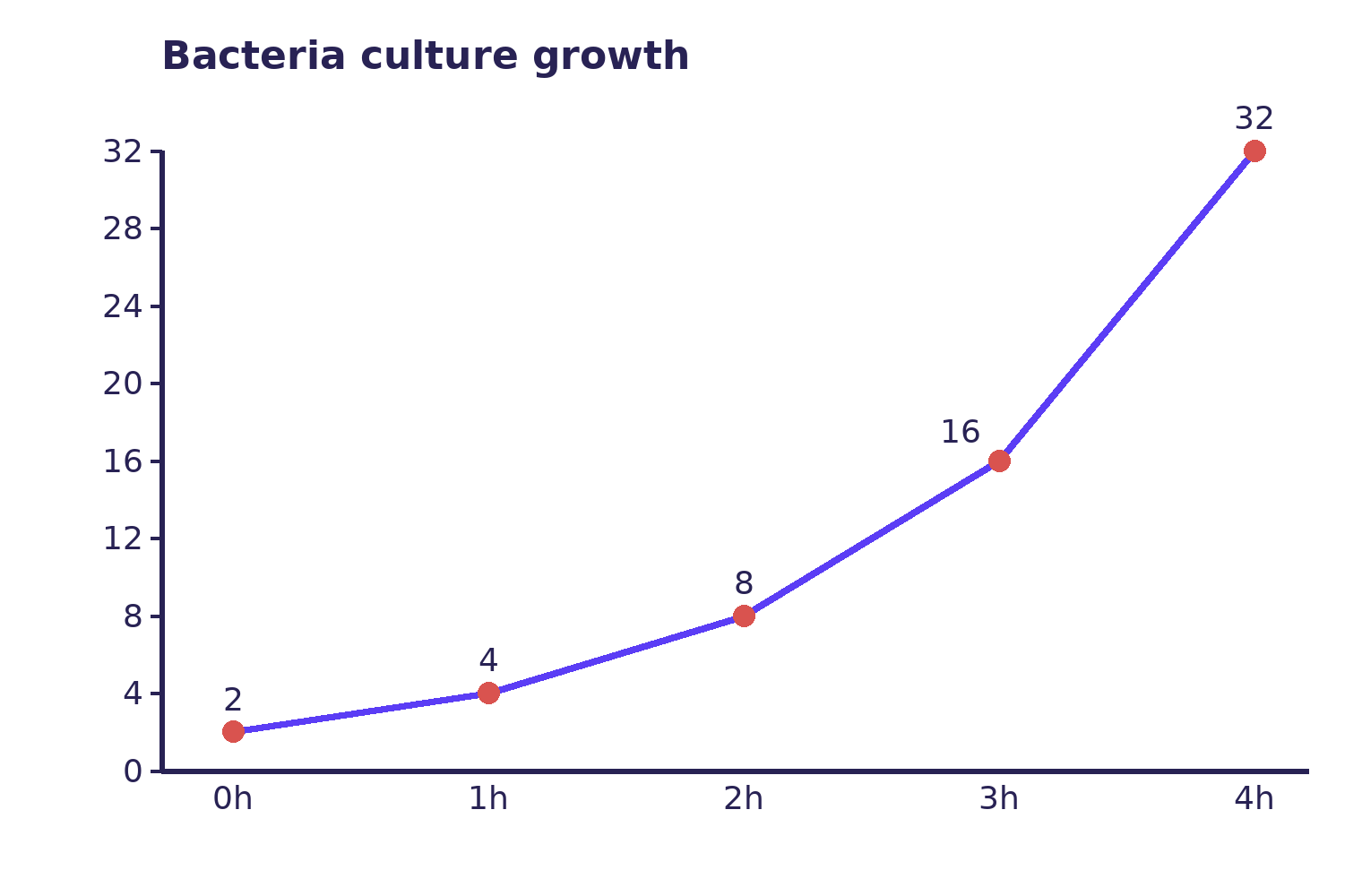
If the chart’s exponential trend continues, what is the first whole-number hour after hour 4 when the bacteria count is a perfect fourth power and its increase since hour 4 is divisible by 49?
7
46
67
25
68
Show a hint
Factor the increase since hour 4, then study its divisibility by 49 separately from the fourth-power condition.
First check when powers of 2 equal 1 modulo 7. Then use 2³ = 1 + 7 to check which of those powers equal 1 modulo 49.
Show the answer and solution
Answer: C — 67
At hour t, the count is 2^(t+1), so its increase since hour 4 is 32(2^(t−4)−1). Because 32 is coprime to 49, the increase is divisible by 49 exactly when 2^(t−4) ≡ 1 (mod 49). Powers of 2 repeat every three exponents modulo 7, so write t−4 = 3m. Then 2^(t−4) = (1+7)^m ≡ 1+7m (mod 49), which equals 1 modulo 49 exactly when 7 divides m. Thus t = 4+21j for a positive integer j. The count is a fourth power when t+1 = 5+21j is divisible by 4, or j ≡ 3 (mod 4). The smallest such j is 3, giving hour 67. Hour 25 is tempting: its increase is divisible by 49, but its count, 2^26, is not a fourth power.
Problem 11 · Find a grouped parity invariant · 3 points
Nine lamps, numbered 1 through 9 clockwise around a circle, start off. A move flips any three consecutive lamps; which set could be exactly the lamps left on?
{1, 2, 3, 4}
{3, 4, 6, 7}
{2, 4, 6, 7}
{1, 2, 6, 8}
{1, 3, 6, 9}
Show a hint
A move touches three positions. Can you group the lamps so that every move treats the groups alike?
Try the groups {1, 4, 7}, {2, 5, 8}, and {3, 6, 9}. What happens to the parity of the number of lit lamps in each?
Show the answer and solution
Answer: B — {3, 4, 6, 7}
Every move flips one lamp in each of the three groups, so their numbers of lit lamps must always have the same parity. For {3, 4, 6, 7}, those numbers are 2, 0, and 2; it is reachable by flipping {3, 4, 5} and then {5, 6, 7}. Every other choice has unequal group parities. In particular, {1, 2, 3, 4} has an even total of four lit lamps, but its group counts are 2, 1, and 1.
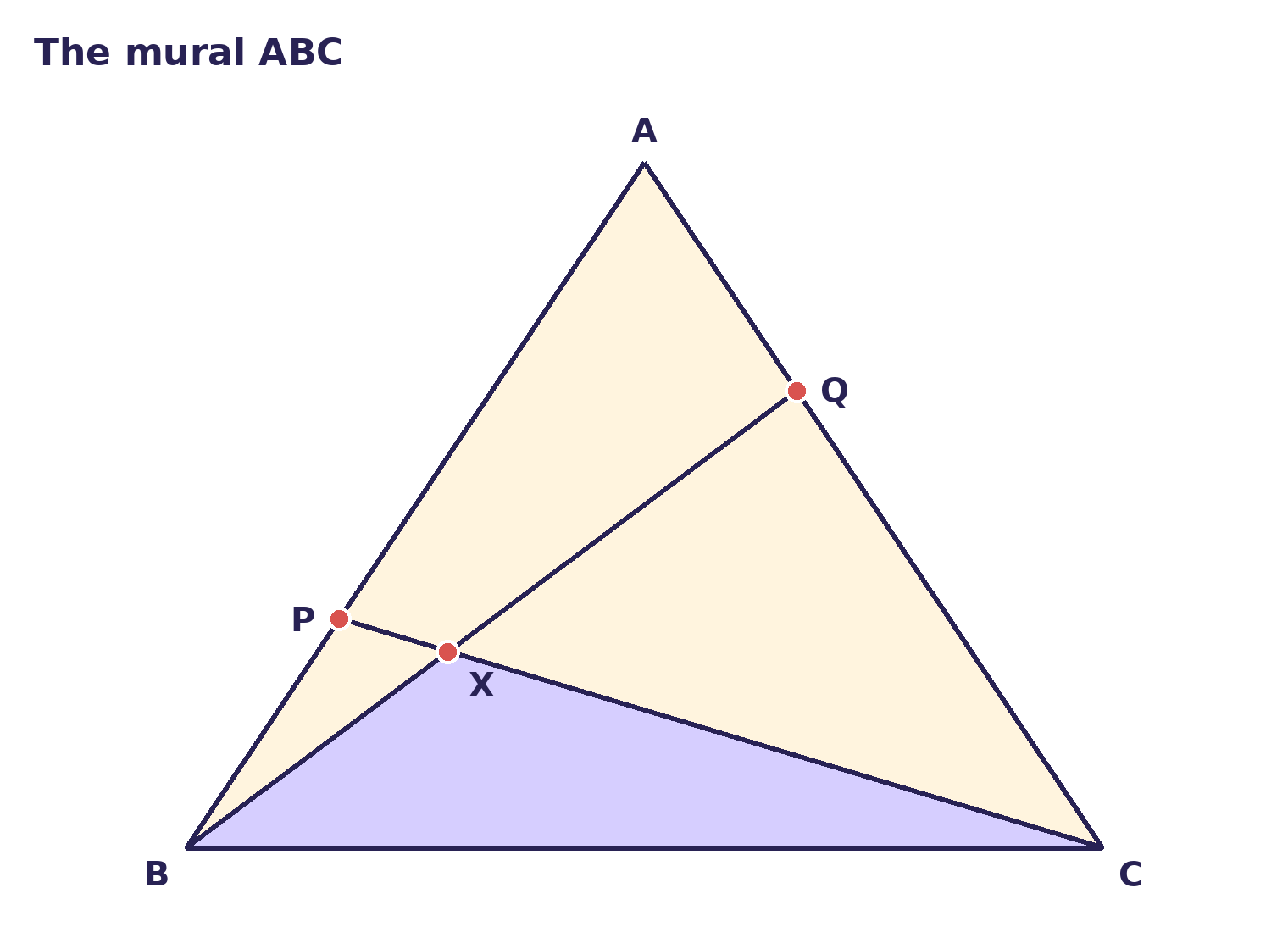
On a triangular mural ABC, P lies on AB with AP:PB = 2:1, and Q lies on AC with AQ:QC = 1:2. If CP and BQ cross at X, what fraction of the mural is triangle BXC?
4/7
1/3
2/7
1/7
5/7
Show a hint
Use AB and AC as coordinate directions; they need not be perpendicular.
Find X, then compare areas with the whole triangle.
Show the answer and solution
Answer: C — 2/7
Use coordinates A = (0,0), B = (1,0), and C = (0,1); this change of shape preserves area ratios. Then P = (2/3,0) and Q = (0,1/3). The lines CP and BQ have equations 3x + 2y = 2 and x + 3y = 1, so X = (4/7,1/7). Triangles ACX and ABX occupy 4/7 and 1/7 of ABC, respectively. The remaining triangle BXC therefore occupies 1 − 4/7 − 1/7 = 2/7. The tempting choice 5/7 adds the two triangles beside A instead of finding the requested triangle.