Grade 6 math puzzles — free practice & printable teacher quizzes
Free grade 6 math puzzles that teach abstract thinking — competition and Olympiad style,
with instant hints, full solutions and a named thinking strategy for every task.
A jacket costs $80. Its price is reduced by 25%. What is the new price?
$75
$65
$20
$60
$55
Show a hint
A percent reduction tells you how much is taken off the original price, not the new price. Find the discount in dollars, then subtract it from the original price.
Use 25% = 1/4 to find the discount on the $80 jacket. Then subtract that discount from $80.
Show the answer and solution
Answer: D — $60
Since 25% = 1/4, the discount is $80 ÷ 4 = $20. The new price is $80 − $20 = $60. The choice $20 is the amount saved, not the new price.
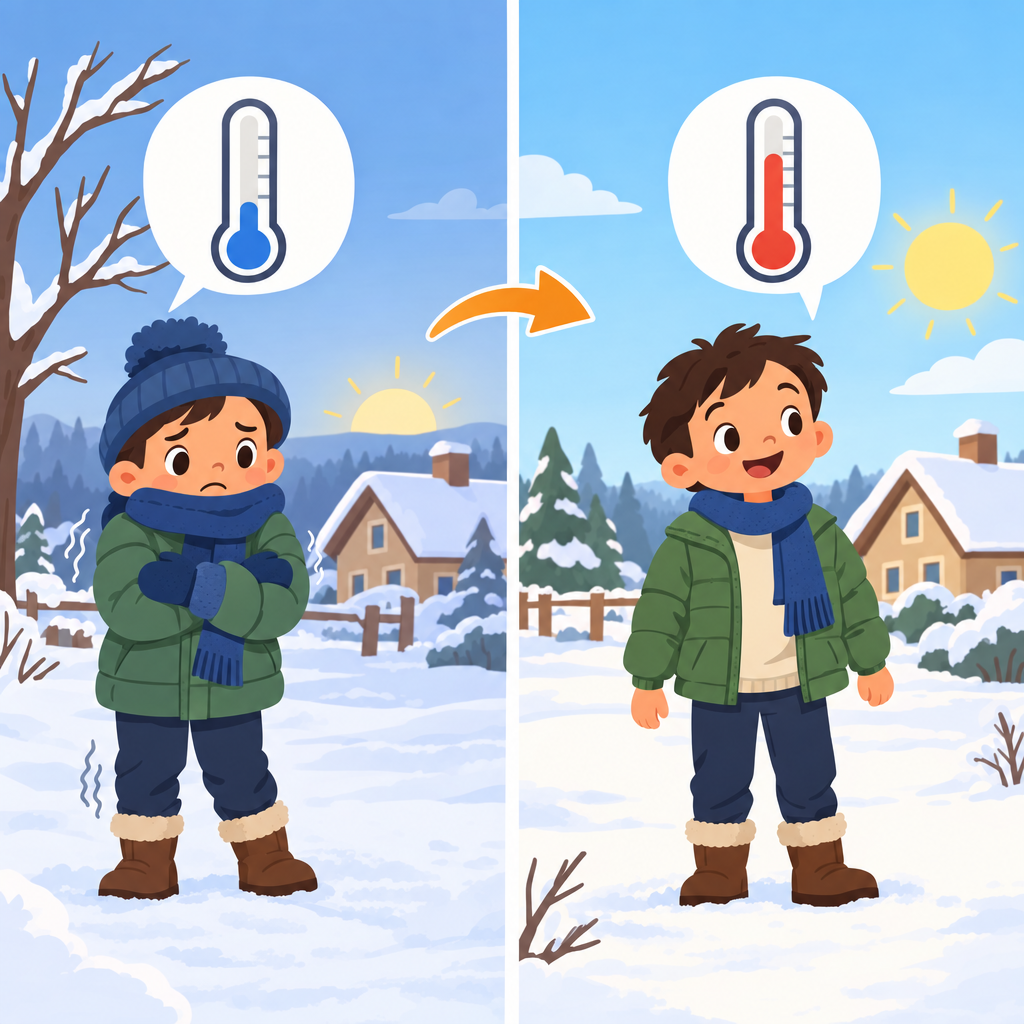
In the morning the temperature was −7 °C. By noon it had risen by 12 degrees. What was the temperature at noon?
5 °C
19 °C
−19 °C
4 °C
−5 °C
Show a hint
Use 0 °C as a checkpoint. Work out whether the rise reaches it, and then consider what happens to any part of the rise left over.
How many degrees does it take to rise from −7 °C to 0 °C? Compare that with the total rise of 12 degrees.
Show the answer and solution
Answer: A — 5 °C
It takes a rise of 7 degrees to go from −7 °C to 0 °C. That leaves 12 − 7 = 5 degrees of the rise, so the temperature at noon was 5 °C. The trap in choosing −5 °C is keeping the negative sign even though the rise carried the temperature past zero.
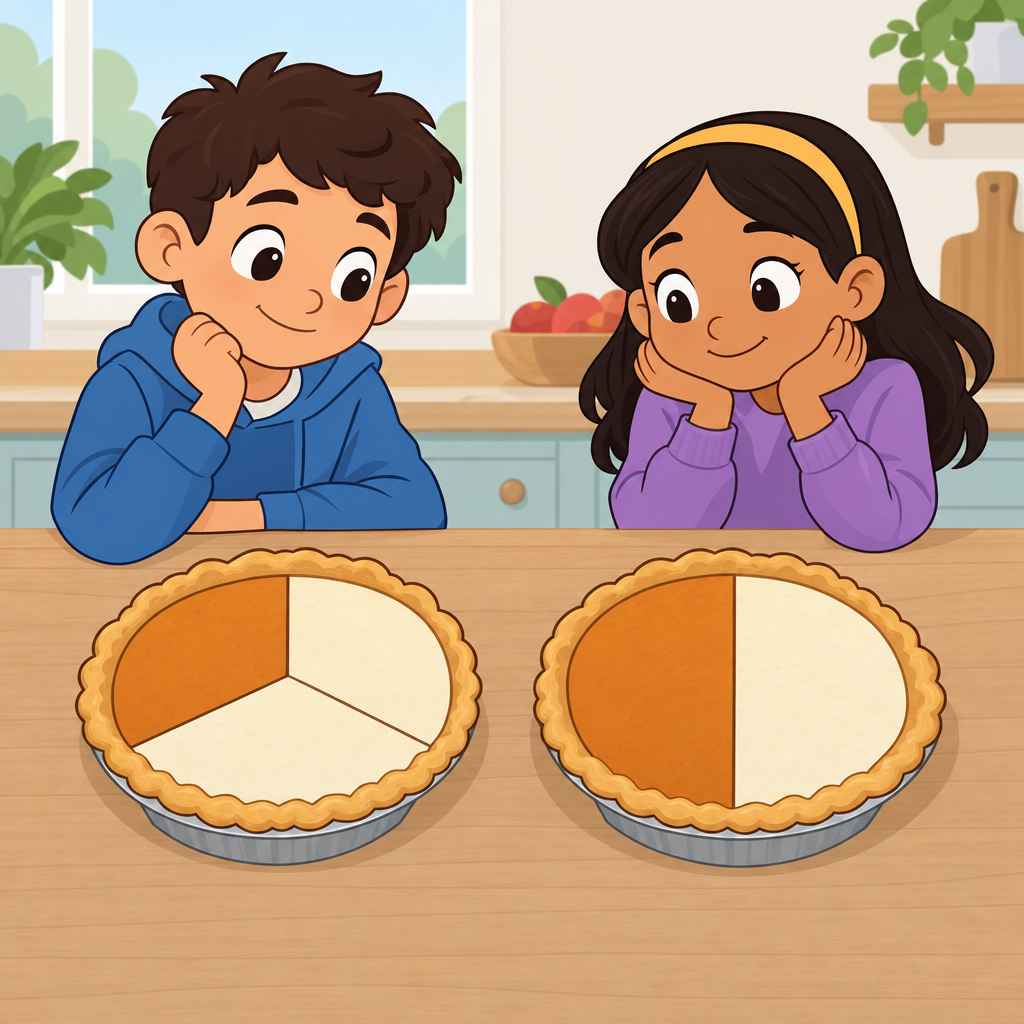
Which fraction is exactly halfway between 1/3 and 1/2?
1/4
3/8
5/12
2/5
4/10
Show a hint
Think of halfway as a distance: find the gap between the two fractions, then move half that gap from the smaller fraction.
The gap is 1/2 − 1/3 = 1/6. Split that gap in half, then add it to 1/3.
Show the answer and solution
Answer: C — 5/12
Half of the gap 1/6 is 1/12, so the halfway point is 1/3 + 1/12 = 4/12 + 1/12 = 5/12. The fraction 2/5 is between 1/3 and 1/2, but it is not halfway: it is 1/15 above 1/3 and 1/10 below 1/2.
Problem 4 · Compare shares of an unchanged total · 4 points
Lina and Mo have stickers in the ratio 3 : 5. Lina gives Mo 3 stickers, and now Mo has twice as many as Lina. How many stickers did Lina have at first?
27
45
72
30
24
Show a hint
The gift changes each person's share, but not their combined total. Compare Lina's share before and after.
Lina starts with 3/8 of the total and ends with 1/3 of it. What fraction of the total did she give away?
Show the answer and solution
Answer: A — 27
Lina gives away 3/8 − 1/3 = 1/24 of the unchanged total. Since that is 3 stickers, the total is 72. Lina started with 3/8 of 72, or 27 stickers. The tempting 24 is how many she has after giving away 3.
The sum of five consecutive whole numbers is 65. What is the LARGEST of the five numbers?
14
17
15
16
13
Show a hint
In a run of consecutive numbers, the middle one is the average of them all.
Show the answer and solution
Answer: C — 15
Five consecutive numbers are symmetric around the middle one, so the middle is 65 ÷ 5 = 13, and the numbers are 11, 12, 13, 14, 15 — largest 15. Exploiting symmetry (instead of setting up x + (x+1) + …) is faster and shows WHY it works.
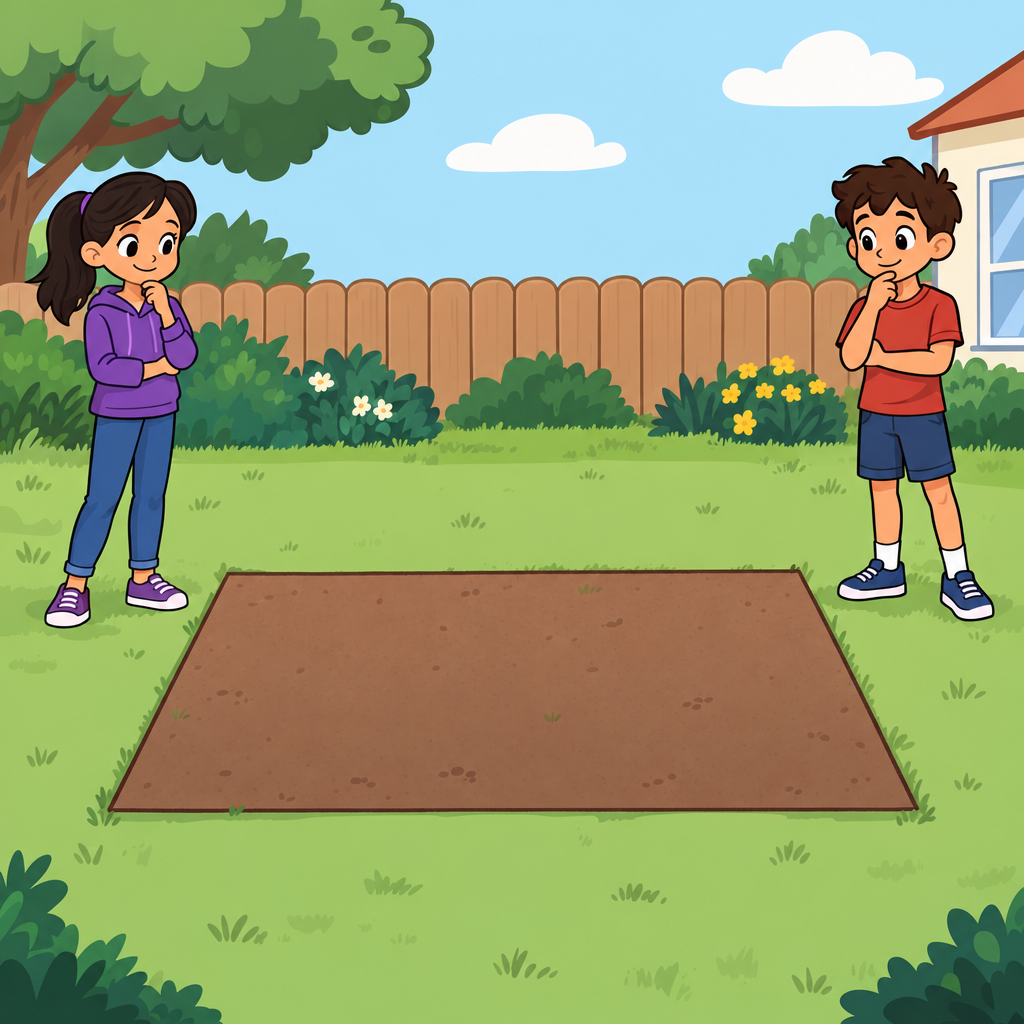
The length of a rectangle is increased by 10% and its width is decreased by 10%. What happens to its area?
it shrinks by 1%
it stays the same
it shrinks by 10%
it grows by 1%
it grows by 10%
Show a hint
Start with a rectangle of unknown length and width. Describe how each percentage change affects a side, then consider how the changes combine when you multiply to find area.
Let the original sides be L and W. Write the changed sides as 1.1L and 0.9W, then compare their product with the original area, LW.
Show the answer and solution
Answer: A — it shrinks by 1%
Let the original length be L and the width be W, so the original area is LW. The new area is (1.1L)(0.9W) = 0.99LW, or 99% of the original area. Therefore, it shrinks by 1%. The tempting answer “it stays the same” is wrong: a 10% increase in one side and a 10% decrease in the other do not cancel when the side lengths are multiplied.
Problem 7 · Filter square roots using remainders · 5 points
How many four-digit perfect squares leave a remainder of 1 when divided by every whole number from 2 through 7?
13
1
2
3
8
Show a hint
Start with the square roots. What can you learn about their final digits from the squares’ final digits?
After checking division by 3, use (root − 1) × (root + 1) to check division by 7.
Show the answer and solution
Answer: C — 2
A four-digit square has a root from 32 to 99. The square must be odd and leave 1 when divided by 5, so it ends in 1; its root must therefore end in 1 or 9. The possible roots are 39, 41, 49, 51, 59, 61, 69, 71, 79, 81, 89, 91, and 99. Removing roots divisible by 3 leaves 41, 49, 59, 61, 71, 79, 89, and 91. Because root² − 1 = (root − 1)(root + 1), the test for 7 leaves only 41 and 71. Their squares are 1681 and 5041; subtracting 1 gives 1680 and 5040, both divisible by every number from 2 through 7. The answer is 2. The tempting answer 8 forgets the test for 7.
Problem 8 · Assume and find a contradiction · 5 points
Four islanders are each either a knight (always tells the truth) or a liar (always lies): Ada says, “Exactly one of Ben, Cora, and Drew is a knight”; Ben says, “Ada and Cora are the same kind”; Cora says, “Ben and Drew are different kinds”; and Drew says, “Ada is a liar.” How many of the four are knights?
4 knights
3 knights
1 knight
2 knights
It cannot be determined
Show a hint
Before counting knights, track who would have to be the same kind or different kinds.
Suppose Ada tells the truth. What would Drew be, and could Ben and Cora then be different kinds?
Show the answer and solution
Answer: D — 2 knights
If Ada were a knight, Drew would be a liar. Cora’s claim would then be true exactly when Ben is a knight, so Ben and Cora would be the same kind. But Ada’s claim requires exactly one of them to be a knight—a contradiction. Thus Ada is a liar and Drew is a knight. Ben’s claim now means Ben is a knight exactly when Cora is a liar, so one of them is a knight: 2 knights in all. “It cannot be determined” is tempting because either Ben or Cora could be the knight, but the total is fixed.
Problem 9 · Reasoning with digit place values · 4 points
I made an odd four-digit number using 1, 2, 3, and 4 once each. Swapping its thousands and tens digits makes it 1,980 larger; swapping its hundreds and ones digits makes it 198 smaller. What number did I make?
4321
1432
2143
1243
2341
Show a hint
Think about what each digit is worth before and after a swap. The other two digits do not change.
Swapping the thousands and tens places changes the number by 990 times the difference between those digits. For the hundreds and ones places, the multiplier is 99.
Show the answer and solution
Answer: E — 2341
The first swap shows that the tens digit is 1,980 ÷ 990 = 2 greater than the thousands digit. The second shows that the hundreds digit is 198 ÷ 99 = 2 greater than the ones digit. Using 1, 2, 3, and 4 once each gives two possibilities: 1432 and 2341. Although 1432 satisfies both swaps, it is even. The odd number is 2341.
Problem 10 · Compare pair averages using totals · 4 points
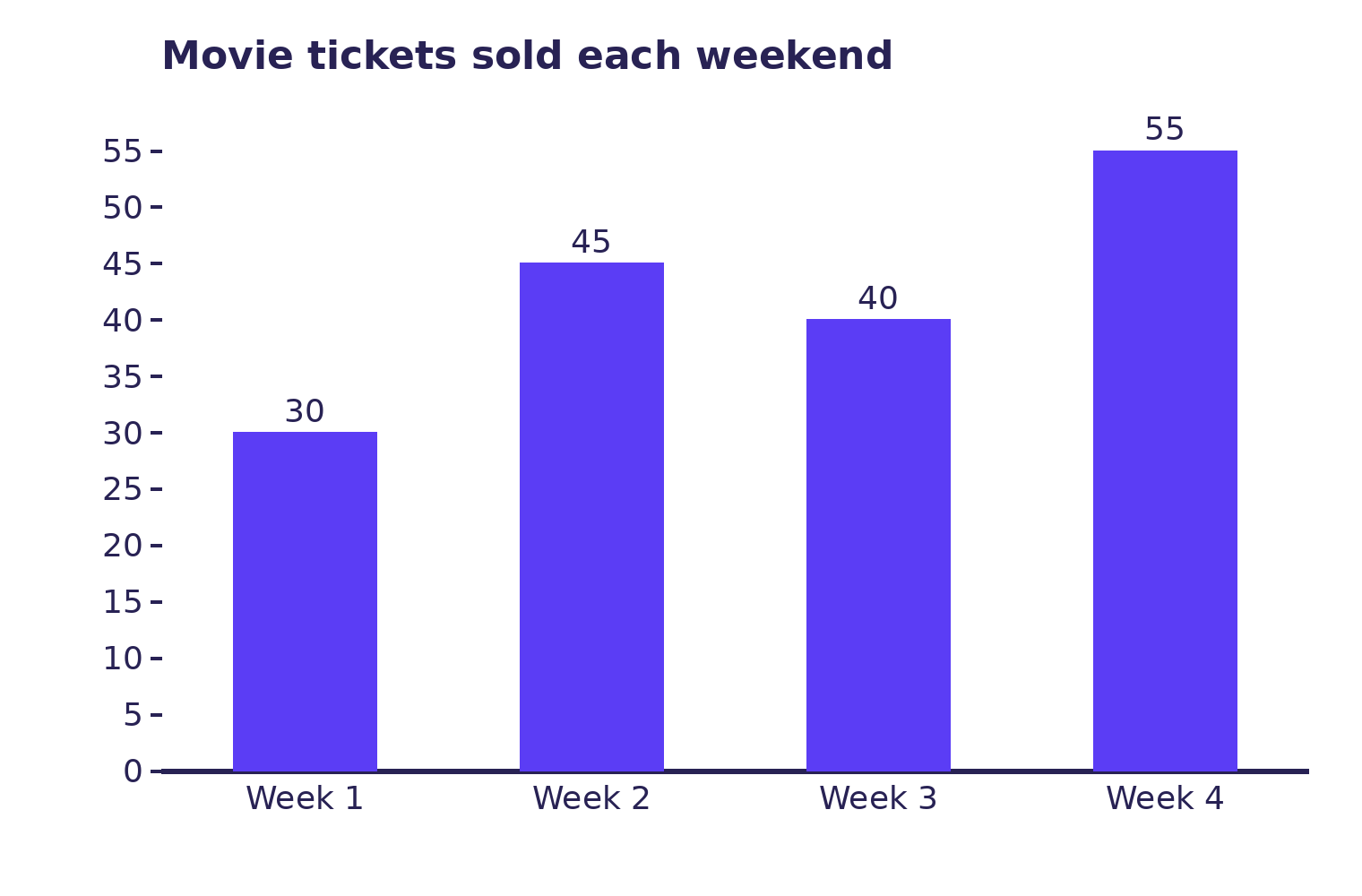
If you choose two different weeks from the chart, how many pairs have an average strictly greater than the average for all four weeks?
0
3
4
1
2
Show a hint
Pair the tallest bar with the shortest, then pair the two leftover bars. What useful comparison do those pairs give you?
The four-week average is 42.5, so a two-week pair needs a total greater than 85.
Show the answer and solution
Answer: E — 2
The four weeks total 170 tickets, giving an average of 42.5. Only weeks 2 and 4 (45 + 55 = 100) and weeks 3 and 4 (40 + 55 = 95) total more than 85, so the answer is 2. Weeks 1 and 4 and weeks 2 and 3 each total exactly 85; counting them would mistake an equal average for a greater one.
Nora’s 3-by-3 tile coaster has exactly five green tiles. Its colors look unchanged after she turns it halfway around (180°); which tile must be green?
Top-left tile
Top-middle tile
Bottom-right tile
Middle-left tile
Center tile
Show a hint
Draw a 3-by-3 grid and trace where each position moves in a half-turn. Use the unchanged color pattern to work out which positions must match.
Tiles that trade places must have the same color. Think about how many green tiles those matching groups can contribute to the total of five.
Show the answer and solution
Answer: E — Center tile
A half-turn exchanges the eight outer tiles in four pairs and leaves the center tile in place. Each pair contains either zero or two green tiles, so the outer tiles contribute an even number of green tiles. Since the coaster has five green tiles, the center tile must be green. The top-left tile is not required to be green: the center, top-middle, bottom-middle, middle-left, and middle-right tiles could be the five green tiles, leaving the top-left tile white.
Problem 12 · Invariant (conserved cubes) · 4 points
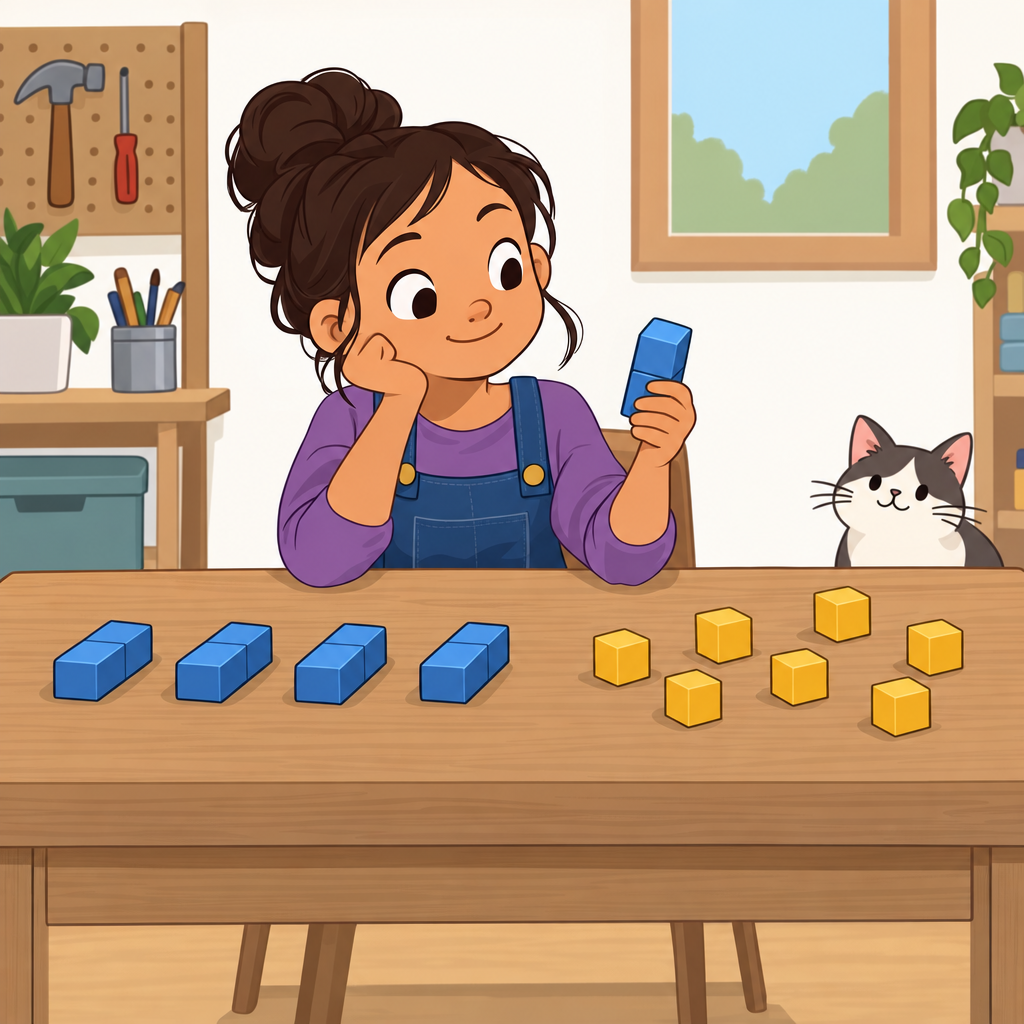
A tinkerer has 5 two-cube rods and 7 single cubes; she may split a rod into two singles or join two singles into a rod. Which total number of separate pieces can she NEVER have?
8
10
12
11
9
Show a hint
Count cubes rather than pieces.
How many cubes could 8 pieces hold at most?
Show the answer and solution
Answer: A — 8
The number of cubes stays at 5 × 2 + 7 = 17. Each piece contains at most 2 cubes, so 8 pieces could hold at most 16 cubes: 8 is impossible. Joining zero, one, two, or three pairs of singles gives 12, 11, 10, or 9 pieces. The trap is 9: although 17 cubes cannot all become rods, they can form 8 rods and 1 single.