Grade 10 math puzzles — free practice & printable teacher quizzes
Free grade 10 math puzzles that teach abstract thinking — competition and Olympiad style,
with instant hints, full solutions and a named thinking strategy for every task. Cumulative: grade 10 problems also test everything needed up to this grade.
Think of the expression as a graph. What feature of an upward-opening parabola marks its minimum, and how could you locate that feature?
For y = x² + bx + c, the axis of symmetry is x = −b/2. Use it to find the vertex, then evaluate the expression there.
Show the answer and solution
Answer: E — 2
The coefficient of x² is positive, so the parabola opens upward and its vertex gives the minimum value. Its axis of symmetry is x = −(−6)/2 = 3. At x = 3, the expression is 3² − 6(3) + 11 = 2, so the correct choice is 2. The choice 3 is the x-value where the minimum occurs, not the minimum value.
Problem 2 · Compare linear and quadratic scaling · 3 points
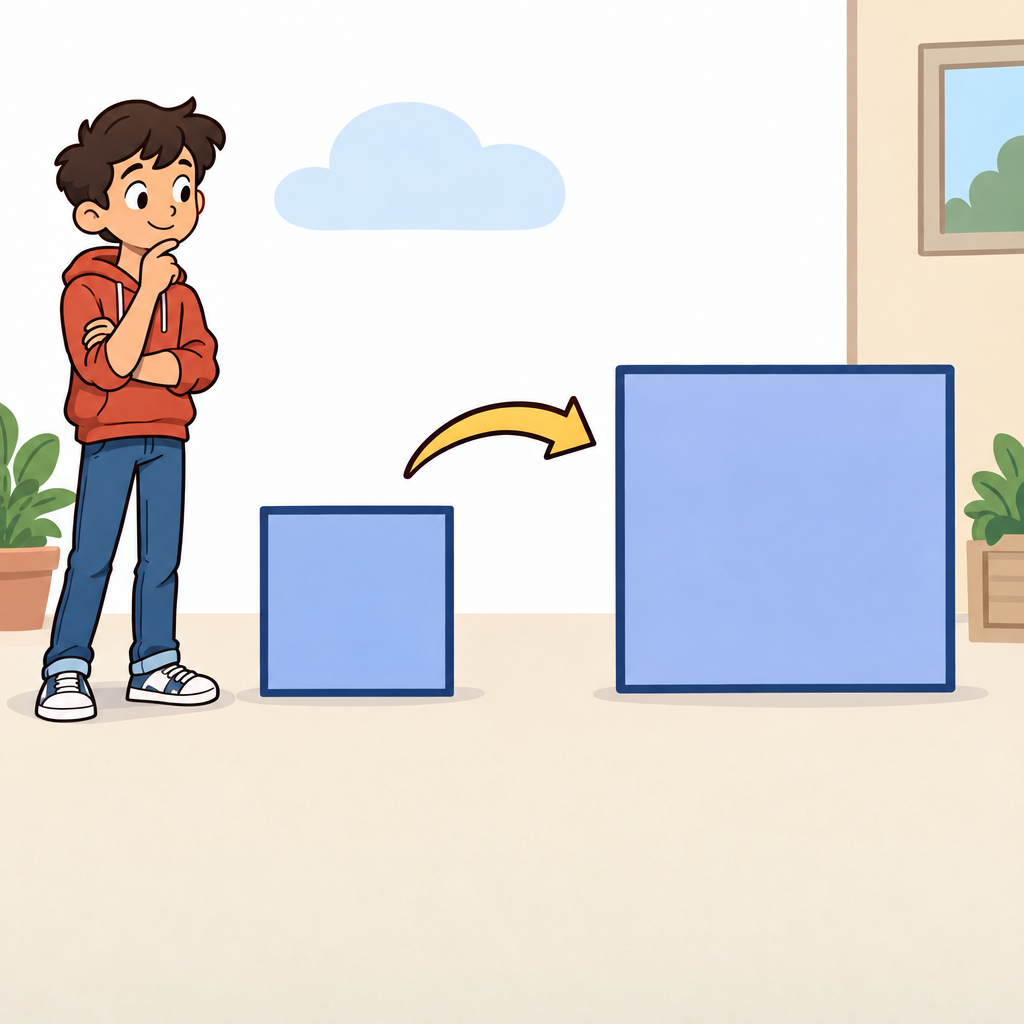
A square is enlarged so that its area’s percent increase is 24 percentage points greater than its perimeter’s percent increase. By what percent did each side increase?
20%
40%
12%
24%
44%
Show a hint
Imagine multiplying every side by the same unknown factor. How would the perimeter and area respond?
Let t be the fractional increase in side length. Express both percent increases in terms of t, then compare them.
Show the answer and solution
Answer: A — 20%
Let t be the fractional increase in each side. The perimeter increases by 100t%, while the area increases by 100((1+t)² − 1)%. Their difference gives t² + t = 0.24, or (t − 0.2)(t + 1.2) = 0. Since the side increased, t = 0.2, so the answer is 20%. The 44% choice is the area’s increase, not the side’s.
Problem 3 · Convert an area ratio into a length ratio · 3 points
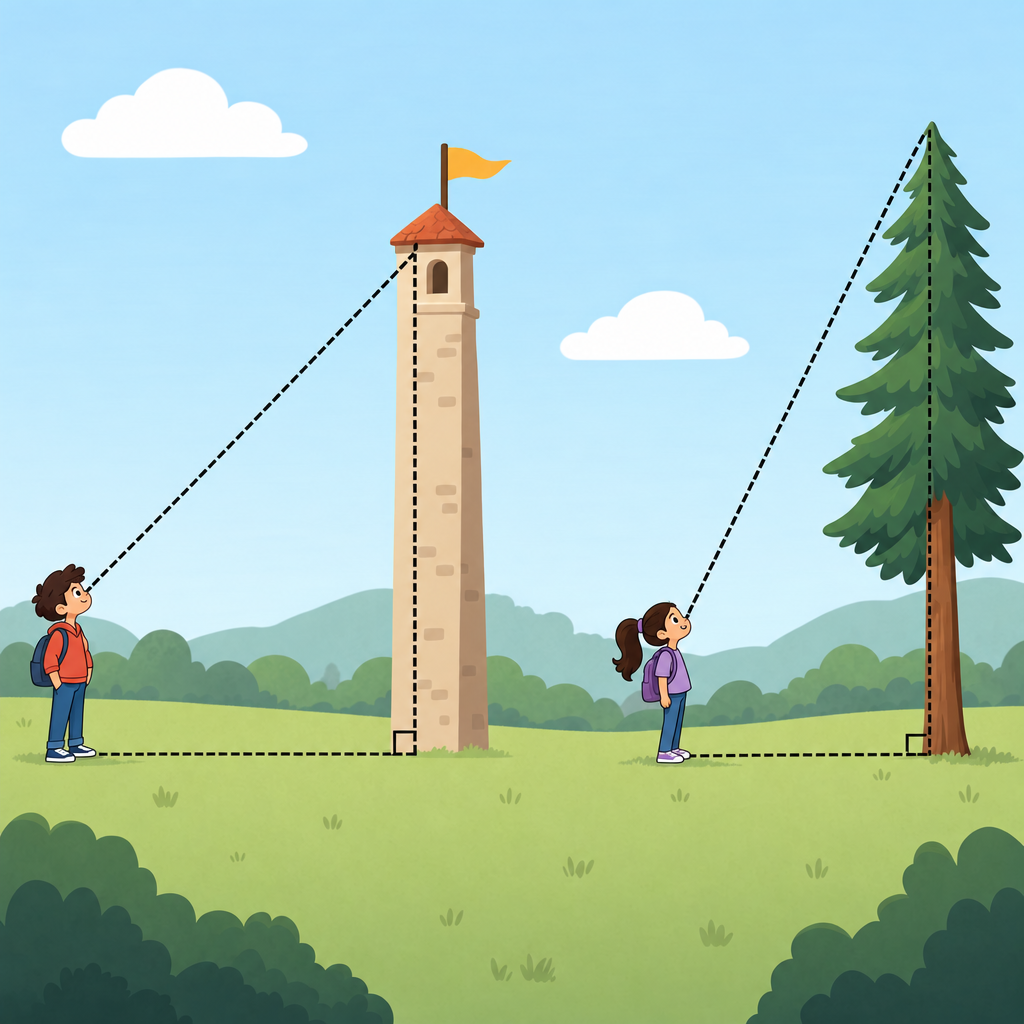
A triangle sits inside a larger, similar triangle. The region between them has five-fourths the area of the inner triangle, and their perimeters add to 130 cm. What is the larger perimeter?
78 cm
90 cm
650/9 cm
52 cm
65 cm
Show a hint
The region between the triangles is only part of the outer triangle. What is the area of the whole outer triangle compared with the inner one?
For similar triangles, the area ratio is the square of the perimeter ratio.
Show the answer and solution
Answer: A — 78 cm
The outer triangle has 1 + 5/4 = 9/4 times the inner triangle’s area. Its perimeter is therefore 3/2 times the inner perimeter, so the two perimeters are in the ratio 3:2. The larger perimeter is (3/5) × 130 = 78 cm. The tempting 90 cm comes from incorrectly using the area ratio 9:4 as the perimeter ratio.
Problem 4 · Choose a perpendicular direction using a half-plane · 4 points
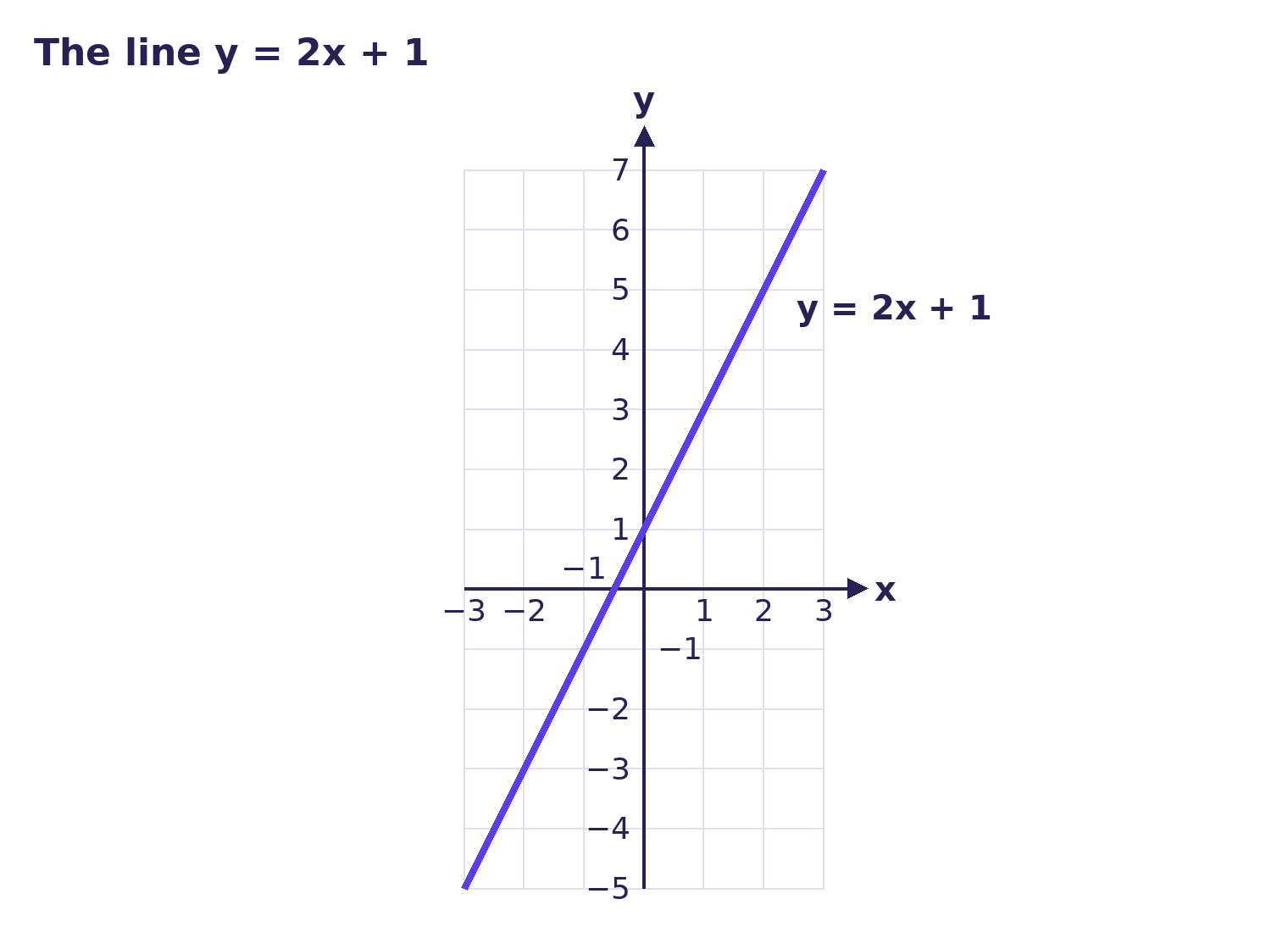
A square has one side from the drawn line’s y-axis crossing to its grid point with x = 1. Its interior is on the same side of the line as the origin. Which grid point is diagonally opposite the y-axis crossing?
(3, 2)
(2, 0)
(3, 4)
(−2, 2)
(−1, 4)
Show a hint
That side could belong to a square on either side of the line. How can the origin help you choose between them?
The side from (0, 1) to (1, 3) moves right 1 and up 2. For the next side, swap the step sizes and reverse one direction; then decide which turn points toward the origin’s side.
Show the answer and solution
Answer: A — (3, 2)
From (0, 1) to (1, 3), the side moves (1, 2). An equal-length perpendicular move toward the origin’s side is (2, −1), which has slope −1/2. Adding it to (1, 3) gives the diagonally opposite corner (3, 2). The tempting (−1, 4) uses the opposite turn, placing the square on the wrong side of the line.
Problem 5 · Cofunction pairing and double-angle identity · 4 points
Let A = sin 15° + cos 75° and B = sin 75° + cos 15°. What is A/B + B/A?
2 − √3
4/√3
4
2
2 + √3
Show a hint
Look for complementary-angle twins inside each sum before calculating any exact values.
After simplifying A and B, combine the fractions and use a double-angle identity.
Show the answer and solution
Answer: C — 4
Because 15° and 75° are complementary, A = 2 sin 15° and B = 2 cos 15°. Thus A/B + B/A = (sin² 15° + cos² 15°)/(sin 15° cos 15°) = 1/(sin 15° cos 15°) = 2/sin 30° = 4. The tempting 2 comes from treating A and B as equal, but sin 15° and cos 15° are not equal.
Problem 6 · Double counting in a triangulation · 4 points
A convex polygon is cut into triangles by noncrossing diagonals. Four triangles have no side on the polygon’s boundary, and five have exactly one boundary side. How many sides does the polygon have?
15
17
16
18
14
Show a hint
Think about what the triangles tell you about the polygon’s original boundary, not just the total number of triangles.
Let x be the number of triangles with two boundary sides. Express both the total number of triangles and the number of polygon sides in terms of x.
Show the answer and solution
Answer: B — 17
Let x triangles have two boundary sides. There are 4 + 5 + x = 9 + x triangles, so the polygon has 11 + x sides. Counting its boundary sides through the triangles instead gives 5 + 2x. Thus 11 + x = 5 + 2x, so x = 6 and the polygon has 17 sides. The tempting answer 15 is the number of triangles, not sides.
Problem 7 · Parity of prime factors in divisor counts · 5 points
Let N = 2⁵·3⁵·5⁵·7⁵. How many positive divisors d of N have the property that both d and N/d have a perfect-square number of positive divisors?
90
96
120
36
126
Show a hint
A number is a square when every prime in its factorization occurs an even number of times. Think about both divisor counts at once.
For each prime with exponent a in d, its contributions to the two divisor counts are a+1 and 6−a.
Show the answer and solution
Answer: B — 96
For j = 1, 2, …, 6, let n_j count the primes whose exponent in d is j−1. Each contributes j to the divisor count of d and 7−j to that of N/d. For both counts to be squares, the prime factor 5 forces n₅ and n₂ to be even; the factor 2 then forces n₆ and n₁ to be even; and the factor 3 forces n₃ and n₄ to be even. Conversely, these conditions make both counts squares. Since the six counts n_j add to 4, either one j occurs four times (6 ways), or two different j values occur twice each (C(6,2)·C(4,2) = 90 ways). The answer is 96; the tempting 90 forgets the all-four-equal cases.
Problem 8 · Track two interacting cycles · 5 points
What is the remainder when 1¹ + 2² + 3³ + ⋯ + 2020²⁰²⁰ is divided by 7?
6
2
5
0
1
Show a hint
Moving seven places keeps the base the same modulo 7. Does it also keep the exponent at the same place in its cycle?
Consider 42 consecutive terms. For each fixed base modulo 7, what exponent remainders occur?
Show the answer and solution
Answer: B — 2
For a base not divisible by 7, powers repeat with a period dividing 6. In any 42 consecutive terms, each base modulo 7 occurs with all six exponent remainders modulo 6. A base of 0 contributes 0; a base of 1 contributes 6; and each base a from 2 through 6 contributes 0 because 1 + a + ⋯ + a⁵ ≡ 0 (mod 7). Thus each 42-term block sums to 6 modulo 7. Since 2020 = 48·42 + 4, the remaining four terms have remainders 1, 4, 6, and 4. The total is 48·6 + 1 + 4 + 6 + 4 = 303, leaving remainder 2. The tempting answer 6 comes from treating seven terms as a full cycle: after seven places the base repeats modulo 7, but the exponent has shifted in its cycle.
Problem 9 · Recognize alternating ratios and compare prime exponents · 5 points
Nora’s sequence of positive integers has this property: in any four consecutive terms, the product of the outer two equals the product of the inner two. If the 1st, 4th, and 9th terms are 2, 36, and 2592, what is the first position whose term is both a perfect cube and divisible by 2^100 × 3^101?
201
206
202
204
203
Show a hint
Think about what the product condition tells you about ratios of consecutive terms, rather than calculating many terms.
Find the first two ratios from the given terms. Then check the exponents of 2 and 3 at even and odd positions separately.
Show the answer and solution
Answer: D — 204
Let r and s be the first two ratios of consecutive terms. The product condition makes the ratios repeat as r, s, r, s, ... . The 9th term gives 2(rs)^4 = 2592, so rs = 6; the 4th gives 2r²s = 36, so r = 3 and s = 2. Thus the term at position 2k is 6^k, while the term at position 2k+1 is 2^(k+1)3^k. An odd-position term cannot be a cube because its two exponents differ by 1. At an even position, k must be at least 101 for divisibility and a multiple of 3 for the term to be a cube. The least such k is 102, giving position 204. The tempting choice 202 gives 6^101, which is divisible by the required number but is not a cube.
Problem 10 · Weighted conditional probability · 5 points
Three points are picked independently and uniformly from inside the pie chart. Given that they land in three different slices, what is the probability that one lands in books?
88%
78.4%
40%
75%
90%
Show a hint
Three different slices leave exactly one slice out. Are the four possible missing slices equally likely?
For each possible missing slice, multiply the percentages of the three slices that remain. Each group of three can occur in the same number of orders.
Show the answer and solution
Answer: A — 88%
The four groups of three slices have relative weights 40×30×20, 40×30×10, 40×20×10, and 30×20×10. Their total is 50,000; the group without books has weight 6,000. So the probability is 1 − 6,000/50,000 = 88%. The tempting 75% treats the four possible missing slices as equally likely, but their weights differ.
Problem 11 · Permutation parity via inversions · 3 points
Five cards start in the row 1, 2, 3, 4, 5. On each of exactly two turns, you choose any three positions and rotate their cards in either direction; which final row is impossible?
2, 1, 4, 3, 5
2, 3, 4, 1, 5
2, 3, 4, 5, 1
3, 1, 2, 4, 5
1, 2, 3, 4, 5
Show a hint
Instead of following one card, look at pairs of cards: which pairs have reversed their original left-to-right order?
A rotation of three cards can be made with two swaps. Think about what each swap does to the parity of the number of reversed pairs.
Show the answer and solution
Answer: B — 2, 3, 4, 1, 5
Each rotation is two swaps, so it preserves the parity of the number of reversed pairs. In 2, 3, 4, 1, 5, the card 1 has passed three cards, giving an odd number; that row is impossible. The other rows can all be made in two turns: 2, 3, 4, 5, 1 by rotating positions 1, 2, 3 left, then 3, 4, 5 left; 2, 1, 4, 3, 5 by rotating 1, 2, 3 right, then 1, 3, 4 left; and 3, 1, 2, 4, 5 by rotating 1, 2, 3 left twice. Even the original row 1, 2, 3, 4, 5 is possible: rotate the same three positions left, then right.
Four sticker printers make 1, 2, 3, or 4 stickers per minute, and four batteries last 2, 5, 9, or 14 minutes each, regardless of printer. If each printer gets one battery and runs it empty, what is the second-largest total number of stickers possible?
95
90
94
92
91
Show a hint
What happens if a faster printer gets a shorter-lasting battery than a slower printer?
Start with the best assignment, then look for the smallest loss from a swap.
Show the answer and solution
Answer: D — 92
If a faster printer has a shorter-lasting battery than a slower printer, swapping their batteries increases the total. So the largest total pairs the printers and batteries in increasing order: 1×2 + 2×5 + 3×9 + 4×14 = 95. In any other assignment, such a swap can increase the total by at least (2−1)(5−2) = 3, so no other total exceeds 92. Swapping the 2- and 5-minute batteries in the best assignment loses exactly 3, giving 92. The tempting choice 95 is the largest total, not the second-largest.