Grade 1 math puzzles — free practice & printable teacher quizzes
Free grade 1 math puzzles that teach abstract thinking — competition and Olympiad style,
with instant hints, full solutions and a named thinking strategy for every task.
Try each one first — the hint and the full solution open when you are ready.
Or solve them in the app with read-aloud and instant feedback.
Problem 1 · Spot and count repeating groups · 3 points
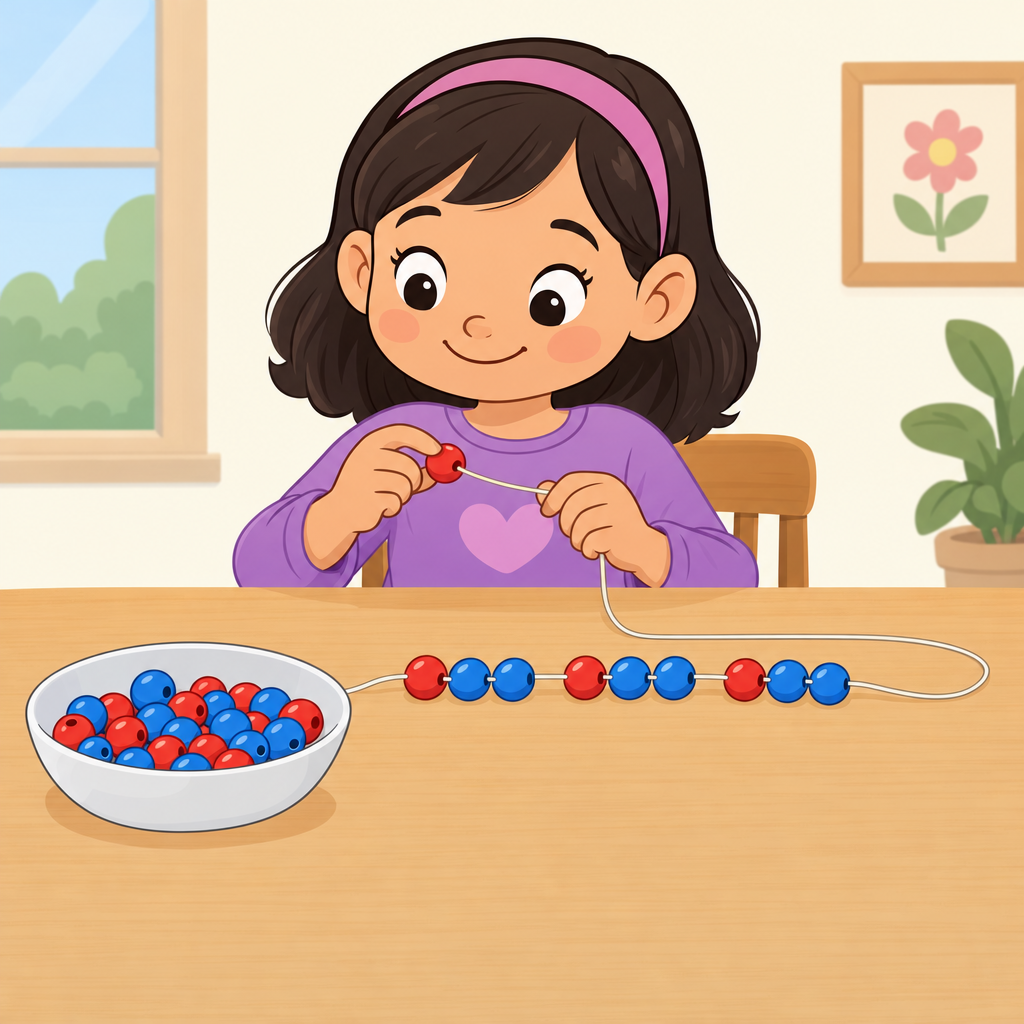
Lia strings beads in a repeating pattern: red, blue, blue, red, blue, blue, red, blue, blue, … How many blue beads are in her first 11 beads?
6
5
7
4
8
Show a hint
Find the smallest group that starts over. How many times does it fit before bead 11?
Remember to count any beads left after the complete groups.
Show the answer and solution
Answer: C — 7
The group red, blue, blue repeats. Three groups make 9 beads with 6 blue beads. Beads 10 and 11 are red and blue, so there are 7 blue beads altogether. The tempting answer 6 forgets to count the blue bead at position 11.
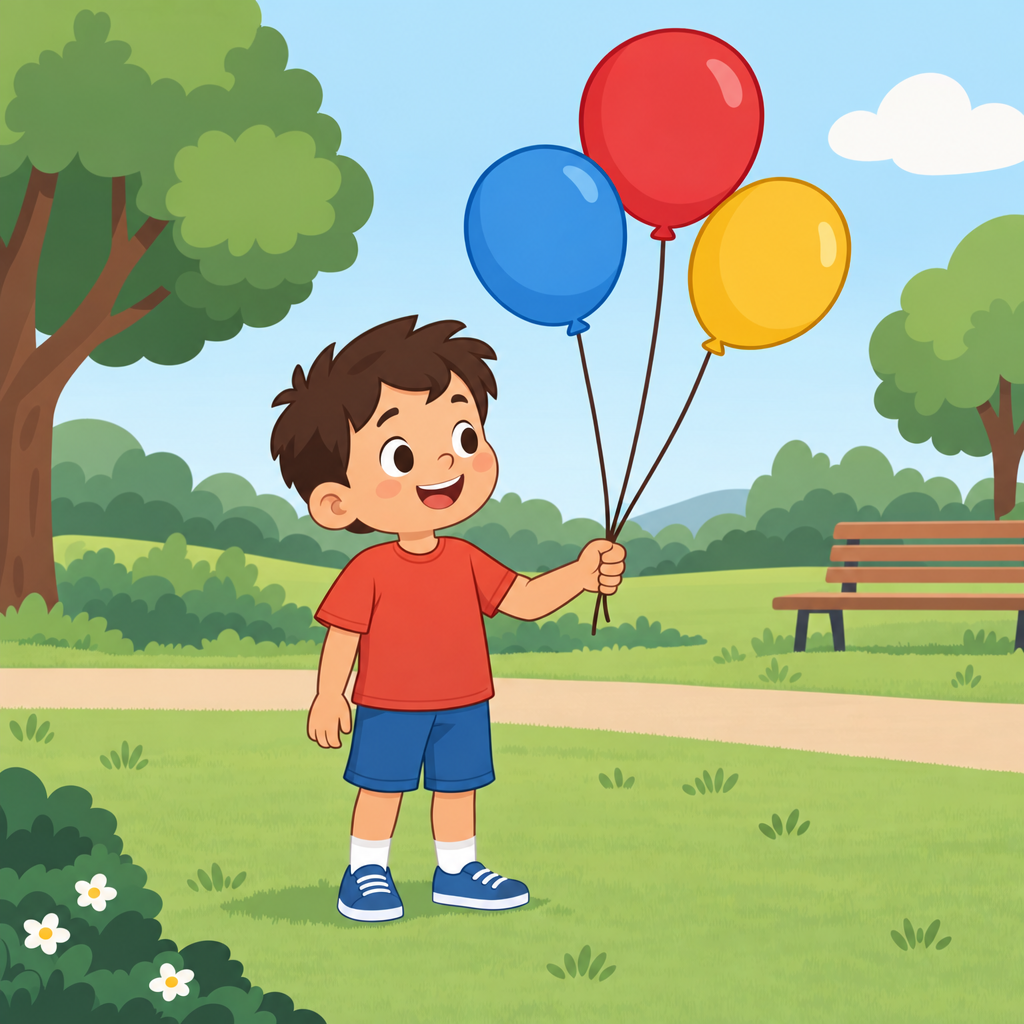
Tom has 3 balloons. Two of them fly away. Then his mom gives him 4 more. How many balloons does Tom have now?
6
5
3
7
4
Show a hint
Do one thing at a time: first the balloons fly away, then mom gives more.
Show the answer and solution
Answer: B — 5
Start with 3. Two fly away: 3 − 2 = 1. Mom gives 4 more: 1 + 4 = 5. When a story has several steps, handle them one at a time in order — never all at once.
Five children stand side by side in a straight row. Mia is exactly in the middle. How many children are to Mia’s left?
5
1
4
3
2
Show a hint
What does Mia being exactly in the middle tell you about the children on each side? How can you use that fact with the total number of children?
Leave Mia out of the count, then share the remaining children equally between her left and right sides.
Show the answer and solution
Answer: E — 2
There are 5 children in all. Leaving Mia out gives 4 other children. Because Mia is exactly in the middle, the same number stand on each side, so 4 ÷ 2 = 2 children are to her left. The correct choice is 2. Choosing 3 would count Mia along with the children on her left, but Mia is not to her own left.
Problem 4 · Order by comparing (transitivity) · 4 points
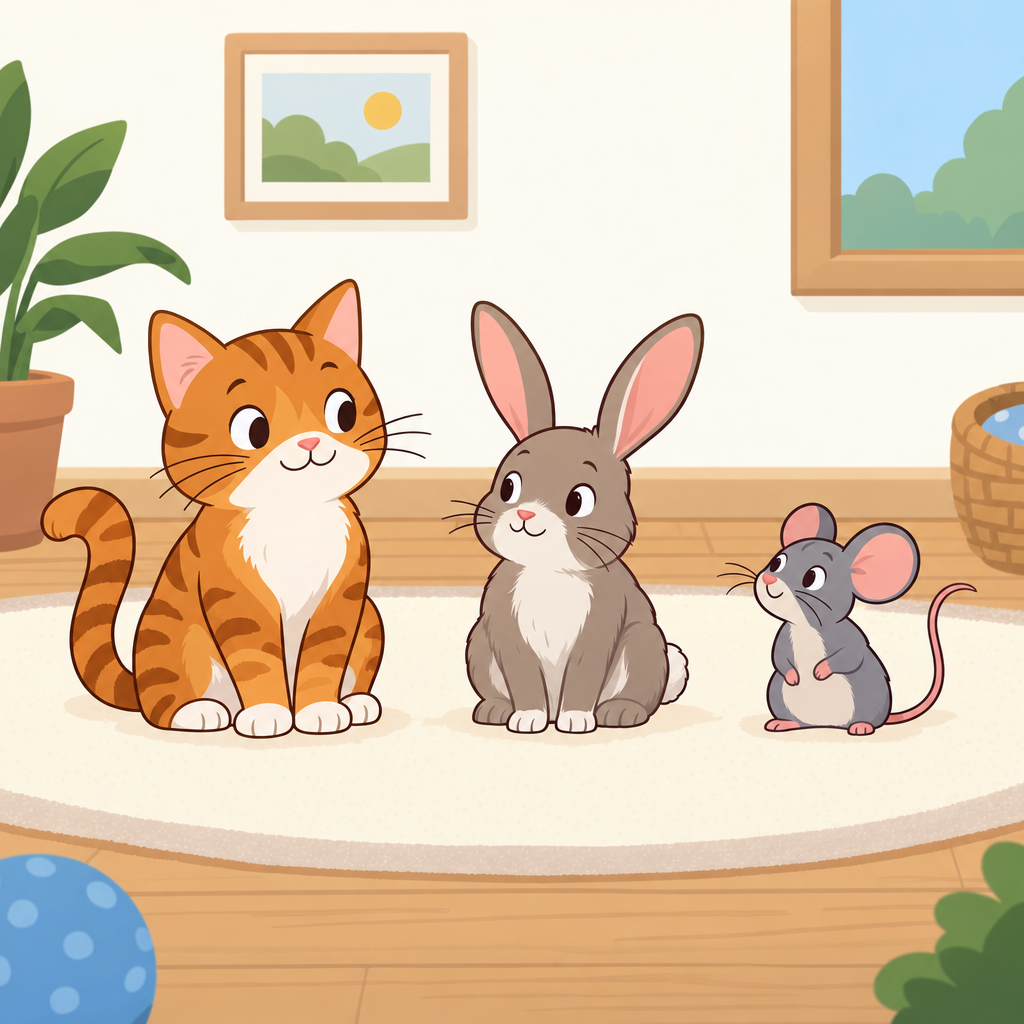
A cat is heavier than a rabbit. The rabbit is heavier than a mouse. Who is the lightest?
the mouse
the rabbit
they weigh the same
the cat
you cannot tell
Show a hint
Make a small drawing for each sentence to show its weight comparison. Then look at both drawings together.
One animal appears in both comparisons. Use that animal to connect the two clues.
Show the answer and solution
Answer: A — the mouse
The cat is heavier than the rabbit, and the rabbit is heavier than the mouse. That means the cat is also heavier than the mouse. Since both the cat and the rabbit are heavier than the mouse, the mouse is the lightest. “You cannot tell” is a tempting wrong choice because the cat and mouse are not compared directly, but the two clues together let us compare them.
Nina has cards labeled 1, 2, 3, 4, and 5. She uses two different cards to make a two-digit number; how many numbers greater than 30 can she make if the two digits add to 6?
4
2
1
5
3
Show a hint
Find the pairs of digits that add to 6. Think about what happens when you swap their places.
Check each number against both rules: it must be greater than 30, and Nina cannot use a card twice.
Show the answer and solution
Answer: B — 2
The two-digit numbers using digits from 1 to 5 that add to 6 are 15, 24, 33, 42, and 51. The first two are too small, and 33 needs the 3 card twice. Only 42 and 51 work, so the answer is 2. The tempting answer 3 wrongly includes 33.
Two numbers add up to 10. One number is 4 more than the other. What is the bigger number?
5
7
6
4
8
Show a hint
Make two groups using 10 counters in all. Rearrange the counters until one group has 4 more than the other.
Start with 5 counters in each group. Move one counter from one group to the other. How far apart are the groups now?
Show the answer and solution
Answer: B — 7
Start with 5 and 5. Move one counter from one group to the other to get 6 and 4. They add to 10, but they are only 2 apart, so 6 is a tempting wrong answer. Move one more counter from the group of 4 to the group of 6 to get 7 and 3. They add to 10, and 7 is 4 more than 3. The bigger number is 7.
Problem 7 · Simulate — and watch the ending · 5 points
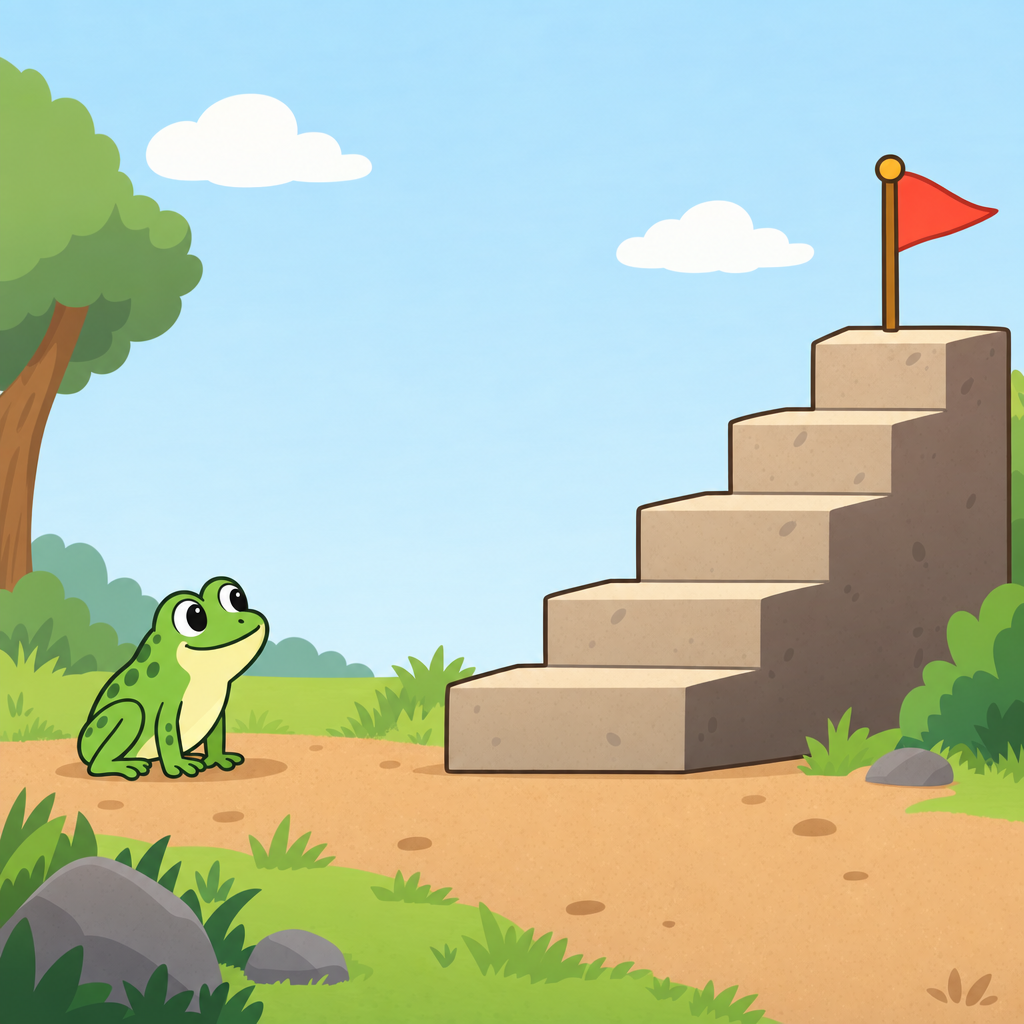
A frog starts on the ground below a 5-step staircase. Each jump takes it up 3 steps, but right after landing it slides down 1 step. The moment it touches step 5, it stops. How many jumps does it need?
1
3
5
2
4
Show a hint
Follow the frog jump by jump. Where is it after the first jump and slide?
On the last jump the frog stops right away — it does not slide back.
Show the answer and solution
Answer: D — 2
Jump 1: up to step 3, slides back to step 2. Jump 2: from step 2 it jumps to step 5 — goal reached, no slide! So 2 jumps. The trap is treating every jump the same: the last step of a process often behaves differently, so always simulate the ending carefully.
Problem 8 · Sort into cases and check a limit · 5 points
Maja has plenty of 1-cent, 2-cent, and 5-cent coins. In how many different ways can she pay exactly 15 cents using no more than 6 coins? The order of the coins does not matter.
5
6
4
2
3
Show a hint
Think about how many 5-cent coins Maja could use. For each possibility, check both the total value and the number of coins.
Could she reach 15 cents with no 5-cent coins? If she uses two 5-cent coins, how can she make the rest?
Show the answer and solution
Answer: C — 4
With no 5-cent coins, six coins are worth at most 12 cents. With one 5-cent coin, she needs five 2-cent coins. With two 5-cent coins, she can add 2+2+1 or 2+1+1+1. Three 5-cent coins also work. That makes 4 ways. Counting 5+5+1+1+1+1+1 as another way is a trap: it uses 7 coins.
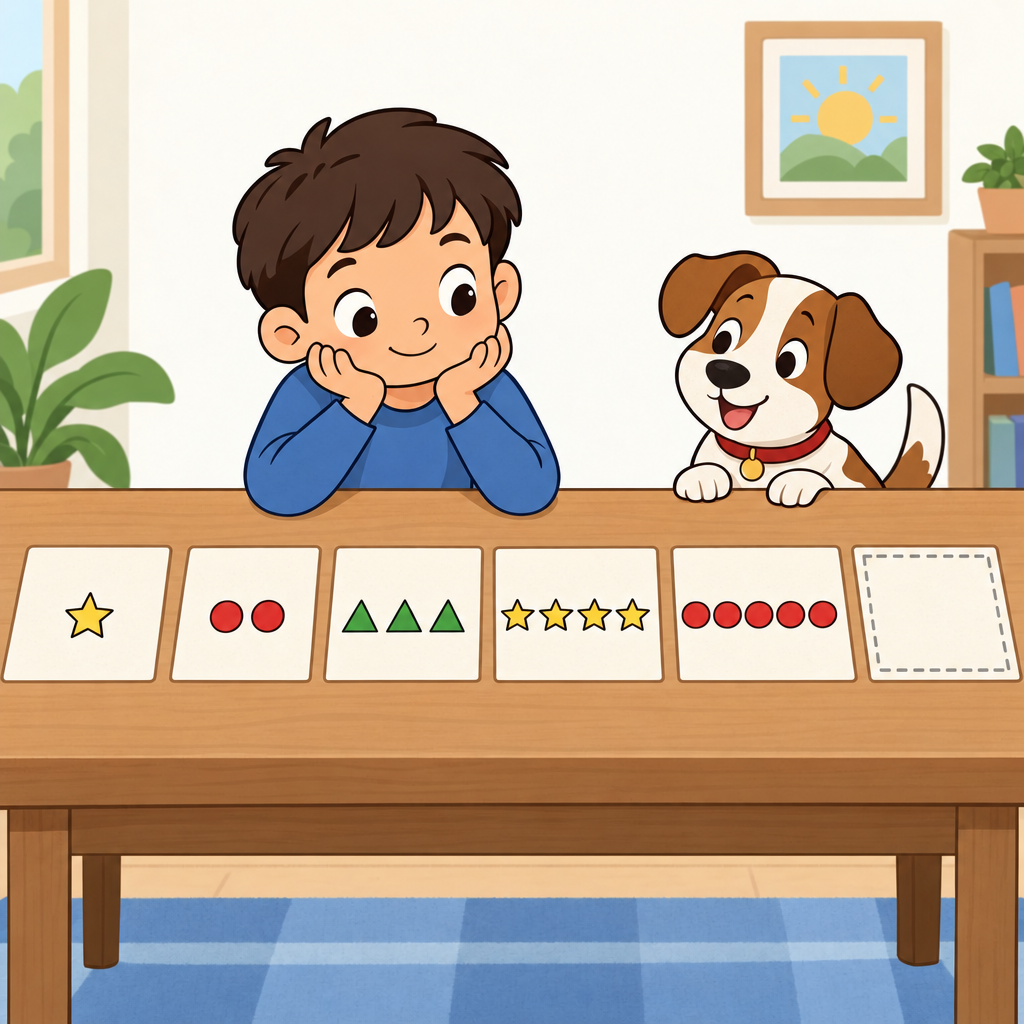
Look at these groups: ★ | ●● | ▲▲▲ | ★★★★ | ●●●●● | ?. Which group comes next?
▲▲▲▲▲▲▲
●●●●●●
★★★★★★
▲▲▲▲▲
▲▲▲▲▲▲
Show a hint
Compare the sizes of the groups, and watch the shapes over several groups.
Count the pictures in each group. Then look at just one shape from each group.
Show the answer and solution
Answer: E — ▲▲▲▲▲▲
The groups have 1, 2, 3, 4, and 5 pictures, so the next has 6. The shapes go ★, ●, ▲, ★, ●, so ▲ comes next. The answer is ▲▲▲▲▲▲. Choosing ●●●●●● copies the last shape instead of continuing the shape pattern.
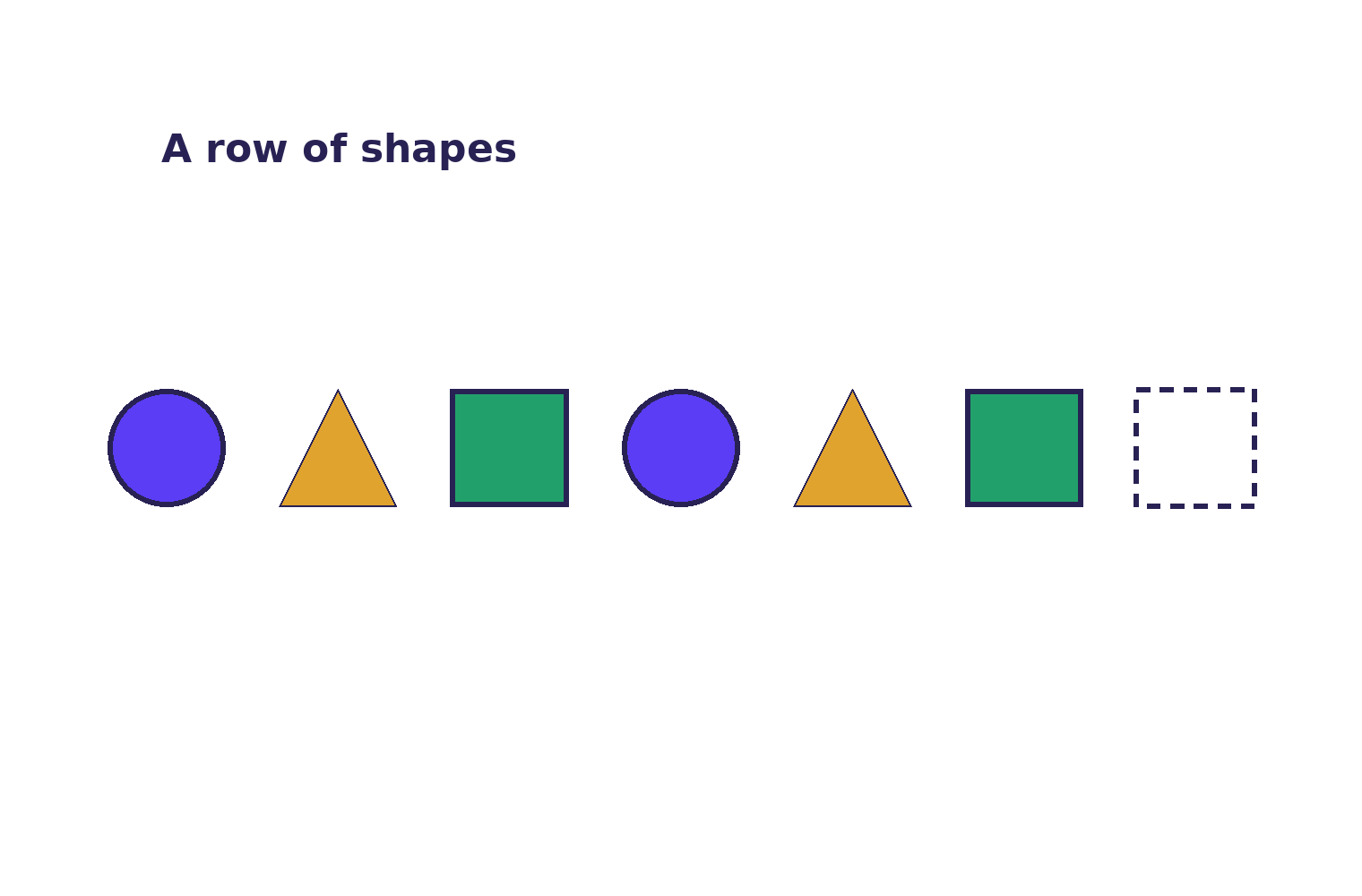
Look at two shapes sitting side by side. Which pair appears once now, but will appear twice when the empty box is filled to keep the pattern going?
circle then square
triangle then circle
triangle then square
square then circle
circle then triangle
Show a hint
Watch pairs of neighboring shapes as you move along the row, not just one shape at a time.
Find the pair that appears only once so far. Will filling the box make that pair again?
Show the answer and solution
Answer: D — square then circle
The shapes repeat circle, triangle, square, so a circle goes in the box. Square then circle appears once in the shown row and once more beside the box. Circle then triangle may be tempting, but that pair already appears twice before the box is filled.
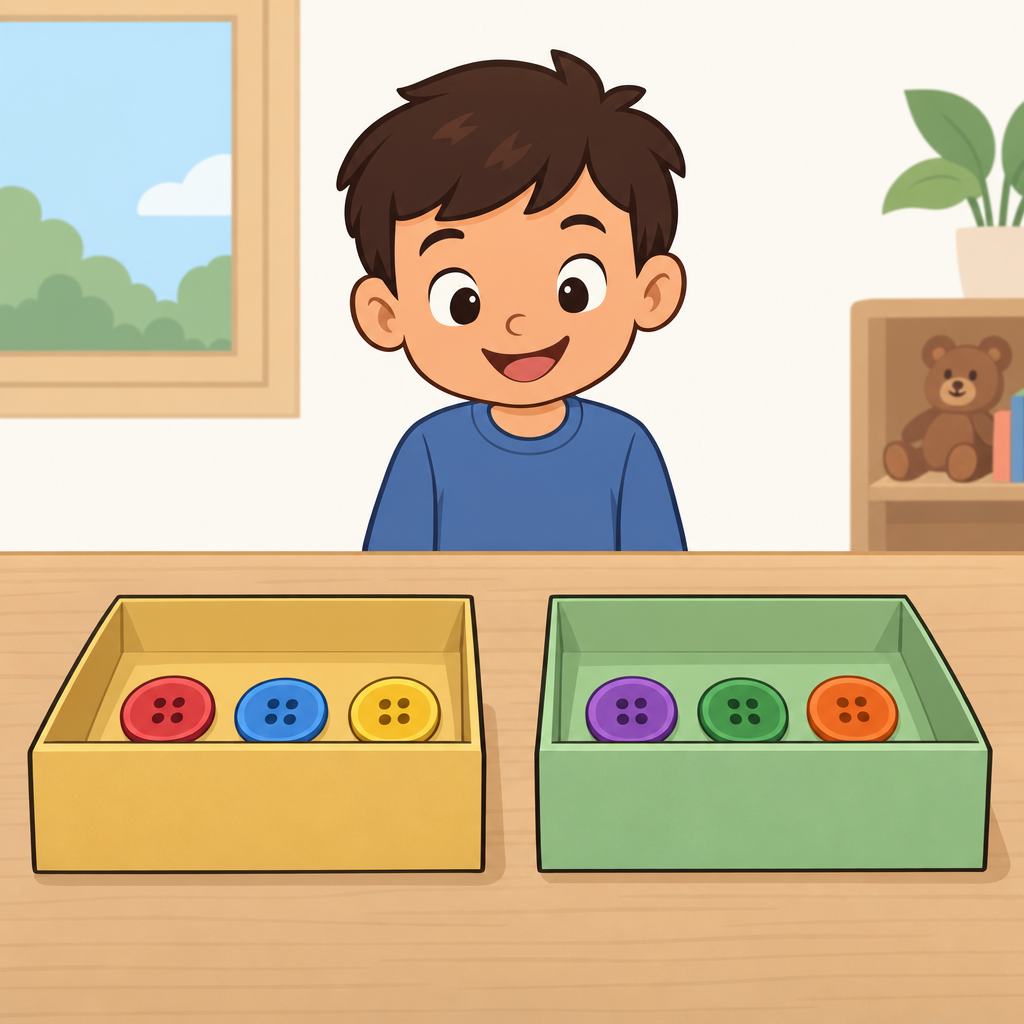
Milo moves 1 button from the left box to the right box. Now each box has 3 buttons. How many buttons were in the left box before the move?
2
4
6
3
5
Show a hint
Draw a 'before' picture and an 'after' picture of the boxes. Use an arrow to show which way the button moved, and fill in what you know about the after picture.
The left box lost a button during the move. How can you undo that change to find its earlier count?
Show the answer and solution
Answer: B — 4
The left box has 3 buttons now. Milo took 1 button from it, so before the move it had 3 + 1 = 4 buttons. The correct choice is 4. Choosing 2 would mean taking another button away from the left box, instead of undoing the move.
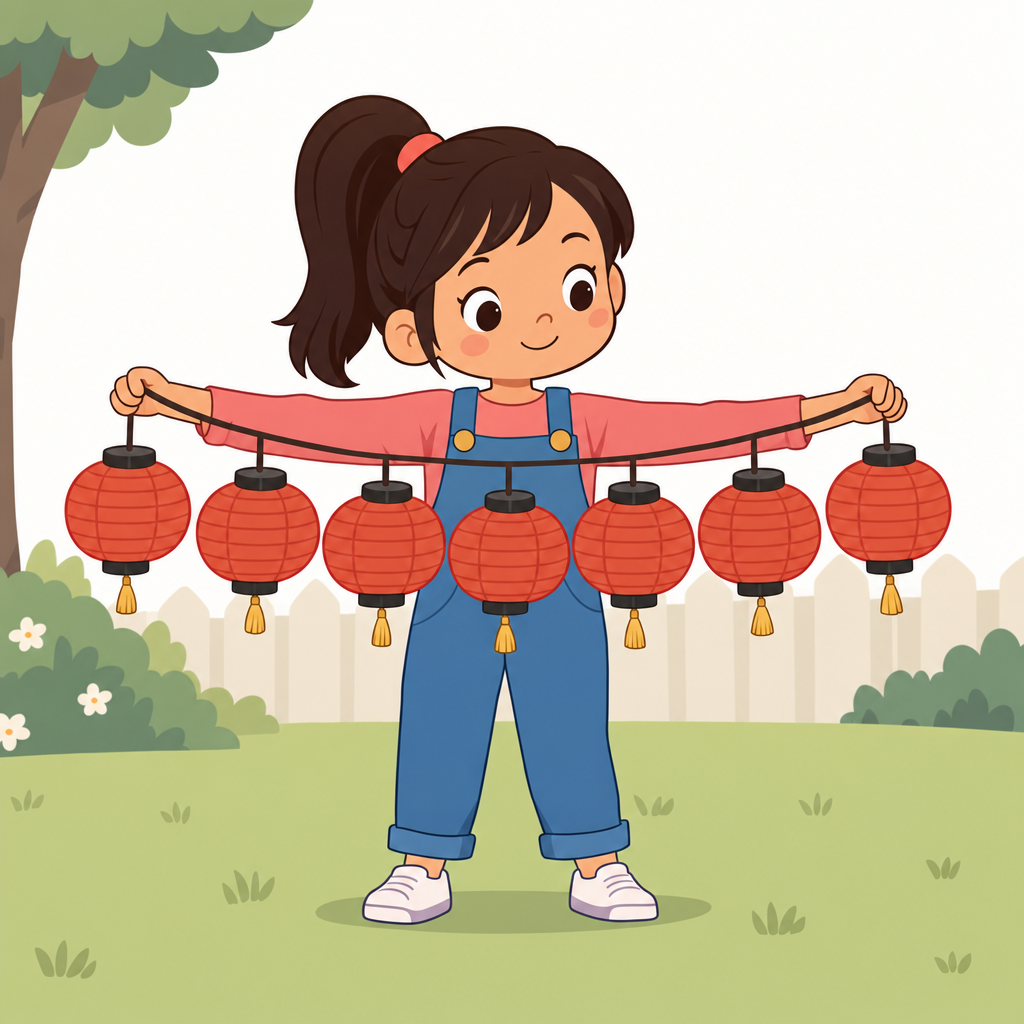
Lulu hangs 7 lanterns in a row. Each is lit or dark, the lit-and-dark order is the same from either end, and exactly 3 lanterns are lit. Counting from the left, which lantern must be lit?
4th
1st
5th
2nd
3rd
Show a hint
Match lanterns at opposite ends.
What is different about the middle lantern?
Show the answer and solution
Answer: A — 4th
The lanterns on either side of the middle match in pairs. So two of the lit lanterns make a pair, and the third must be the middle, 4th lantern. The 1st lantern might be lit, but it need not be: the lit pair could be the 2nd and 6th lanterns instead.