Grade 8 math puzzles — free practice & printable teacher quizzes
Free grade 8 math puzzles that teach abstract thinking — competition and Olympiad style,
with instant hints, full solutions and a named thinking strategy for every task. Cumulative: grade 8 problems also test everything needed up to this grade.
Try each one first — the hint and the full solution open when you are ready.
Or solve them in the app with read-aloud and instant feedback.
Problem 1 · Split side lengths around their midpoint · 3 points
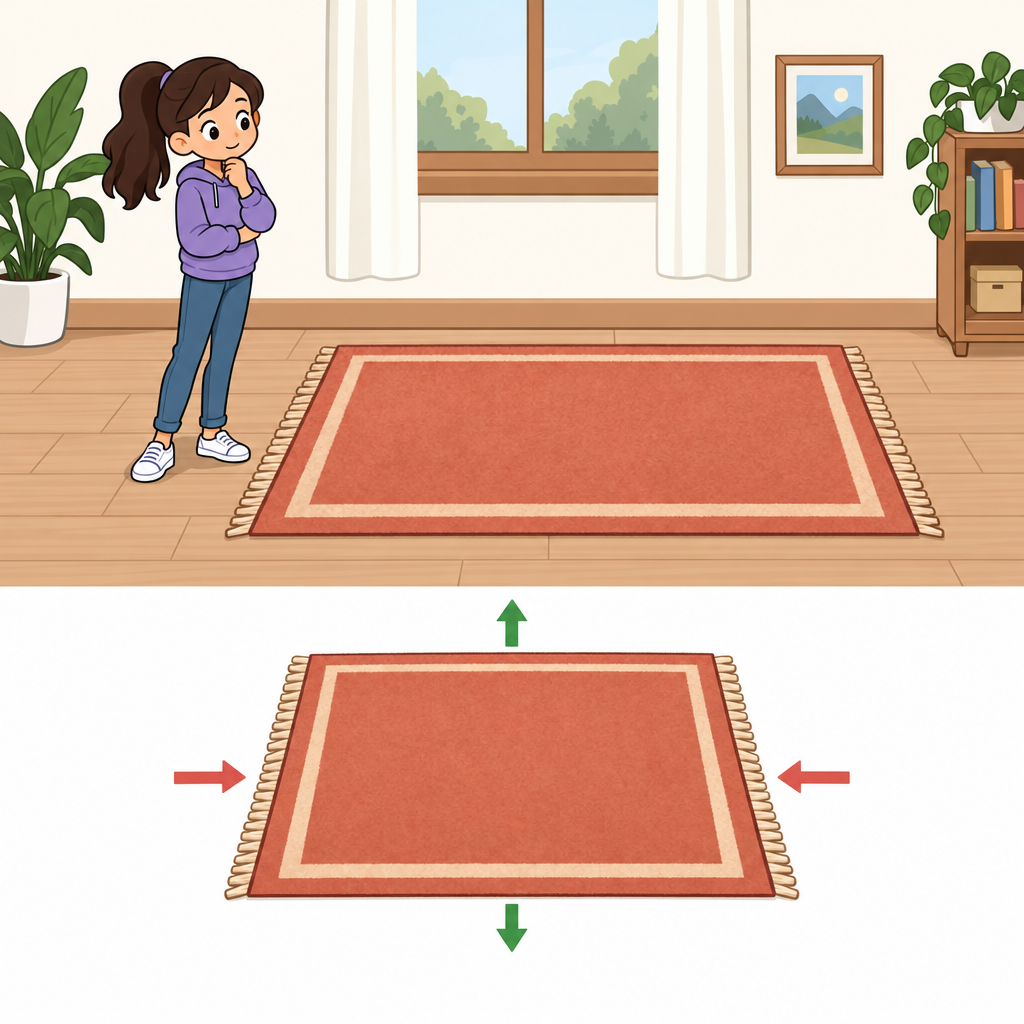
A rectangle has a perimeter of 56 cm. Its area increases by 20 cm² if its longer side is shortened by 2 cm and its shorter side is lengthened by 2 cm. What was its original area?
196
180
160
176
192
Show a hint
The side lengths keep the same sum. Think about how far each one is from their shared midpoint before and after the change.
If the original sides are 14 + d and 14 − d, the changed sides are 14 + (d − 2) and 14 − (d − 2). Compare their areas.
Show the answer and solution
Answer: C — 160
The side lengths sum to 28 cm, so their midpoint is 14 cm. Write the original sides as 14 + d and 14 − d. Their area is 196 − d²; after the change it is 196 − (d − 2)². Thus d² − (d − 2)² = 20, giving 4d − 4 = 20 and d = 6. The original sides were 20 cm and 8 cm, so the area was 160 cm². The tempting 180 cm² is the area *after* the change.
Problem 2 · Recognize structure (triples) · 3 points
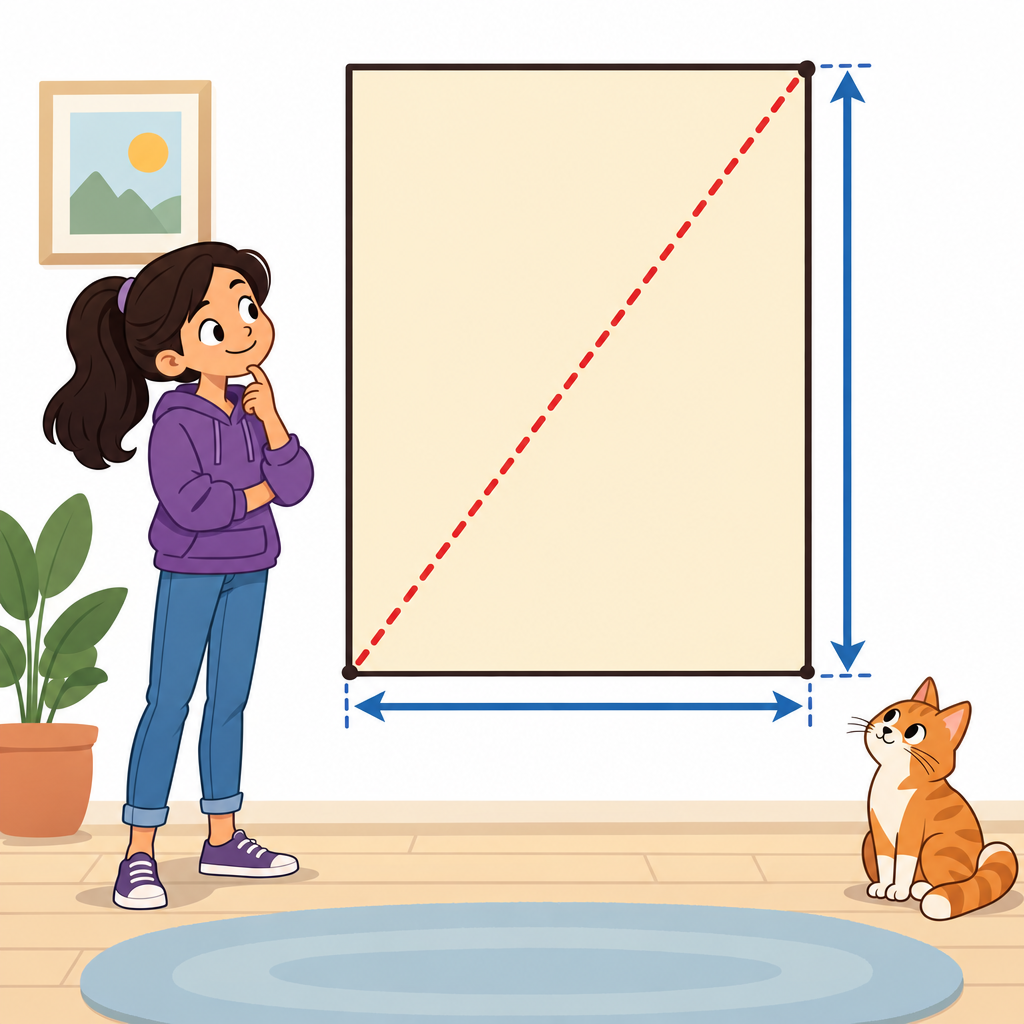
A rectangle is 6 wide and 8 tall. How long is its diagonal?
9
10
14
12
11
Show a hint
Draw the diagonal and look at the shape it makes with two sides of the rectangle. What kind of triangle is it?
The width and height are the legs of a right triangle, and the diagonal is its hypotenuse. How are the squares of those three lengths related?
Show the answer and solution
Answer: B — 10
The diagonal is the hypotenuse of a right triangle with legs 6 and 8. By the Pythagorean theorem, d² = 6² + 8² = 36 + 64 = 100, so d = 10. The choice 14 comes from adding 6 and 8, but that gives the length of a path along two sides of the rectangle, not the diagonal.
Problem 3 · Use a common power for squares and cubes · 3 points
A positive whole number has both a whole-number square root and a whole-number cube root. If those roots add up to 36, what is the number?
64
729
4096
1296
46656
Show a hint
Think about how the prime factors must be grouped for both roots to be whole numbers.
The number must be a sixth power, k⁶. What do its two roots add up to in terms of k?
Show the answer and solution
Answer: B — 729
Write the number as k⁶. Its square root is k³ and its cube root is k², so k³ + k² = 36. For k = 1, 2, and 3, the sums are 2, 12, and 36; larger k give larger sums. Thus k = 3 and the number is 3⁶ = 729. The tempting 1296 is 36², but its cube root is not a whole number.
Problem 4 · Relate proportional rise and run · 4 points
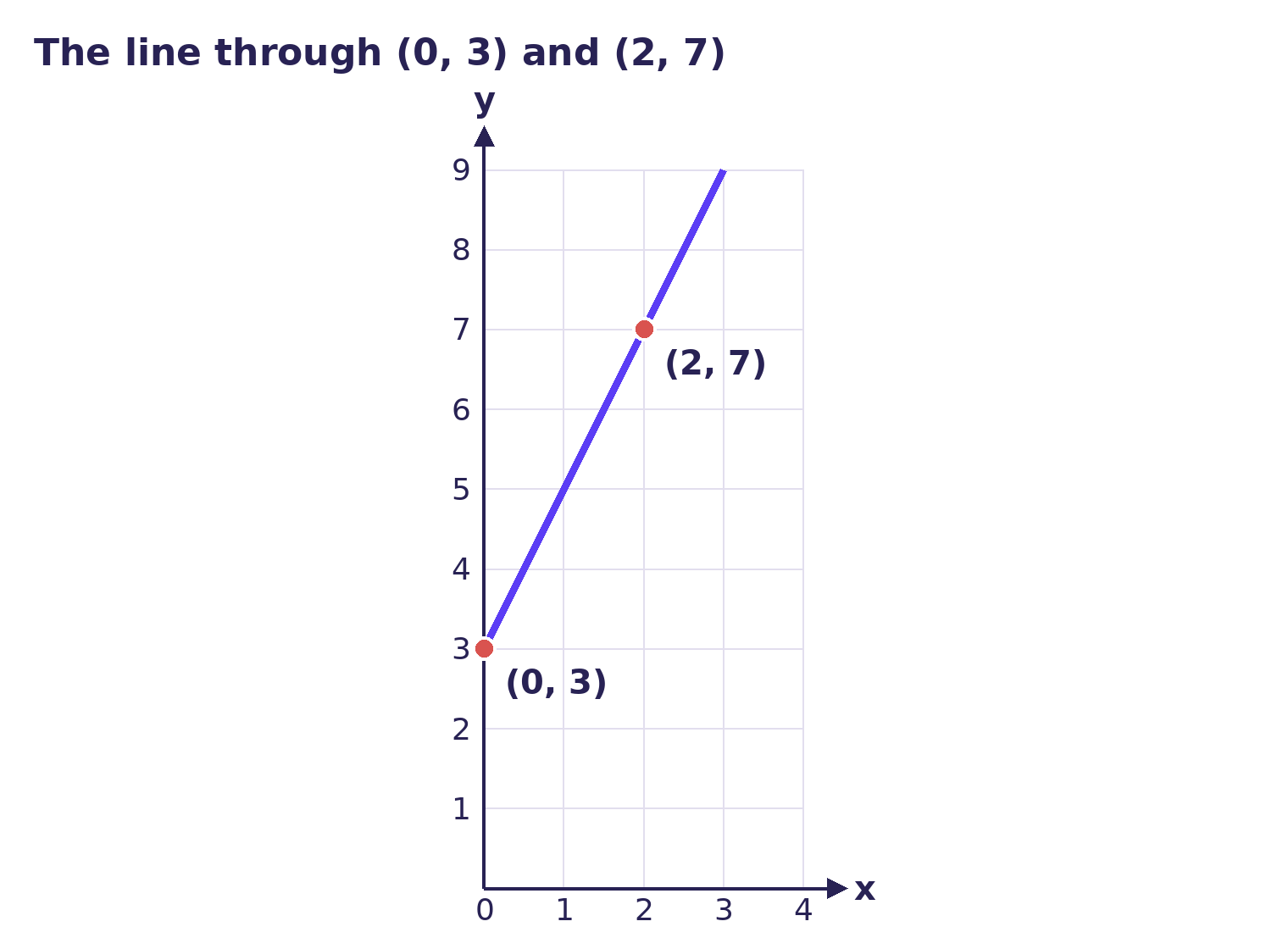
Start at (0, 3) and travel along the drawn line toward (2, 7). When your vertical climb equals the horizontal distance you still have to go, what fraction of the segment between the labeled points have you traveled?
3/4
1/2
2/3
1/4
1/3
Show a hint
Traveling part of a straight segment gives you the same fraction of its total rise and its total horizontal distance. Think about which distance is still left.
Let t be the fraction of the segment traveled. The climb so far is 4t, while the horizontal distance left is 2(1−t).
Show the answer and solution
Answer: E — 1/3
Between the labeled points, the total rise is 4 and the total horizontal distance is 2. If t of the straight segment has been traveled, the climb is 4t and the horizontal distance left is 2(1−t). Thus 4t = 2(1−t), giving t = 1/3. The tempting 2/3 is the fraction still left, not the fraction traveled.
Problem 5 · Use a shared root and factor pairs · 4 points
The equations x² − ax + 24 = 0 and x² − bx + 36 = 0 each have two distinct positive integer solutions, and they share one solution. What is the smallest possible value of a + b?
23
22
26
34
29
Show a hint
Think about how the constant term limits the positive integer solutions of each equation. Which numbers could be a solution to both?
Call the shared solution r. Find the other solution of each equation in terms of r, then check the possible values of r. Remember that each equation needs two distinct solutions.
Show the answer and solution
Answer: A — 23
The shared solution r must divide both 24 and 36, so r is 1, 2, 3, 4, 6, or 12. The other solutions are 24/r and 36/r, giving a + b = 2r + 60/r. For r = 1, 2, 3, 4, and 12, the totals are 62, 34, 26, 23, and 29. The tempting total 22 comes from r = 6, but then the second equation has the repeated solution 6. Thus the minimum is 23, achieved when the solutions are 4 and 6 for one equation, and 4 and 9 for the other.
Problem 6 · Count arrangements and ties · 4 points
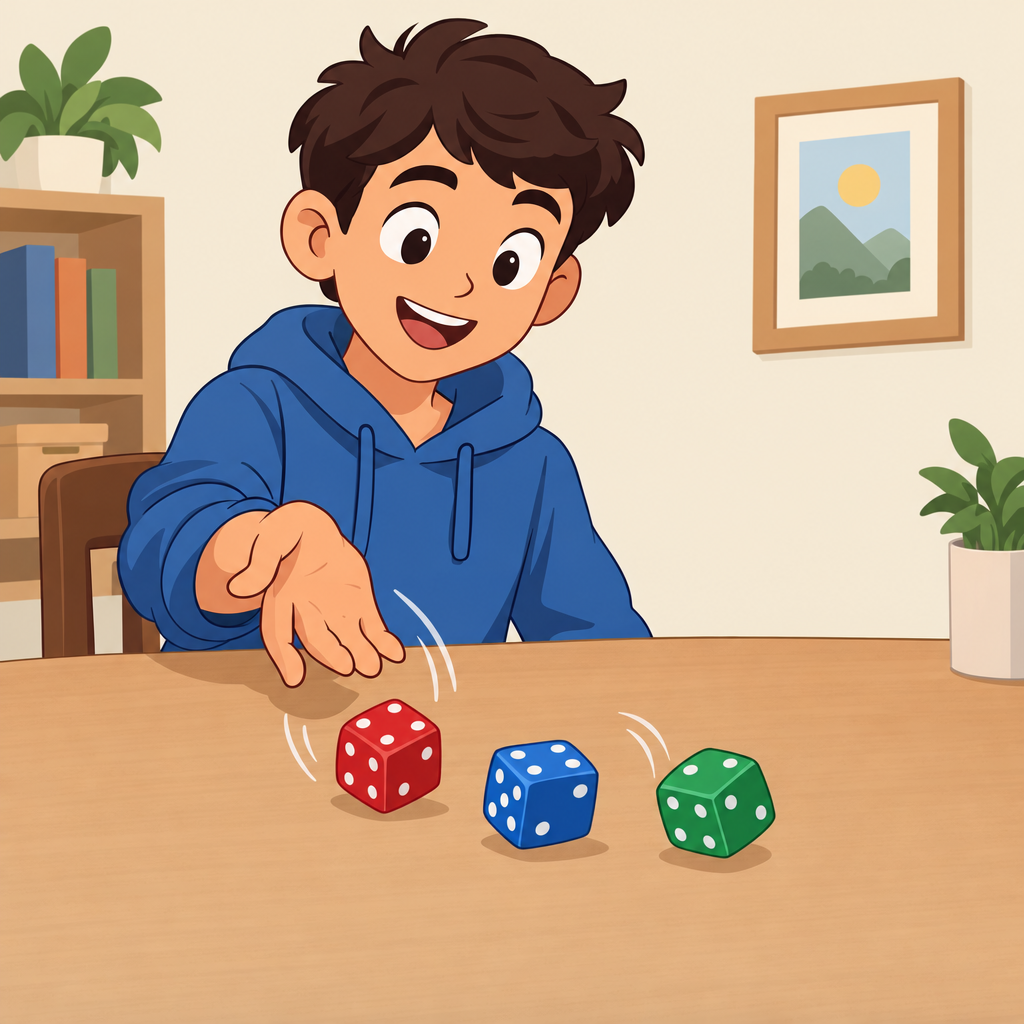
Three different-colored fair six-sided dice are rolled. What is the probability that at least one die shows the average of the other two?
1/4
7/36
1/36
1/12
1/6
Show a hint
Try sorting the three rolls. What successful patterns are possible, including when numbers match?
For three distinct rolls, look for an equally spaced triple. Then count its arrangements on the colored dice separately from the all-equal rolls.
Show the answer and solution
Answer: B — 7/36
The distinct triples that work are (1,2,3), (2,3,4), (3,4,5), (4,5,6), (1,3,5), and (2,4,6). Each has 6 arrangements on the colored dice, giving 36 outcomes. The 6 all-equal outcomes also work, for a total of 42 out of 216 equally likely outcomes. Thus the probability is 42/216 = 7/36. The tempting 1/6 counts the distinct triples but misses the all-equal rolls.
N is the smallest positive integer such that N ÷ 2 is a perfect square and N ÷ 3 is a perfect cube. What is N?
648
324
216
108
432
Show a hint
Write N = 2ᵃ·3ᵇ and translate each condition into conditions on a and b.
N/2 square → a−1 even, b even. N/3 cube → a divisible by 3, b−1 divisible by 3.
Show the answer and solution
Answer: A — 648
Let N = 2ᵃ3ᵇ. N/2 = 2ᵃ⁻¹3ᵇ must be a square → a−1 and b even. N/3 = 2ᵃ3ᵇ⁻¹ must be a cube → a and b−1 divisible by 3. Smallest a: odd and divisible by 3 → 3. Smallest b: even with b−1 divisible by 3 → 4. N = 2³·3⁴ = 8 · 81 = 648 (check: 648/2 = 324 = 18², 648/3 = 216 = 6³). No other prime can help: its exponent would have to be even AND divisible by 3, and the smallest such exponent, 0, means "leave it out". Translating a number problem into bookkeeping on prime exponents is a signature olympiad technique.
Problem 8 · Checkerboard coloring and construction · 5 points
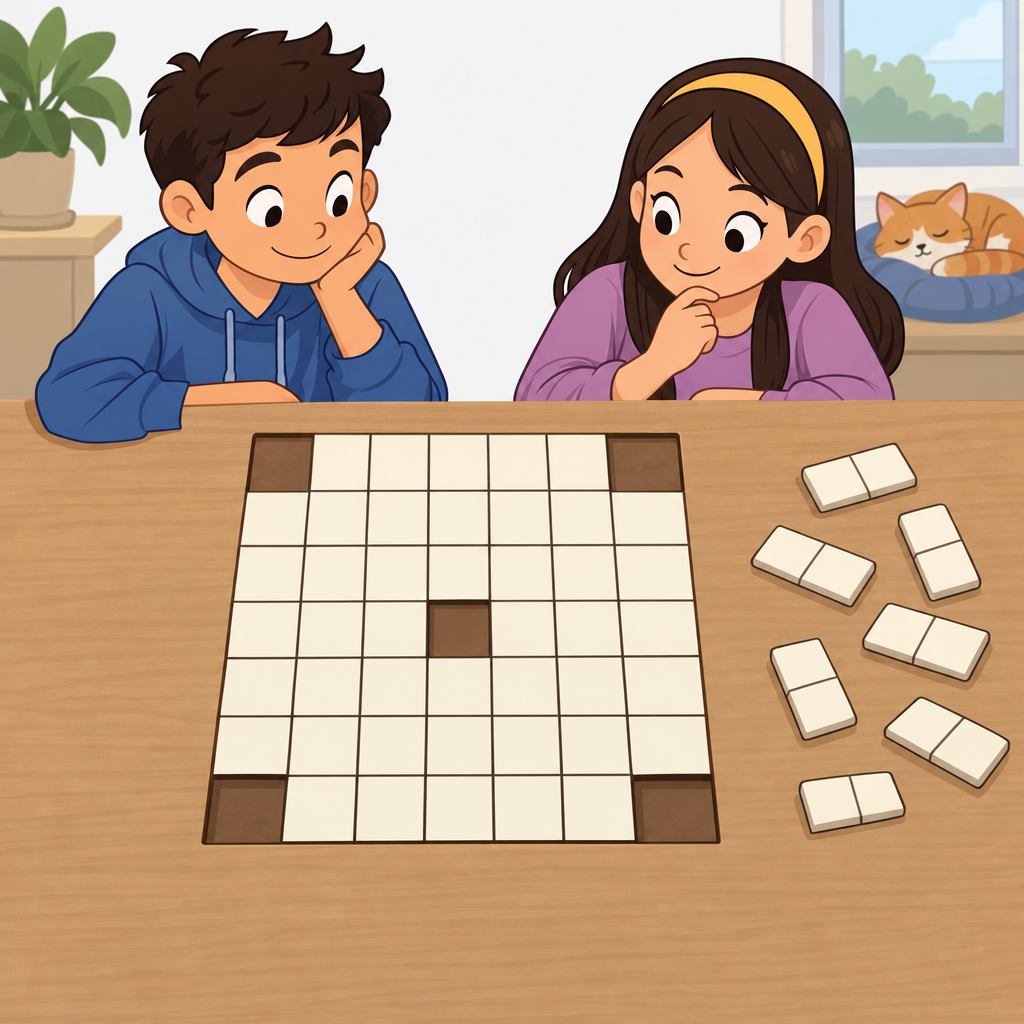
A 7×7 grid of unit squares loses its four corner squares and its center square. What is the greatest number of 1×2 dominoes you can cut from what remains, in either orientation, if you may leave some squares unused?
20
21
19
18
22
Show a hint
Counting squares gives a tempting limit, but can the dominoes actually reach it? Try coloring the grid like a checkerboard.
The corners and center all have the same color. After finding an upper bound, look for a way to cut that many dominoes.
Show the answer and solution
Answer: A — 20
A checkerboard coloring has 25 dark and 24 light squares. The five removed squares are all dark, leaving 20 dark and 24 light. Each domino covers one of each, so at most 20 can be cut; 22 is the trap from counting area alone. To reach 20, also leave unused the squares at (row, column) (2,1), (2,7), (6,1), and (6,7). The top and bottom two rows each become a tileable 2×5 rectangle. In the middle three rows, tile the 2×3 blocks in rows 3–4, columns 1–3 and rows 4–5, columns 5–7, and the 1×4 strips in row 3, columns 4–7 and row 5, columns 1–4.
Problem 9 · Count two interleaved sequences · 4 points
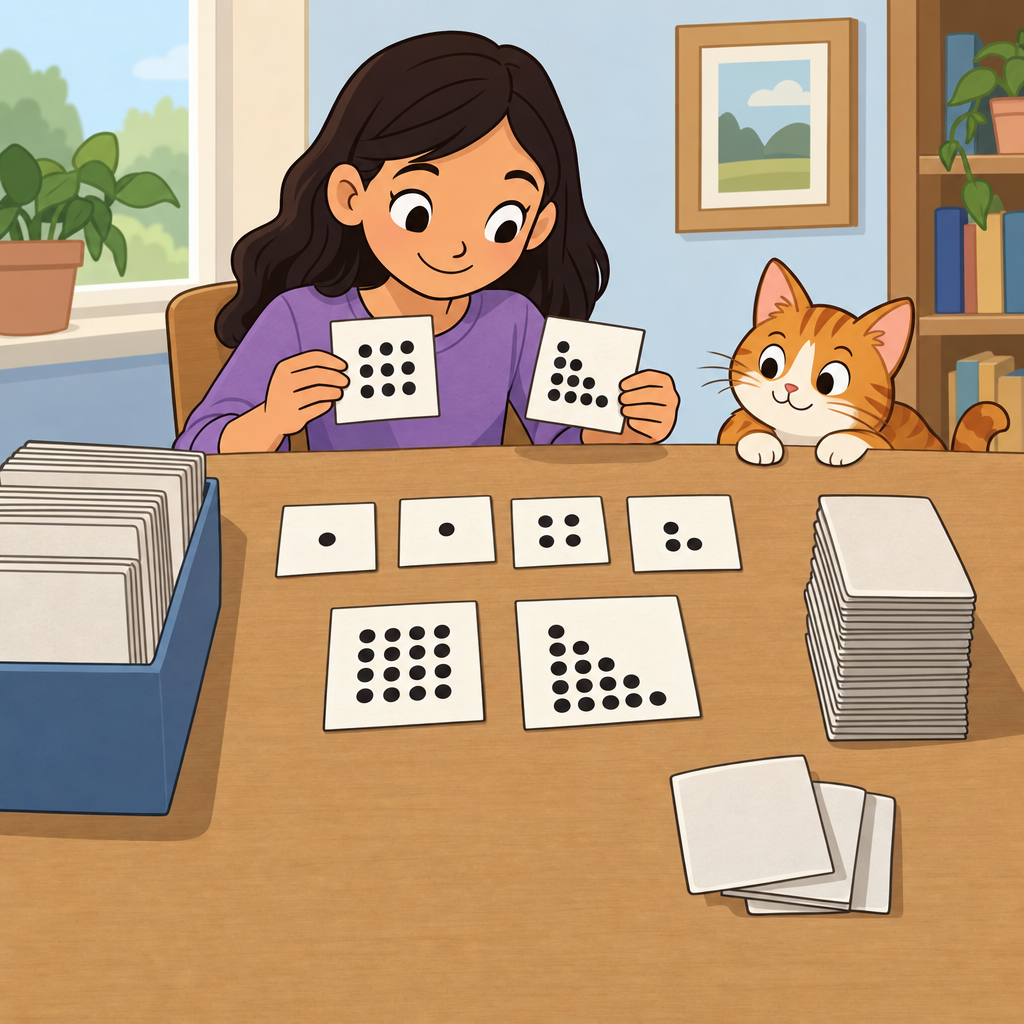
For every positive integer n, Mira makes two dot cards: an n×n square and a staircase with rows of 1, 2, ..., n dots. She sorts all the cards by dot count, keeping tied cards separately; how many dots are on the 100th card?
1770
1764
1711
1681
1849
Show a hint
Rather than listing cards from the start, count how many come at or before a conveniently sized square. Remember that equal dot counts still belong to separate cards.
A staircase with n rows has n(n+1)/2 dots. How many square cards and staircase cards have at most 40×40 dots?
Show the answer and solution
Answer: B — 1764
Up to 1600 dots, there are 40 square cards. The 56th staircase has 56×57/2 = 1596 dots, while the 57th has 1653, so there are 56 staircase cards: 96 cards altogether. The next four dot counts are 1653, 1681, 1711 and 1764. Thus the 100th card has 1764 dots. The tempting choice 1849 results from merging tied cards, but ties must be kept separately.
Problem 10 · Extremal reasoning with reordered increases · 4 points
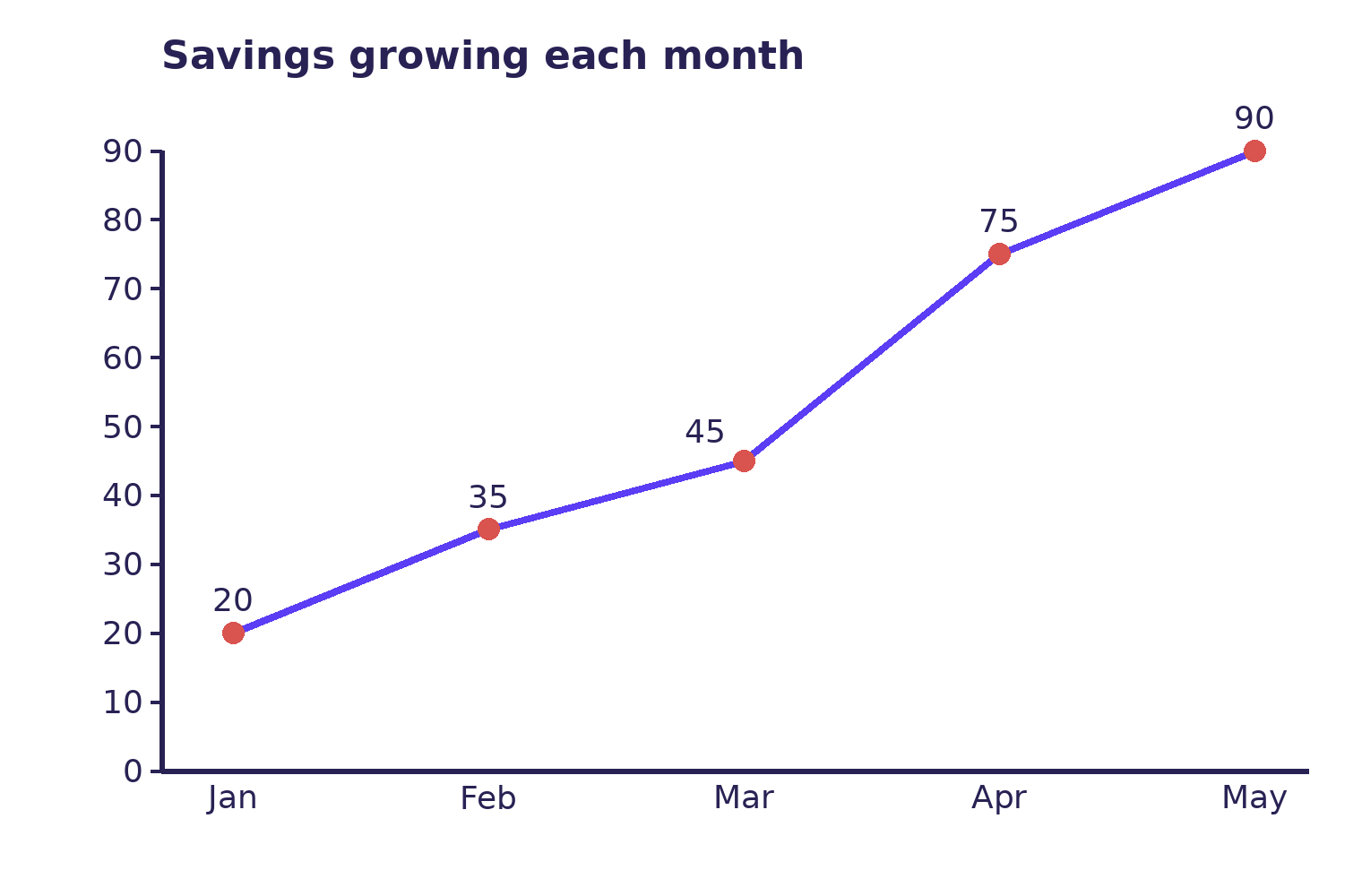
Imagine the four monthly savings increases happened in a different order, while January’s savings stayed the same. Which month’s plotted total could never be made lower by reordering the increases, but could be made higher?
April
February
May
March
January
Show a hint
Reordering the increases changes which ones have happened by a given month, but not the final total. Think about what would make an intermediate total as small as possible.
The four increases are $15, $10, $30, and $15. For each month, consider which increases would have to happen first to give the smallest possible total.
Show the answer and solution
Answer: D — March
By March, the chart has used the $15 and $10 increases—the two smallest—so no reordering can lower March’s total. Putting the $30 increase before March could make it higher. February’s total could be lowered by putting $10 first, and April’s could be lowered by saving the $30 increase for last. January and May are tempting because their totals cannot be lowered, but reordering cannot make either one higher.
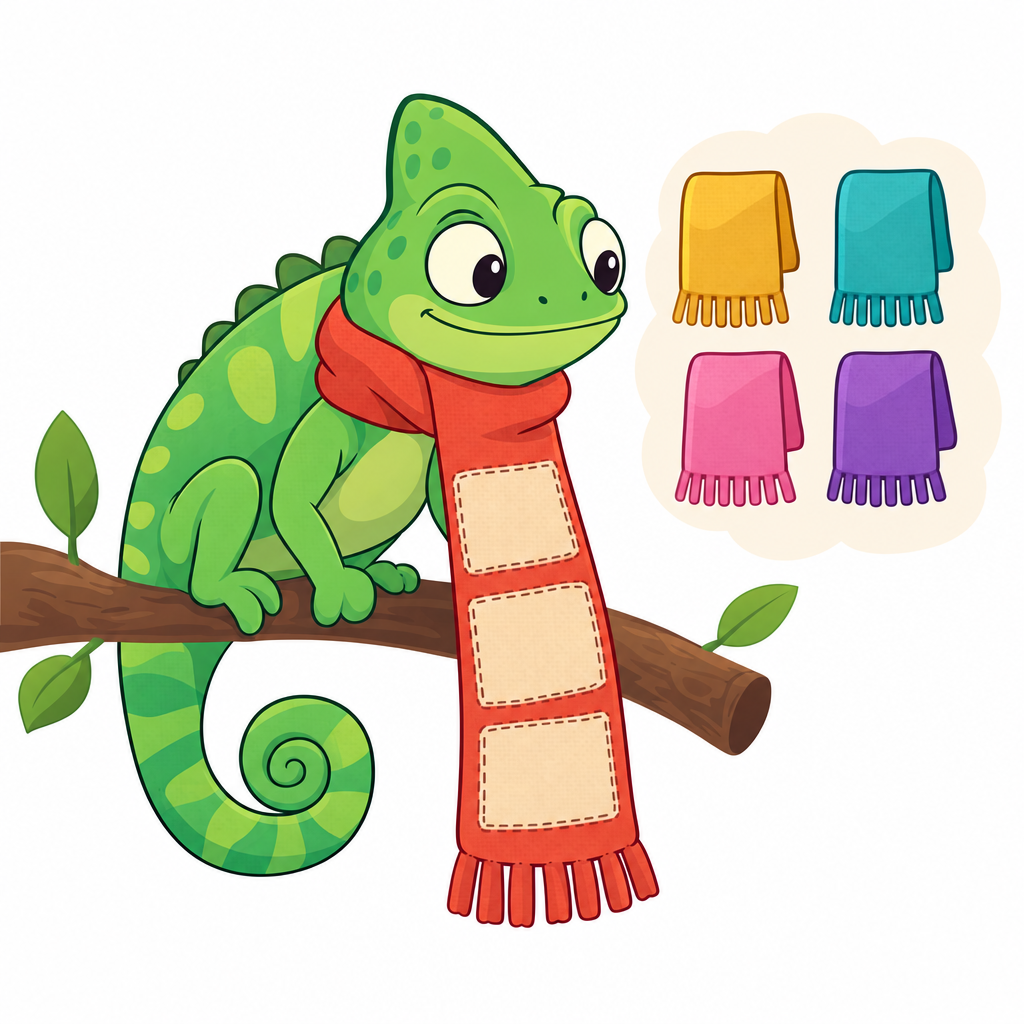
A chameleon’s scarf has three patches numbered 1, 2, and 3. Each patch can be gold, teal, pink, or purple; how many different scarves have at least one gold patch?
36
64
48
37
27
Show a hint
Count all possible scarves first.
Subtract those with no gold patches.
Show the answer and solution
Answer: D — 37
Each of the three patches has 4 choices, giving 4 × 4 × 4 = 64 scarves. With no gold, each patch has 3 choices, giving 3 × 3 × 3 = 27 scarves. So the answer is 64 − 27 = 37. The tempting answer 48 comes from choosing which patch is gold and then coloring the other two, but it counts scarves with multiple gold patches more than once.
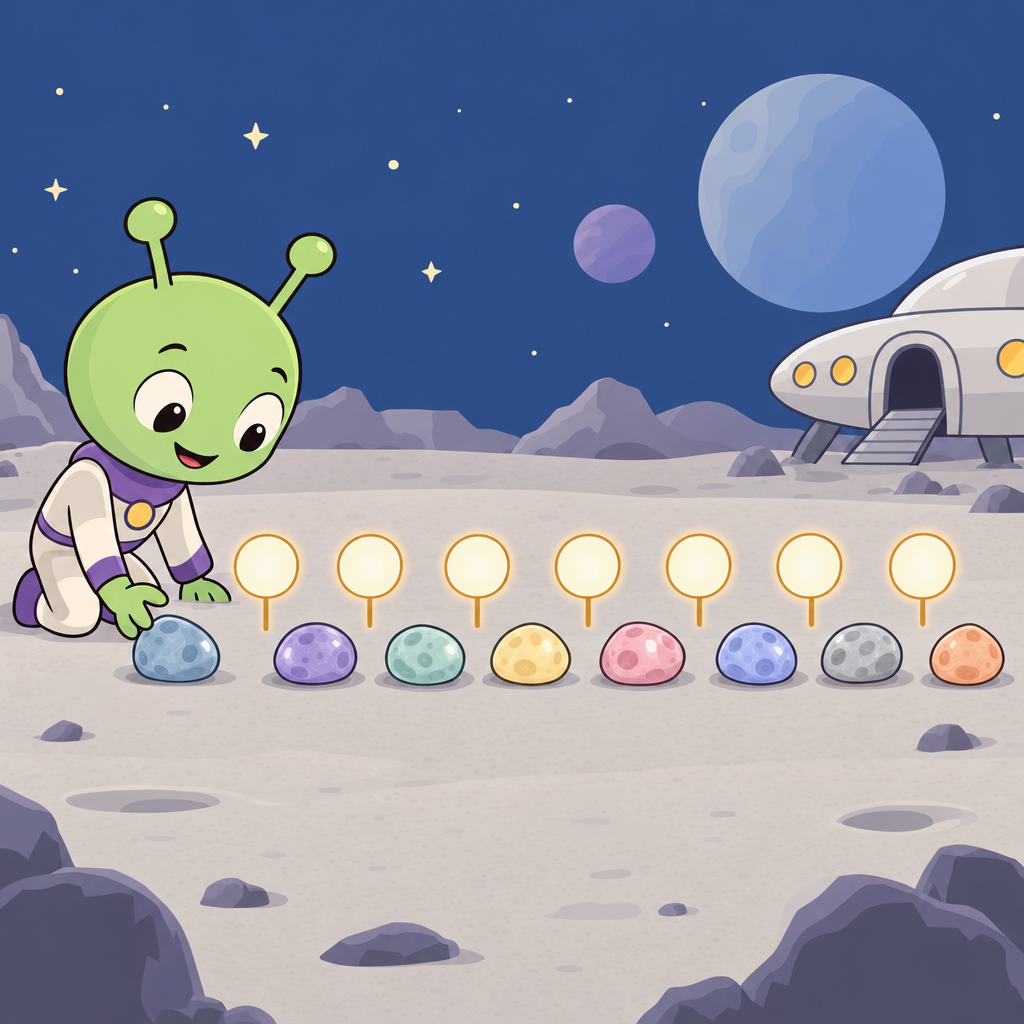
An alien lines up moonstones numbered 1 through 8, using each number once, and writes the sum on every gap between neighbors. If the seven sums add to 69, which two numbers are at the ends?
7 and 8
2 and 3
3 and 4
1 and 3
1 and 2
Show a hint
How many times does an end number appear in the seven sums?
Start by counting every number twice.
Show the answer and solution
Answer: E — 1 and 2
The numbers 1 through 8 add to 36, so counting each twice gives 72. Each end number appears in only one gap sum instead of two, so the end numbers add to 72 − 69 = 3. The only two different numbers that work are 1 and 2. The tempting choice 1 and 3 would make the seven sums total 72 − 4 = 68.