Grade 5 math puzzles — free practice & printable teacher quizzes
Free grade 5 math puzzles that teach abstract thinking — competition and Olympiad style,
with instant hints, full solutions and a named thinking strategy for every task.
Compare fractions two at a time using cross-products. Keep track of the larger fraction as you check the others, rather than judging by numerators alone.
For example, to compare 3/7 and 4/9, compare 3 × 9 with 4 × 7. Then compare the larger fraction with one you have not checked yet.
Show the answer and solution
Answer: B — 1/2
Compare 1/2 with each other fraction by cross-multiplying: 1 × 5 = 5 > 2 × 2 = 4, 1 × 7 = 7 > 3 × 2 = 6, 1 × 9 = 9 > 4 × 2 = 8, and 1 × 11 = 11 > 5 × 2 = 10. So 1/2 is larger than every other fraction. The trap is choosing 5/11 because 5 is the largest numerator; its denominator is larger too, and 5/11 is less than 1/2.
Problem 2 · Compare two division sentences · 3 points
A positive whole number gives a quotient and a remainder when divided by 7. When the same number is divided by 8, the quotient and remainder switch places. What is the number?
55
62
47
54
56
Show a hint
Picture the number as complete groups of 7 plus leftovers, then as complete groups of 8 plus leftovers. How do those two pictures compare?
Call the first quotient q and remainder r. The two ways to build the number are 7q + r and 8r + q; also, r must be less than 7.
Show the answer and solution
Answer: A — 55
Since both expressions give the same number, 7q + r = 8r + q, so 6q = 7r. The only possible positive remainder less than 7 that makes this work is r = 6, giving q = 7. The number is 7 × 7 + 6 = 55, and 55 divided by 8 gives quotient 6, remainder 7. The tempting 47 gives quotient 6, remainder 5 when divided by 7; division by 8 gives quotient 5 but remainder 7, not 6.
Problem 3 · Count shared endpoints and gaps · 3 points
A rectangular garden has posts 2 m apart around its edge and along a fence joining the midpoints of its long sides, with posts at every corner and at both ends of the middle fence. There are 47 different posts in all, and each long side has 13 posts; how long is a short side?
12 m
20 m
18 m
14 m
16 m
Show a hint
Think about which posts would be counted twice if you counted each stretch of fence separately.
Count the posts on both long sides first. Where must the remaining posts be?
Show the answer and solution
Answer: E — 16 m
The two long sides have 26 different posts, leaving 21 posts between them. These lie along three equally long stretches: the two short sides and the middle fence. Each stretch has 7 posts between its endpoints, making 8 gaps of 2 m, so a short side is 16 m. The tempting 14 m counts the 7 posts between the endpoints as 7 gaps instead of 8.
Problem 4 · Count overlapping groups using totals · 4 points
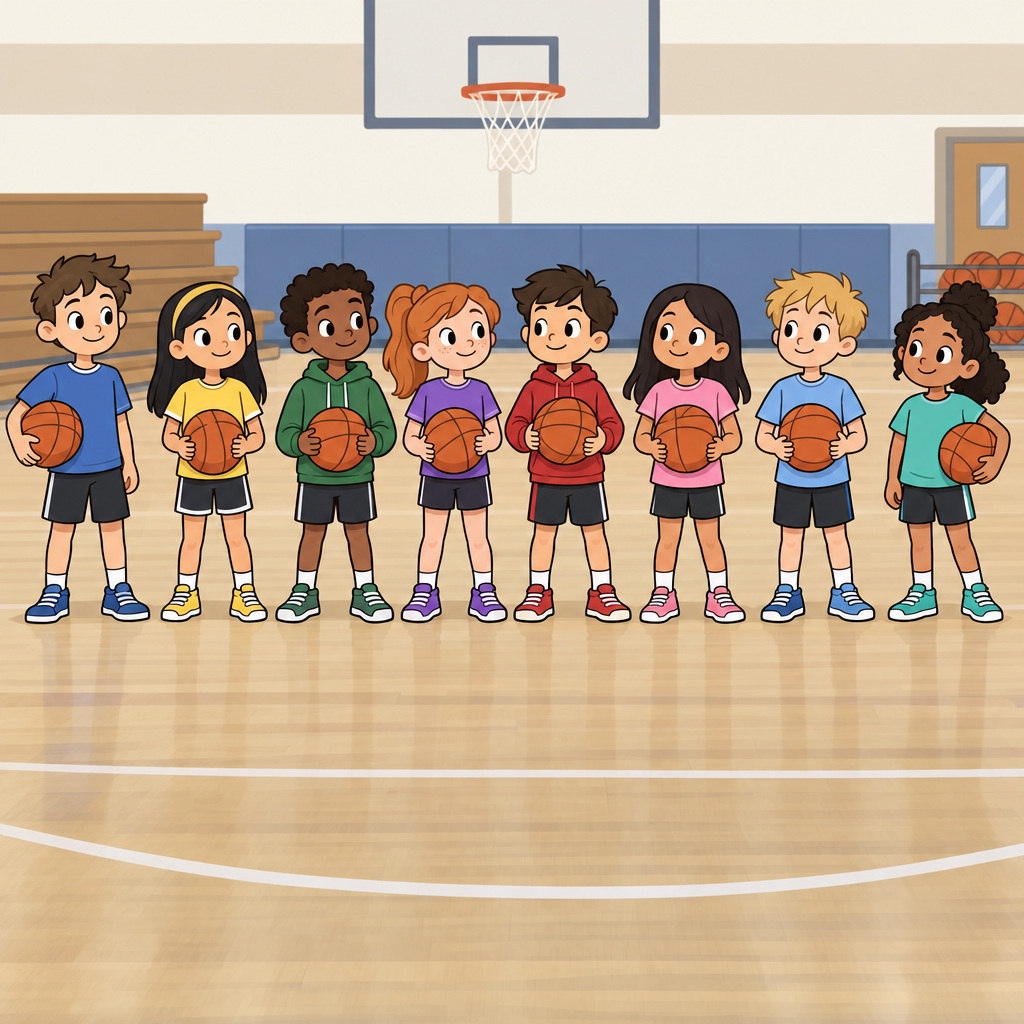
Eight kids line up: the first five average 11 points, the last five average 15 points, and all eight average 12 points. What is the average score of the middle two kids?
13
15
17
12
34
Show a hint
Draw eight boxes in a row. Mark the first five and the last five in different colors.
Compare the two groups’ combined total with the total for all eight kids.
Show the answer and solution
Answer: C — 17
The first five scored 5 × 11 = 55 points in total, and the last five scored 5 × 15 = 75. Together, those totals count the middle two kids twice, while the total for all eight—8 × 12 = 96—counts them once. So the middle two scored 55 + 75 − 96 = 34 points together, and their average is 34 ÷ 2 = 17. The tempting answer 34 is their total, not their average.
Problem 5 · Sort by position, then count · 4 points
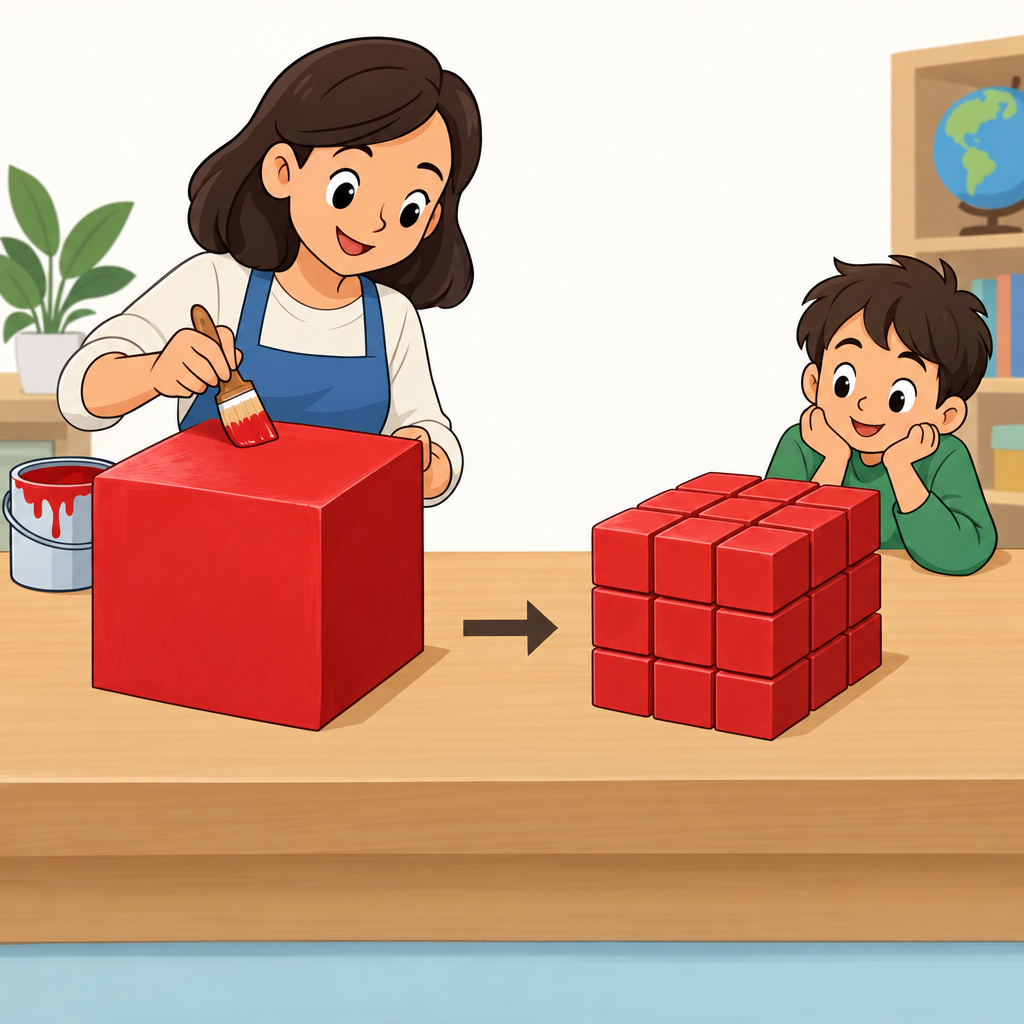
A large cube is painted red on the outside and then cut into 27 equal small cubes (3 × 3 × 3). How many small cubes have exactly ONE red face?
6
8
26
12
1
Show a hint
Where can a cube with exactly one painted face sit: corner, edge, middle of a face, or center?
Show the answer and solution
Answer: A — 6
Classify by position: corners (8) have 3 painted faces, edge cubes (12) have 2, the hidden center (1) has 0, and the middle cube of each face has exactly 1 — one per face, 6 faces → 6 cubes. Classifying objects by role before counting turns a 3-D headache into simple bookkeeping.
Nina's two-digit number becomes exactly 27 LARGER when its digits are reversed. What is the smallest number Nina could have written?
25
13
14
36
12
Show a hint
Write the number as 10a + b. What is the reversed number worth?
Reversing changes the value by 9 × (difference of the digits).
Show the answer and solution
Answer: C — 14
A number 10a + b reversed becomes 10b + a; the change is 9(b − a). For +27 we need b − a = 3. The smallest such number takes a = 1, b = 4: the number 14 (41 − 14 = 27 ✓). Writing numbers by their place-value structure exposes exactly which digit relationships matter — pure abstract thinking about notation itself.
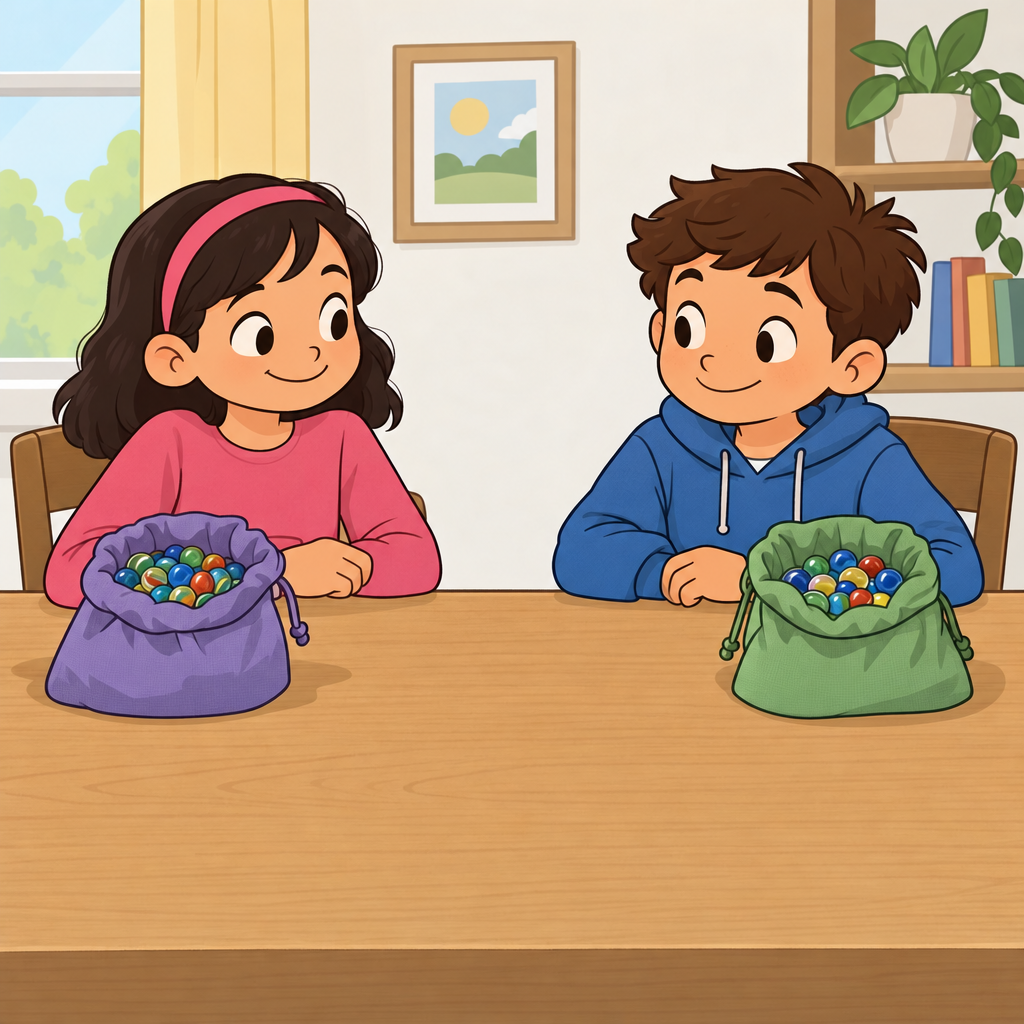
Ada and Bo play three rounds with marbles: first Ada gives Bo as many as Bo already has, then Bo gives Ada as many as Ada now has, and finally Ada gives Bo as many as Bo now has. If they end with 24 marbles each, how many did Ada start with?
24
36
15
33
18
Show a hint
No marbles are added or lost. Think about what each gift does to the receiver’s pile.
Start with the final gift: Bo had half as many marbles just before it as he had afterward. Use the total to find Ada’s pile at that moment, then keep working toward the start.
Show the answer and solution
Answer: D — 33
Together they always have 48 marbles. Just before the final gift, Bo had 12 and Ada had 36. Just before the middle gift, Ada had 18 and Bo had 30; just before the first gift, Bo had 15 and Ada had 33. So Ada started with 33. The tempting answer 36 is what Ada had just before the final gift, not at the start.
Problem 8 · Block-swap pairing with a leading-zero check · 5 points
Using 0, 1, 2, 3, and 4 exactly once, make five-digit numbers whose last two digits also form a two-digit number. How many have a larger two-digit number at the start than at the end?
12
48
72
60
36
Show a hint
What happens if you swap the two-digit block at the start with the one at the end? Check whether the new number is still allowed.
Where can 0 go without starting either two-digit block? Then count the ways to arrange the other digits.
Show the answer and solution
Answer: E — 36
The 0 cannot be first or fourth, so it has 3 possible positions. The other digits have 4 × 3 × 2 × 1 = 24 orders, making 72 allowed numbers. Swapping the two end blocks pairs these numbers: exactly one in each pair has the larger block at the start, since the blocks cannot be equal. So the answer is 72 ÷ 2 = 36. The tempting 48 comes from halving all 96 five-digit arrangements, including ones where 0 starts the last block and it is not a two-digit number.
Look at how many letters you move forward each time.
The jumps get bigger by 1 each step.
Show the answer and solution
Answer: A — U
The letter moves forward by 2, then 3, then 4, then 5, so the next jump is 6. Starting from O, moving 6 letters gives U. A common trap is V, which would come from adding 7 instead of continuing the pattern of increasing by 1.
Problem 10 · Equal grouping from chart totals · 4 points
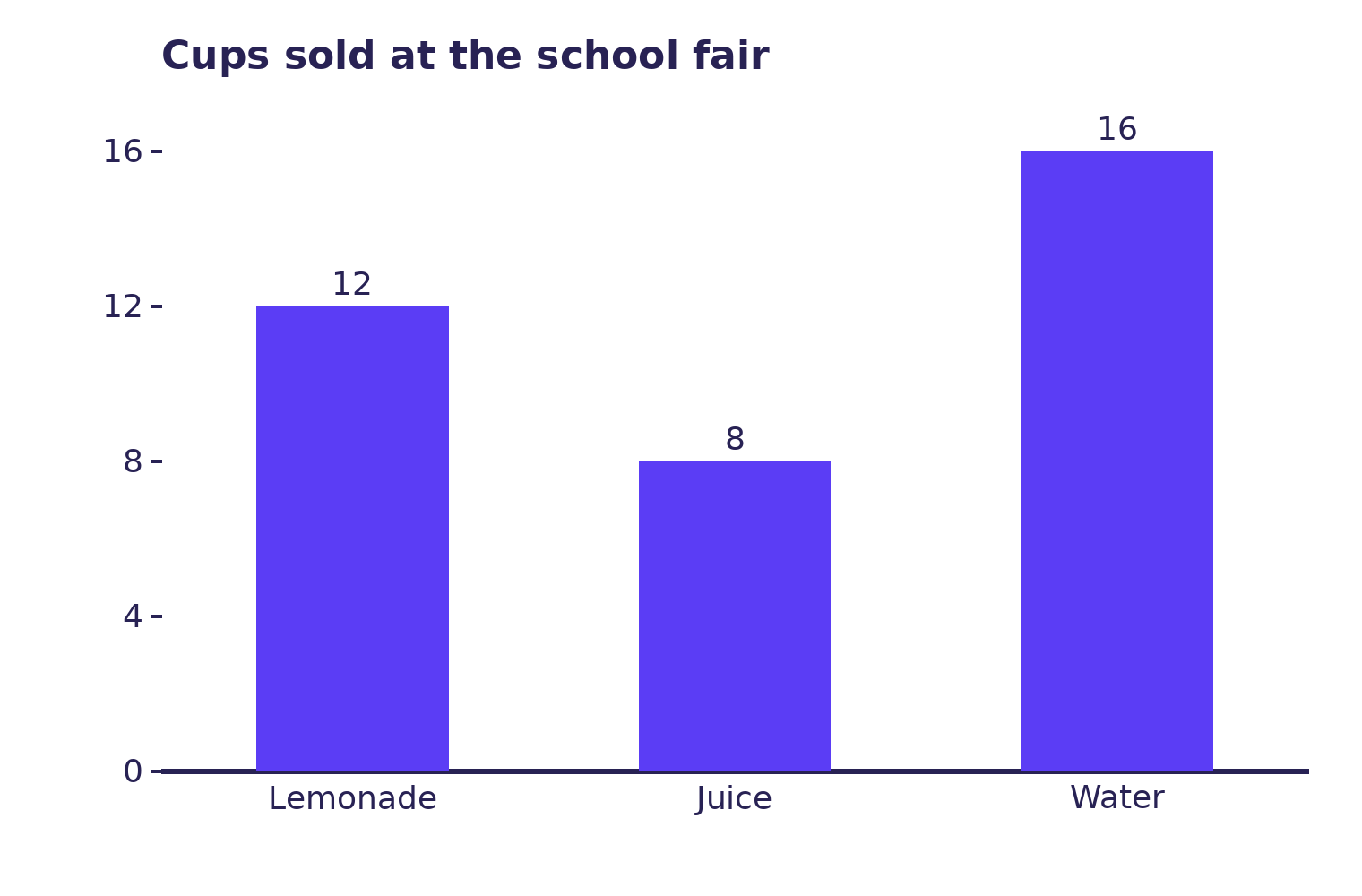
The chart shows cups of lemonade, juice, and water sold at the fair. If all the cups are put onto as many identical trays as possible, with every tray holding all three drinks, how many cups will be on each tray?
36
18
4
9
12
Show a hint
Which numbers of trays would let you share out every kind of drink evenly, with none left over?
Find the greatest number of trays that works for all three chart values, then work out what goes on one tray.
Show the answer and solution
Answer: D — 9
The greatest number of trays that divides 12 lemonade cups, 8 juice cups, and 16 water cups evenly is 4. Each tray holds 3 lemonade, 2 juice, and 4 water cups, for a total of 9. The tempting answer 36 counts cups on all the trays, not on one tray.
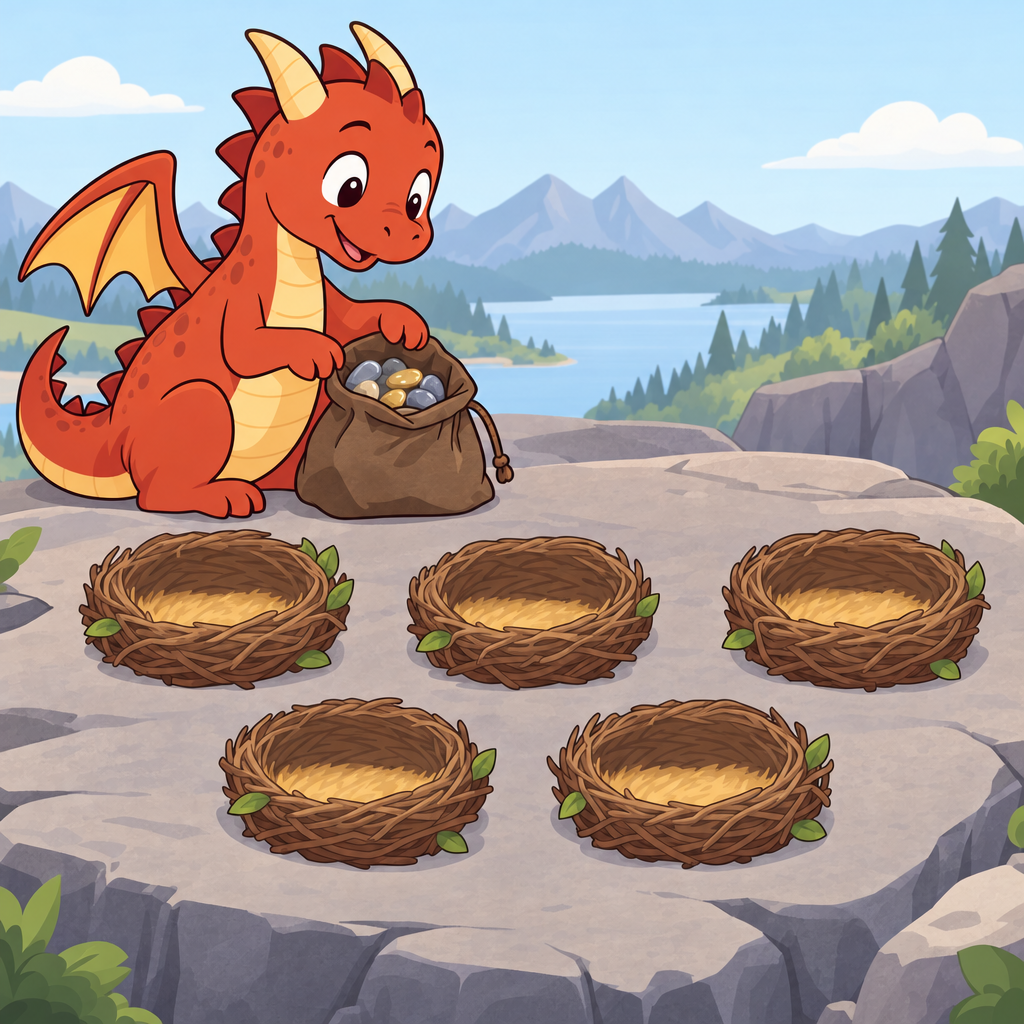
Five tiny dragon nests can each hold at most 3 shiny pebbles. A dragon puts 13 pebbles in the nests; what is the smallest possible number of nests holding exactly 3 pebbles?
1
4
2
3
5
Show a hint
Try filling as few nests as possible with 3 pebbles.
Show the answer and solution
Answer: D — 3
If only 2 nests held 3 pebbles, the other 3 could hold at most 2 each, for a total of 3 + 3 + 2 + 2 + 2 = 12. So 2 is a tempting but incorrect choice. Three nests can hold 3 pebbles each and the other two can hold 2 each, making 13. The answer is 3.
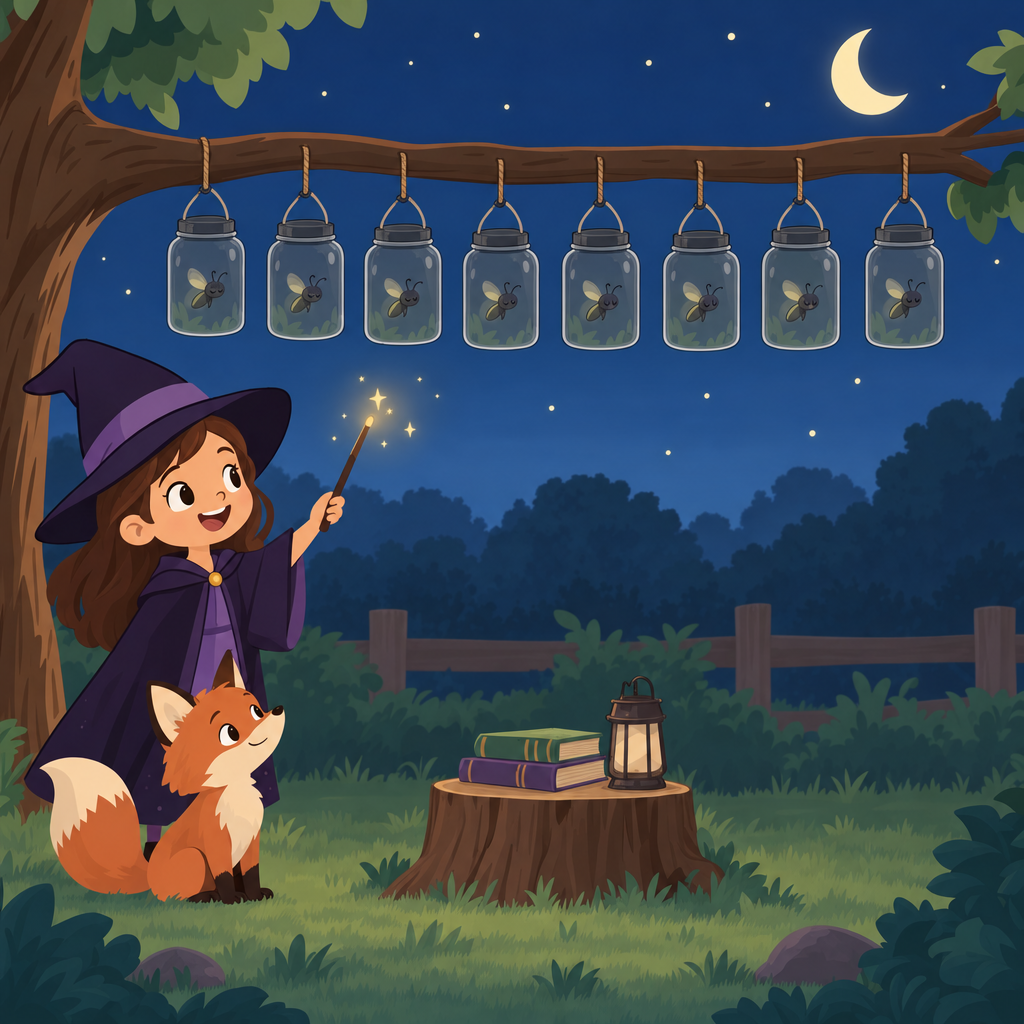
Eight firefly lanterns are off. Each spell flips exactly three different lanterns (on becomes off and off becomes on); after exactly three spells, what is the greatest number that can be on?
7
8
5
3
6
Show a hint
Think about whether the number of lit lanterns is odd or even.
Can one lantern be flipped twice?
Show the answer and solution
Answer: A — 7
Each spell changes the number of lit lanterns from even to odd or from odd to even. Starting at 0, the number lit after three spells must be odd, so 8 is impossible. To get 7, flip lanterns 1, 2, 3; then 4, 5, 6; then 1, 7, 8. Lantern 1 is off again, and the other seven are on. Thus 7 is the greatest possible.