Grade 7 math puzzles — free practice & printable teacher quizzes
Free grade 7 math puzzles that teach abstract thinking — competition and Olympiad style,
with instant hints, full solutions and a named thinking strategy for every task.
Try each one first — the hint and the full solution open when you are ready.
Or solve them in the app with read-aloud and instant feedback.
Problem 1 · Undo a repeated routine in reverse · 3 points
A machine doubles a two-digit number, adds 7, then swaps the digits of the result. It runs this routine twice and displays 53. What number went in first?
32
14
17
23
28
Show a hint
What must the screen have shown just before the very last digit swap?
Work backward through the last round to find the number between the two rounds. Then work backward through the first round.
Show the answer and solution
Answer: C — 17
Working backward, swap 53 to get 35, subtract 7 to get 28, and halve to get 14. But 14 was the input to the second round, not the first. Swap 14 to get 41, subtract 7 to get 34, and halve to get 17. Checking forward: 17 → 34 → 41 → 14 → 28 → 35 → 53.
Write down the last digit each time you multiply a power of 2 by 2. What happens if you keep going?
Once the last digits repeat, use the exponents to find where each power falls in the cycle.
Show the answer and solution
Answer: E — 2
The last digits of powers of 2 repeat in a cycle: 2, 4, 8, 6. Since 2026 leaves remainder 2 when divided by 4, 2^2026 ends in 4. The next power ends in 8, and 4 + 8 = 12, so the sum ends in 2. The tempting 8 is the last digit of 2^2027 alone, not of the sum.
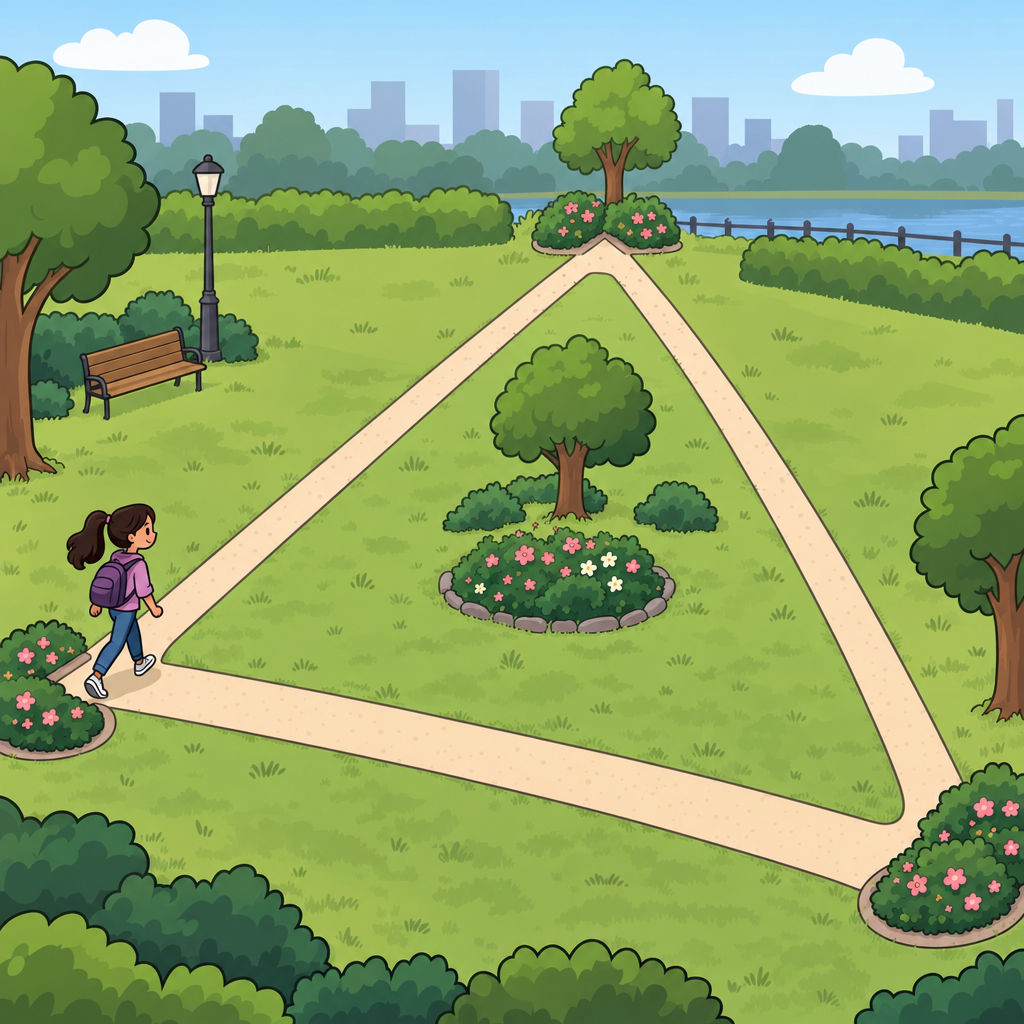
Maya walks once around a triangular park, turning left at each corner to follow its sides. Her first turn is 30° larger than her second, and her third turn is 140°; how large is her second turn?
5°
125°
95°
110°
80°
Show a hint
After a full lap, which way is Maya facing compared with when she started? Think about her total change in direction.
The three turns make one full revolution. Find the total of the first two, then use the 30° difference.
Show the answer and solution
Answer: C — 95°
Maya makes one full turn, or 360°, during the lap. Her first two turns therefore add to 360° − 140° = 220°. Since the first is 30° larger, the second is (220° − 30°) ÷ 2 = 95°. The tempting 110° splits 220° equally but ignores the 30° difference.
A shirt's price is raised by 20%, and later the new price is reduced by 20%. Compared to the original price, the final price is:
10% lower
the same
2% lower
4% lower
4% higher
Show a hint
Try it with a $100 shirt.
Show the answer and solution
Answer: D — 4% lower
Start at $100 → up 20% → $120 → down 20% of $120 → $96: 4% below the original. The −20% acts on a BIGGER base than the +20% did, so they don't cancel: 1.2 × 0.8 = 0.96. Percent changes compose by multiplication — a fact the SAT loves to test.
Problem 5 · Build a count, then correct for overlap · 4 points
A convex polygon has exactly 20 diagonals. Two vertices joined by a diagonal are colored blue; how many diagonals have no blue endpoint?
9
15
10
11
12
Show a hint
Imagine adding a new corner between two neighboring vertices. What happens to the diagonal count?
Once you know how many vertices there are, count the diagonals touching each blue vertex. Is any diagonal in both counts?
Show the answer and solution
Answer: D — 11
A triangle has no diagonals. Adding a corner to make a k-vertex polygon creates k−3 diagonals from the new corner and turns the old side into a diagonal, adding k−2 in all. The totals for 4 through 8 vertices are therefore 2, 5, 9, 14, and 20, so this is an octagon. Each blue vertex touches 5 diagonals, but the diagonal joining them is counted twice. Thus 20−(5+5−1)=11 diagonals have no blue endpoint. The tempting answer 10 subtracts their shared diagonal twice.
Problem 6 · Total distance ÷ total time · 4 points
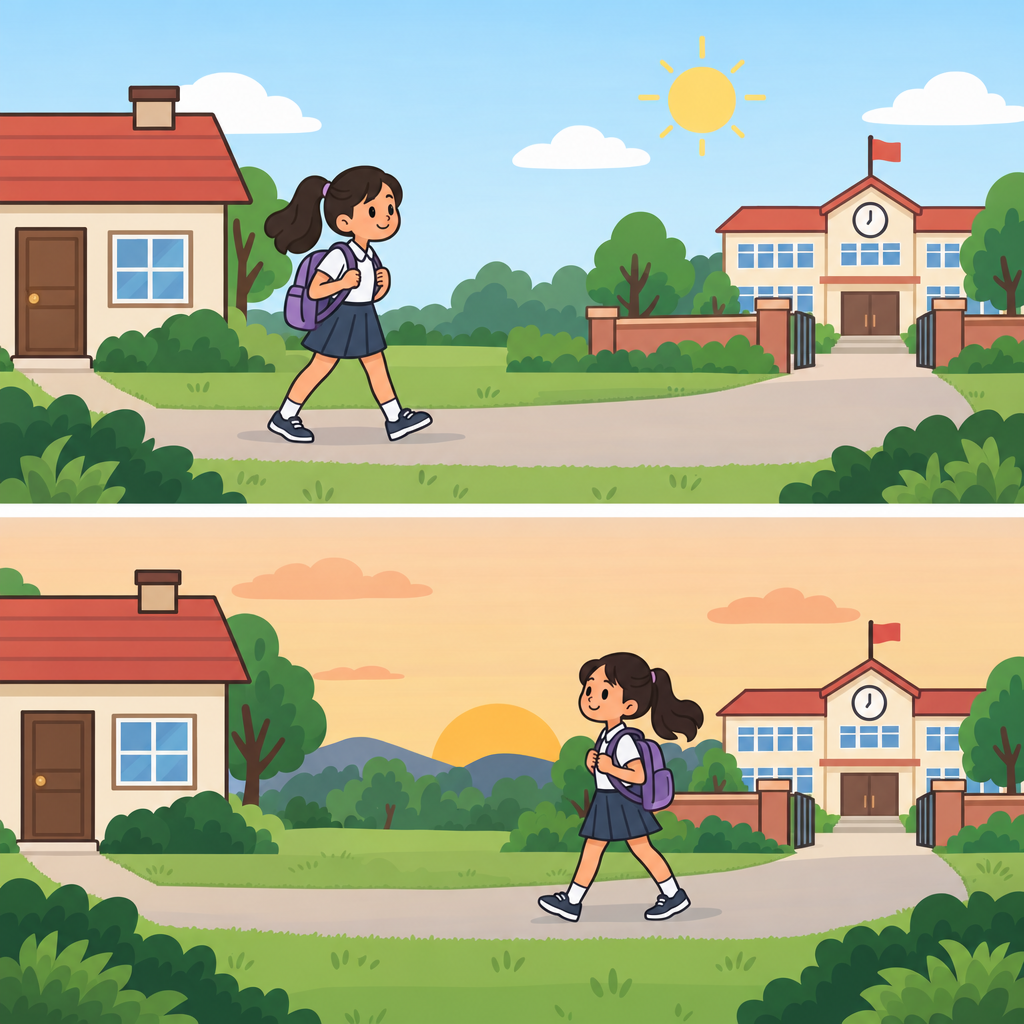
Ala walks to school at 4 km/h and returns home by the same route at 6 km/h. What is her average speed for the whole round trip?
5.2 km/h
5 km/h
4.8 km/h
4.4 km/h
4.6 km/h
Show a hint
Pick a convenient distance, say 12 km each way, and compute the total time.
Show the answer and solution
Answer: C — 4.8 km/h
Take 12 km each way: going takes 3 h, returning 2 h. Total: 24 km in 5 h → 4.8 km/h. The "obvious" 5 is wrong because Ala spends MORE TIME at the slower speed. Averages must be weighted by what actually accumulates (time) — a deep idea that reappears in statistics and physics.
Problem 7 · Count guaranteed prime factors · 5 points
Write down any nine consecutive positive whole numbers, cross out one, and multiply the other eight. Which number is guaranteed to divide the product?
288
720
144
432
1008
Show a hint
Think about which small prime factors must survive, even if you cross out a number that supplies several of them.
In a group of nine consecutive numbers, count the evens, the multiples of 4, and the multiples of 3. How many of each can one crossed-out number take away?
Show the answer and solution
Answer: C — 144
Nine consecutive numbers contain at least four evens, at least two multiples of 4, and exactly three multiples of 3. Crossing out one leaves enough factors for at least 2⁴ × 3² = 144. The trap is assuming an extra factor must survive too: starting with 1 through 9, crossing out 8, 9, 5, or 7 gives 144 × 315, 144 × 280, 144 × 504, or 144 × 360, respectively—ruling out 288, 432, 720, and 1008.
Problem 8 · Count unordered groups by dividing out their orders · 5 points
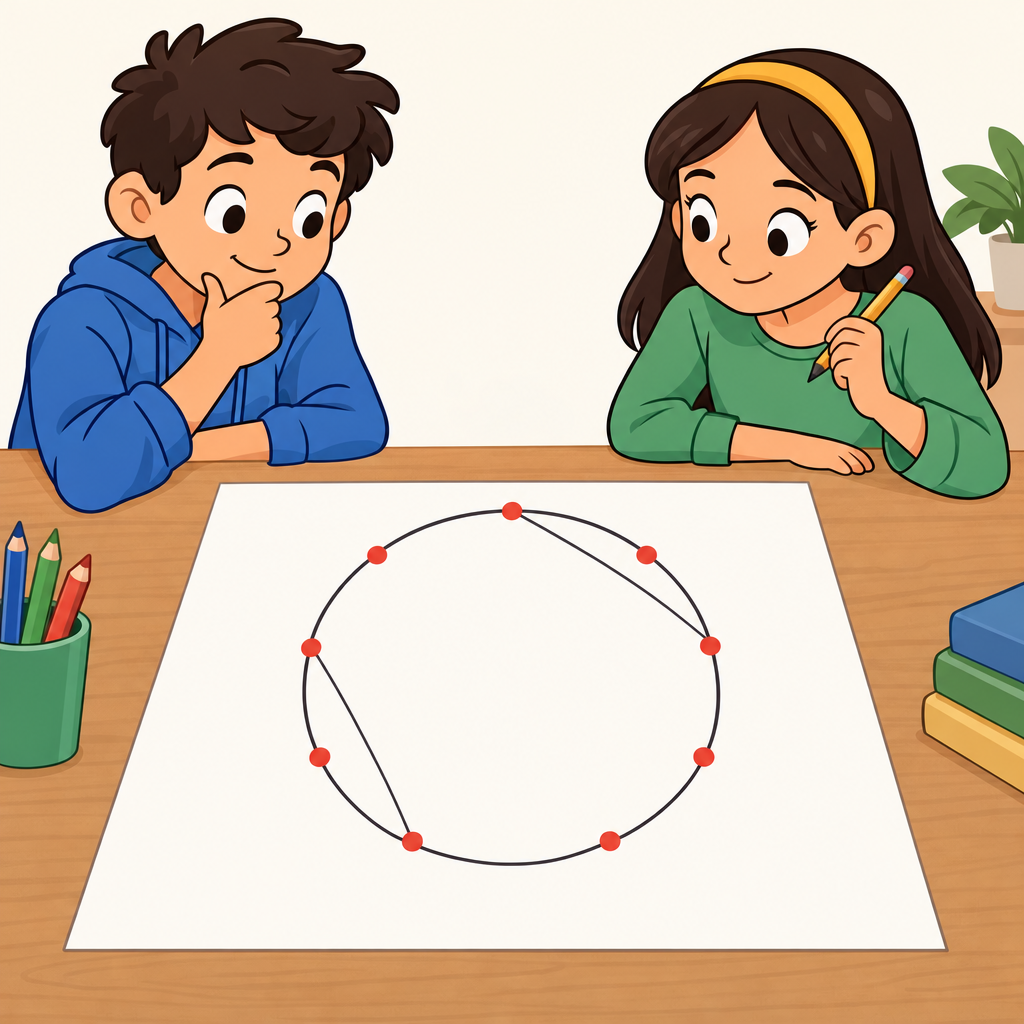
Nine dots lie on a circle, and every pair is joined by a straight segment. If no three segments meet at the same point inside the circle, how many distinct crossing points are there?
630
252
378
84
126
Show a hint
Focus on one crossing and trace its two segments back to the dots that made it.
Any four dots form a quadrilateral. How many pairs of its sides or diagonals cross inside the circle?
Show the answer and solution
Answer: E — 126
Each crossing comes from four dots. For any four dots, exactly one pair of segments crosses inside the circle: the quadrilateral’s two diagonals. Since no three segments meet at one interior point, different groups of four give different crossing points. Counting the dots in order and dividing out their 4 × 3 × 2 × 1 possible orders gives (9 × 8 × 7 × 6) ÷ 24 = 126. The tempting 378 counts all three ways to pair four dots, but only one pairing crosses.
Problem 9 · Find and verify a two-term recursive pattern · 4 points
One number in this chain has been smudged: 2, 5, 12, 29, __, 169, 408. What number was it?
71
70
58
41
63
Show a hint
Look at groups of three numbers. Can you find a relationship that works on both sides of the blank?
Notice that 12 = 2 × 5 + 2 and 29 = 2 × 12 + 5. What would come after 29 if that relationship continues?
Show the answer and solution
Answer: B — 70
Each number is twice the previous number plus the number before that. So the blank is 2 × 29 + 12 = 70. This checks in both later terms: 2 × 70 + 29 = 169 and 2 × 169 + 70 = 408. The tempting 63 comes from adding 5 instead of 12 to twice 29.
Problem 10 · Compare signed triangular areas · 4 points
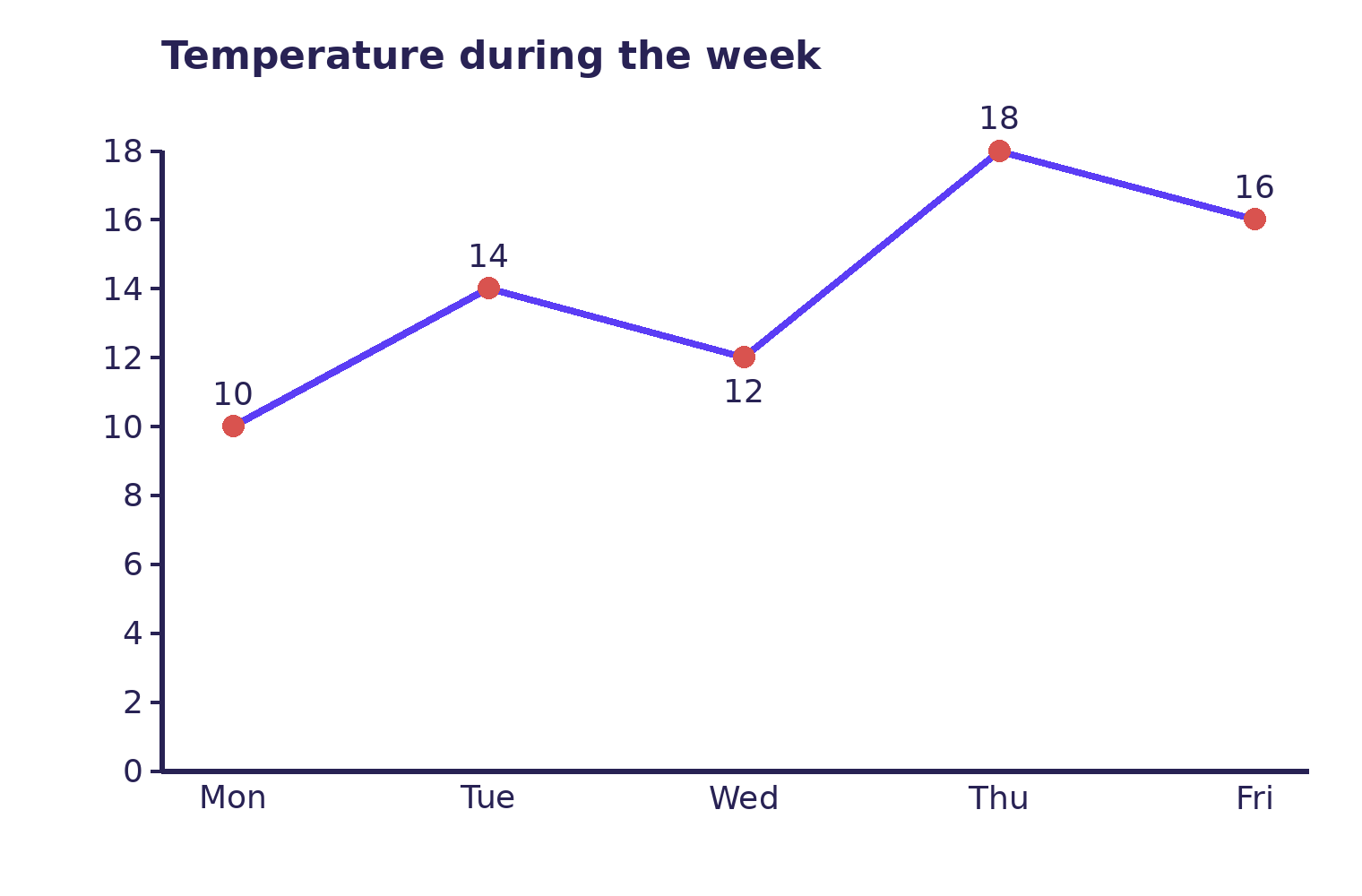
Erase one dot from Tuesday, Wednesday, or Thursday, then join its two neighbors with a straight line. Which dot makes the area beneath the graph shrink the most? Give its original temperature.
12 degrees
18 degrees
14 degrees
10 degrees
16 degrees
Show a hint
The new line makes a triangular change in area. First decide whether each change makes the area grow or shrink.
All three triangles span two days. Compare each dot’s height with the height of the new line at that day.
Show the answer and solution
Answer: B — 18 degrees
Erasing Tuesday’s 14-degree dot shrinks the area: it is 3 degrees above the line joining 10 and 12. Erasing Thursday’s 18-degree dot shrinks it more: it is 4 degrees above the line joining 12 and 16. The triangles have equal bases, so the taller one removes more area. Wednesday’s 12-degree dot is also 4 degrees from its new line, but it lies below that line, so erasing it makes the area grow instead.
Problem 11 · Bound with neighboring pairs · 3 points
Seven bowls sit in a row and hold 44 marbles altogether. Each bowl has a positive whole number of marbles, and neighboring bowls hold different amounts. What is the greatest possible number of marbles in the least-filled bowl?
3
6
7
4
5
Show a hint
Think about how few marbles two neighboring bowls could hold together if every bowl were fairly full. Then consider several pairs in the row.
Pair bowls 1–2, 3–4, and 5–6, leaving bowl 7 on its own. Could every bowl hold at least 6 marbles?
Show the answer and solution
Answer: E — 5
If every bowl held at least 6 marbles, each of the three neighboring pairs would hold at least 6 + 7 = 13. With at least 6 in the remaining bowl, that would require 45 marbles, so 6 is impossible. But the row 5, 12, 5, 6, 5, 6, 5 totals 44 and has different amounts in neighboring bowls. Thus the answer is 5. The tempting answer 6 comes from dividing 44 by 7 without allowing for the neighboring bowls.
Mila draws cards numbered 1 to 12, without looking. What is the fewest cards she must draw to be certain that two of their numbers differ by exactly 3?
8
7
9
6
5
Show a hint
Can you split the cards into pairs whose numbers differ by 3?
Find six cards that avoid such a pair.
Show the answer and solution
Answer: B — 7
Pair the cards as (1,4), (2,5), (3,6), (7,10), (8,11), and (9,12). With 7 cards, Mila must have both cards from at least one pair. But 6 is not enough: she could draw 1, 2, 3, 7, 8, and 9, with no two numbers differing by 3. So the answer is 7; the trap in choosing 6 is thinking that one card from each pair is enough.