Grade 4 math puzzles — free practice & printable teacher quizzes
Free grade 4 math puzzles that teach abstract thinking — competition and Olympiad style,
with instant hints, full solutions and a named thinking strategy for every task.
Try each one first — the hint and the full solution open when you are ready.
Or solve them in the app with read-aloud and instant feedback.
Problem 1 · Compare two expressions by their differences · 3 points
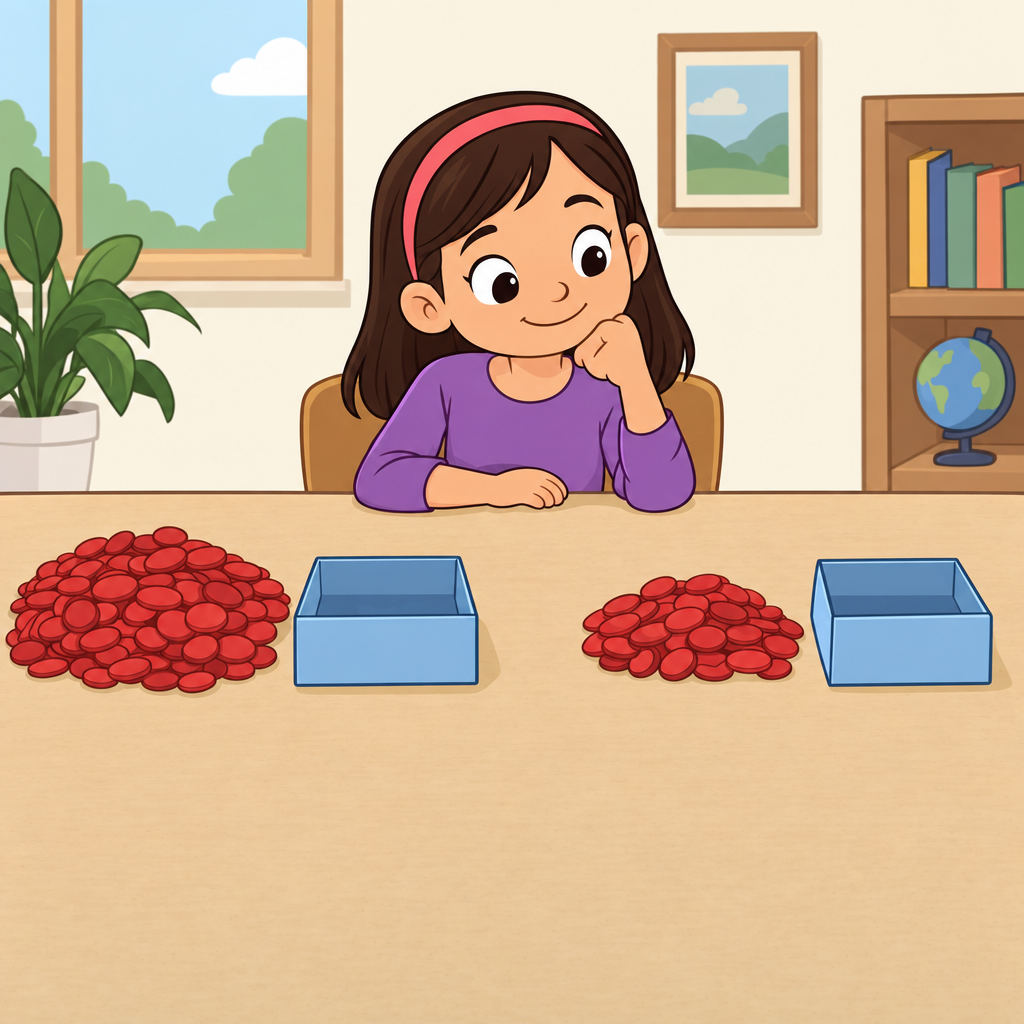
Lena puts the same whole number in both boxes to make 84 − 5 × □ = 48 − 2 × □. What number goes in each box?
24
12
36
0
18
Show a hint
Which side starts with more, and which side takes away more groups of the box?
How many extra groups must be taken away to close the gap between 84 and 48?
Show the answer and solution
Answer: B — 12
The left side starts 36 higher but subtracts 3 more copies of the box. So 3 copies make 36, and each box is 12. Checking: 84 − 5 × 12 = 24 and 48 − 2 × 12 = 24. The tempting 0 comes from subtracting before multiplying, which would make both sides zero; in the given expressions, 0 gives 84 and 48.
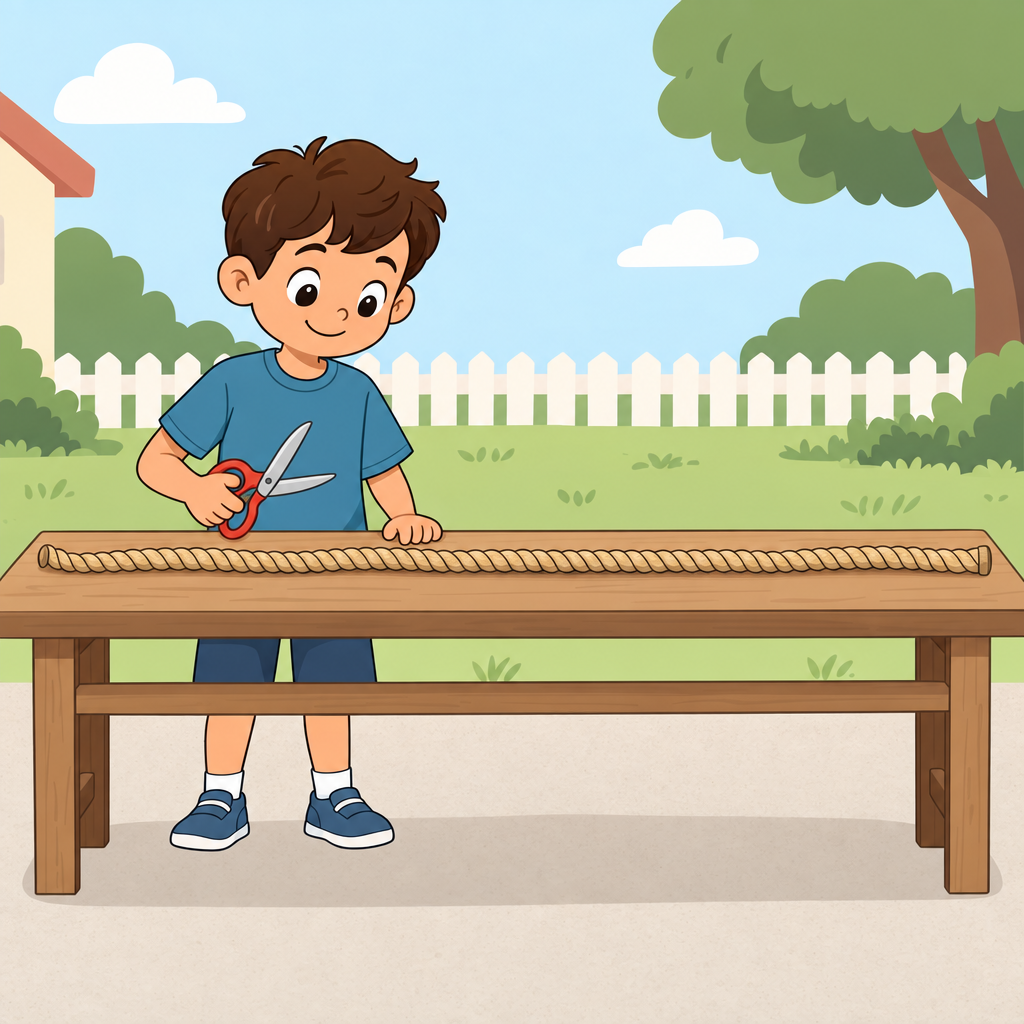
A rope 12 m long is cut into pieces that are each 2 m long. How many cuts are needed?
4
7
6
5
3
Show a hint
Try a smaller rope first. Start with one piece, make a cut, and notice how the number of pieces changes.
Work out how many 2 m pieces the rope must become. Use the pattern from your smaller example to find the cuts needed.
Show the answer and solution
Answer: D — 5
The rope makes 12 ÷ 2 = 6 pieces. It starts as one piece, and each cut increases the number of pieces by one. So reaching 6 pieces takes 5 cuts. The answer is 5. Choosing 6 would mean counting one cut for every piece, but the last piece is already separated after the fifth cut.
Problem 3 · Combine moves, then discard full laps · 3 points
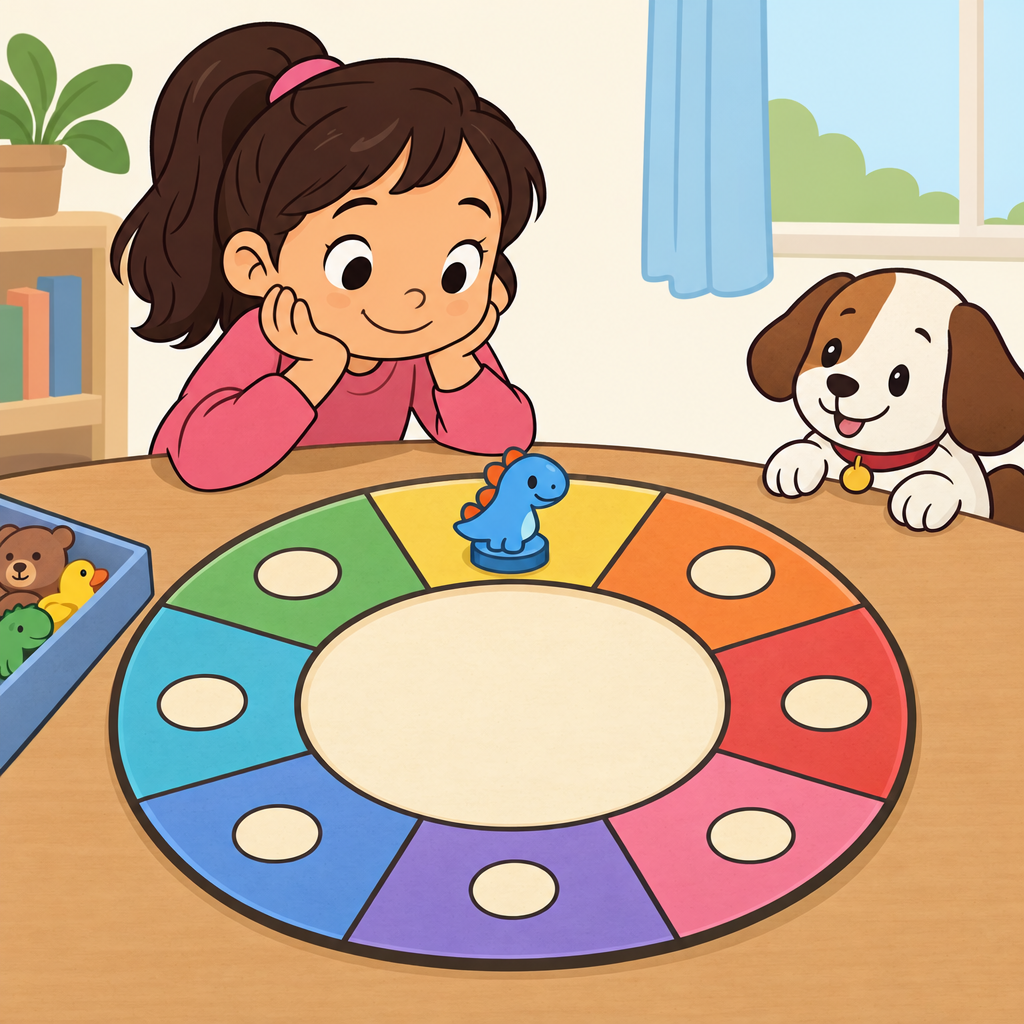
A toy starts on space 1 of a circular board numbered 1 to 8 clockwise. Each dance moves it 5 spaces clockwise, then 2 spaces counterclockwise; where is it after 47 dances?
6
5
4
2
3
Show a hint
Think about where one complete dance leaves the toy compared with where it began. What happens when it makes a full lap?
Each dance moves the toy 3 spaces clockwise overall. How many full laps can you ignore after 47 dances?
Show the answer and solution
Answer: A — 6
Each dance moves the toy 5 − 2 = 3 spaces clockwise. After 47 dances, that is 47 × 3 = 141 spaces. Since 141 = 17 × 8 + 5, the toy finishes 5 spaces clockwise from 1, on space 6. Space 4 is tempting if you count the clockwise moves but forget that every dance also moves the toy backward.
Problem 4 · List factor pairs, then test · 4 points
Mara multiplies two whole numbers and gets 24. When she adds the same two numbers she gets 11. What is the DIFFERENCE of the two numbers?
5
10
4
23
2
Show a hint
Which pairs of whole numbers multiply to 24? Check each pair's sum.
Show the answer and solution
Answer: A — 5
Factor pairs of 24: 1×24 (sum 25), 2×12 (sum 14), 3×8 (sum 11 ✓), 4×6 (sum 10). The numbers are 3 and 8, difference 5. Generating all candidates from the stronger clue (the product) and filtering with the weaker one is faster than guessing blindly.
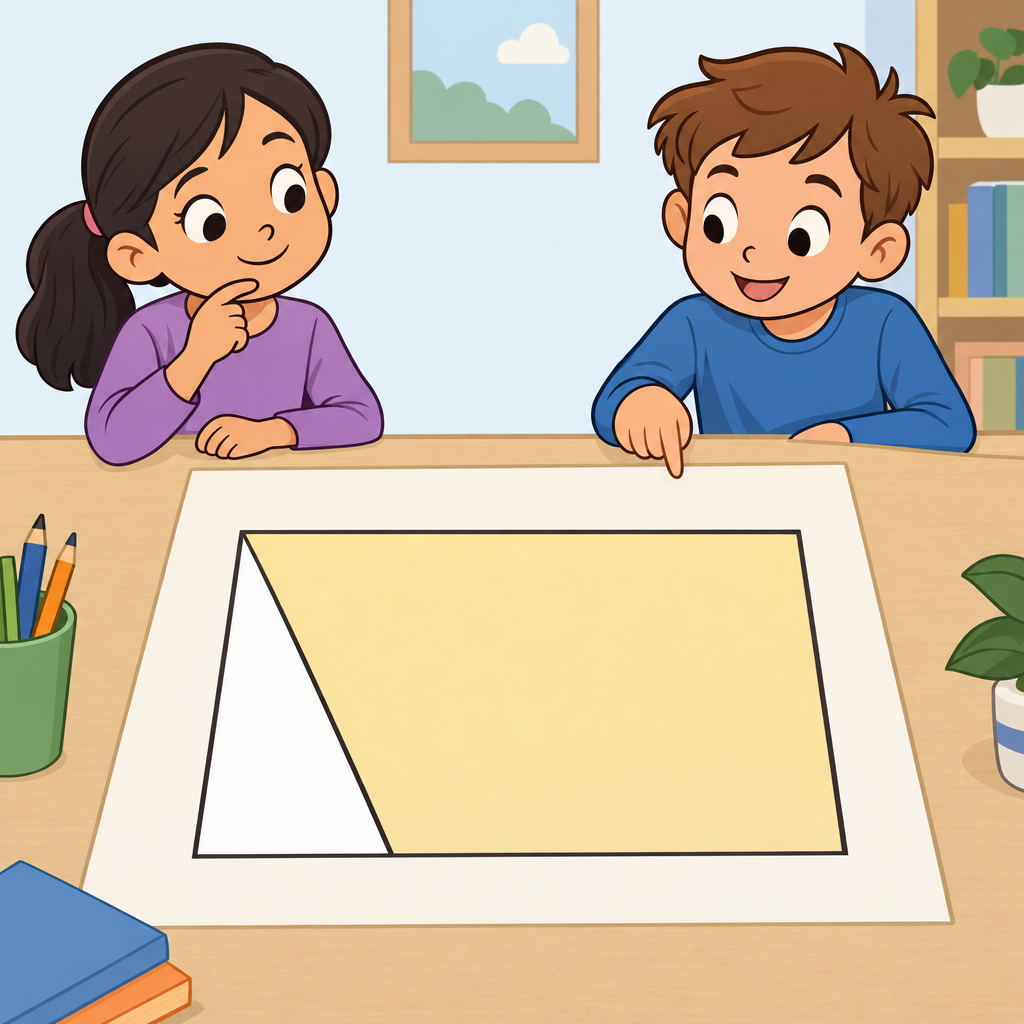
A 12 cm-wide, 8 cm-tall rectangle has a triangular piece cut from its bottom-left corner. The piece reaches 4 cm along the bottom and 8 cm up the left side. A vertical line divides the remaining shape into two equal areas. How far is the line from the rectangle’s original left side?
4 cm
6 cm
5 cm
8 cm
7 cm
Show a hint
Imagine putting the missing corner back. How does that change the amount of rectangle on each side of the line?
Find the missing triangle’s area and half of the remaining area. Then work out how much of the original rectangle must lie left of the line.
Show the answer and solution
Answer: E — 7 cm
The missing triangle is half of a 4 cm by 8 cm rectangle, so its area is 16 cm². The remaining area is 12 × 8 − 16 = 80 cm², and half is 40 cm². The cut must be beyond the triangle, so the original rectangle to its left has area 40 + 16 = 56 cm². At a height of 8 cm, that makes the distance 56 ÷ 8 = 7 cm. The tempting 6 cm is halfway across the original rectangle, but the missing corner makes the areas on its two sides unequal.
Problem 6 · Count the gaps, not the posts · 4 points
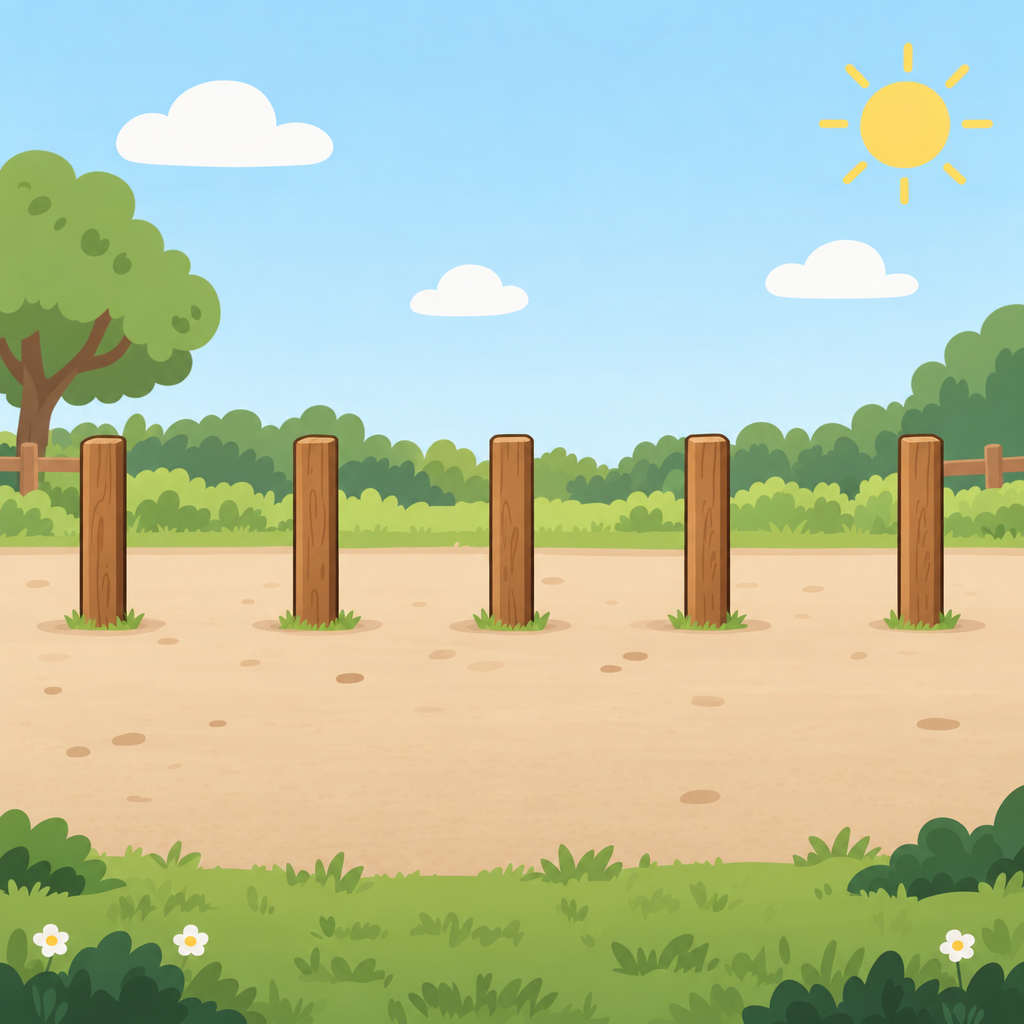
Five posts stand in a straight row. The distance between one post and the next is 3 m. How far is it from the first post to the last post?
12 m
9 m
18 m
10 m
15 m
Show a hint
Sketch the row of posts and label the distances given in the question. How could your sketch help you find the distance from end to end?
Starting at the first post, add 3 m each time you move to the next post. Stop when you reach the last post.
Show the answer and solution
Answer: A — 12 m
From the first post to the last, you cross 4 gaps. Each gap is 3 m, so the distance is 4 × 3 = 12 m. The incorrect 15 m comes from counting one 3 m distance for each of the 5 posts, rather than for each gap between posts.
A three-digit number has digits that add up to 26. How many such numbers are there?
3
1
5
4
2
Show a hint
What is the biggest digit sum a 3-digit number can have?
You need a sum only 1 less than the maximum.
Show the answer and solution
Answer: A — 3
The maximum digit sum is 9 + 9 + 9 = 27, so a sum of 26 means the digits are 9, 9, 8 in some order: 998, 989, 899 — three numbers. Anchoring at the extreme case and stepping back from it shrinks a huge search to almost nothing.
Problem 8 · Count digit occurrences by position · 5 points
Ola writes every number from 1 to 9999. In the numbers whose digits add up to 14, how many times does she write the digit 7?
112
36
140
138
144
Show a hint
Count written 7s, not just numbers: one number might contribute twice. You can imagine zeros in front of shorter numbers.
Choose a place for one 7. Count the ways the other three digits can add up to what is needed by considering their first digit in turn.
Show the answer and solution
Answer: E — 144
Imagine every number written with four digits, adding zeros in front if needed. Choose the place of a written 7; the other three digits must add up to 7. If the first of those digits is 0, there are 8 ways to choose the final two; if it is 1, there are 7 ways; and so on down to 1 way. That makes 8 + 7 + 6 + 5 + 4 + 3 + 2 + 1 = 36 for each of the four places, or 144 written 7s. The tempting answer 138 counts numbers instead: six numbers have two 7s and must each contribute twice.
Problem 9 · Test a pattern against examples and counterexamples · 3 points
Mia’s number box accepts 9, 25, 49, and 81, but rejects 16, 35, 64, and 99. Which number below would it accept?
121
144
120
100
143
Show a hint
Try arranging the numbers in equal rows and columns. Some rejected numbers can be arranged that way too, so look more closely.
Compare the side lengths of square arrays for accepted numbers with those for 16 and 64.
Show the answer and solution
Answer: A — 121
The accepted numbers are squares with odd side lengths: 3 × 3, 5 × 5, 7 × 7, and 9 × 9. So 121 belongs because it is 11 × 11. The tempting choice 144 is also a square, but its side length is even: 12 × 12. The same is true of 100 = 10 × 10. Neither 120 nor 143 is a square: 120 lies between 100 and 121, while 143 lies between 121 and 144.
Problem 10 · Find and add gaps to a common total · 3 points
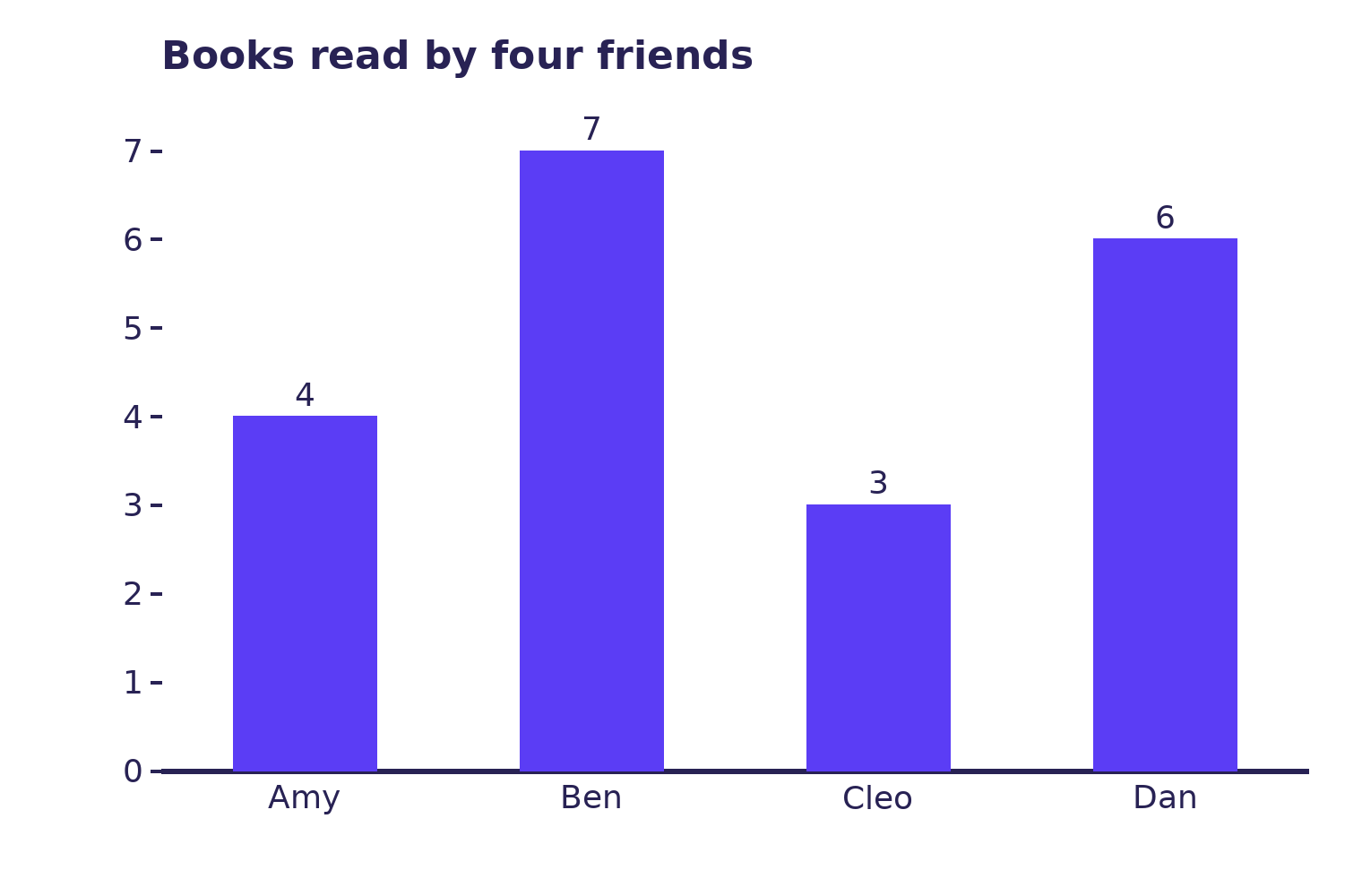
If the four friends keep reading until they have all read the same number of books, what is the fewest extra books they must read altogether?
7
3
8
4
1
Show a hint
No one can unread a book. Which bar sets the lowest possible finish line for everyone?
Find how far each shorter bar is from that finish line, then add the gaps.
Show the answer and solution
Answer: C — 8
Ben has read the most, so the smallest possible equal total is 7 books each. Amy needs 3 more, Cleo needs 4 more, and Dan needs 1 more. Together they need 3 + 4 + 1 = 8 extra books. The choice 4 counts only Cleo’s books, not everyone’s.
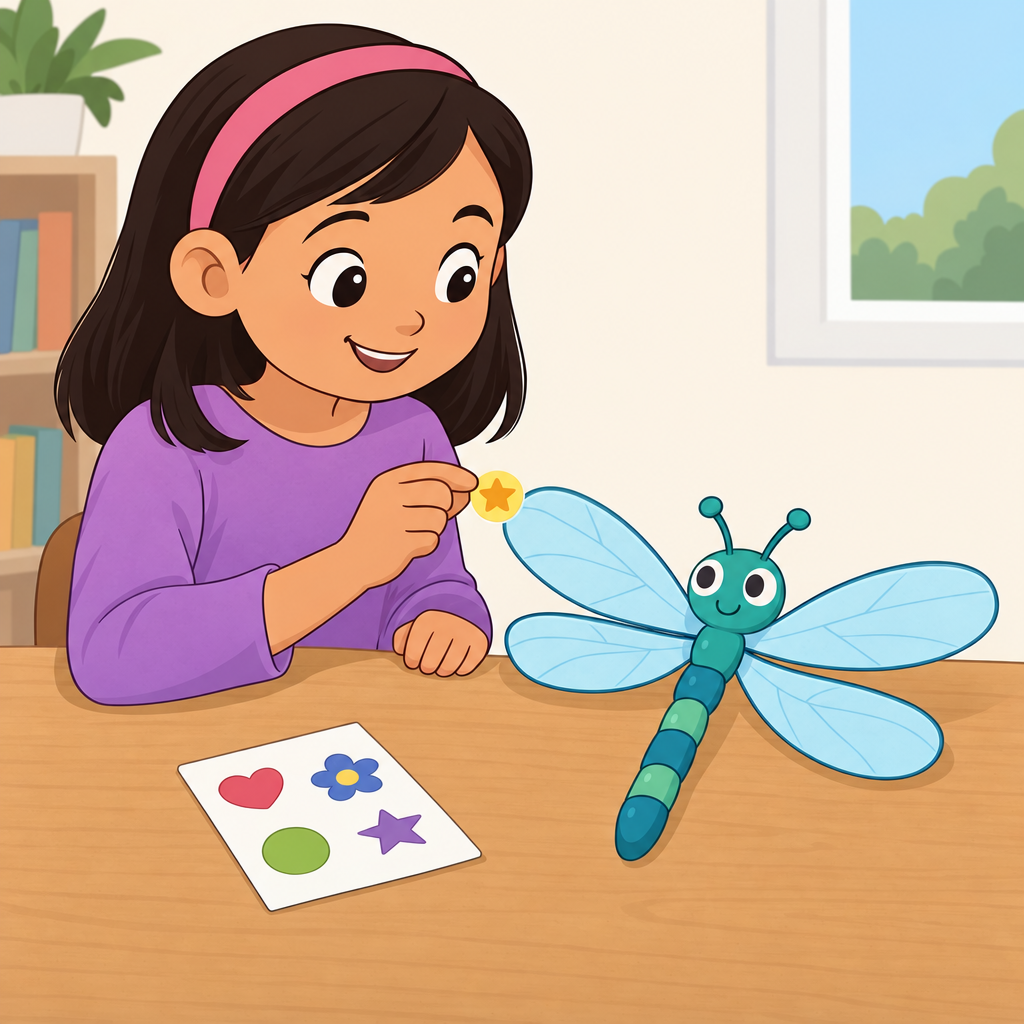
A toy dragonfly has four wings. Tia puts five stickers on its wings, each on exactly one wing; which statement MUST be true?
Some wing has no stickers.
Every wing has a sticker.
Some wing has at least two stickers.
Exactly one wing has two stickers.
Some wing has three stickers.
Show a hint
Think about what “MUST be true” means. Try different ways to spread the stickers among the wings; one possible arrangement can rule out a statement.
Suppose each wing could hold no more than one sticker. How many stickers could the four wings hold altogether?
Show the answer and solution
Answer: C — Some wing has at least two stickers.
If each wing had no more than one sticker, the four wings could hold at most four stickers. Tia has five, so some wing has at least two stickers. It does not follow that every wing has a sticker: Tia could put all five on one wing, leaving the other three empty.
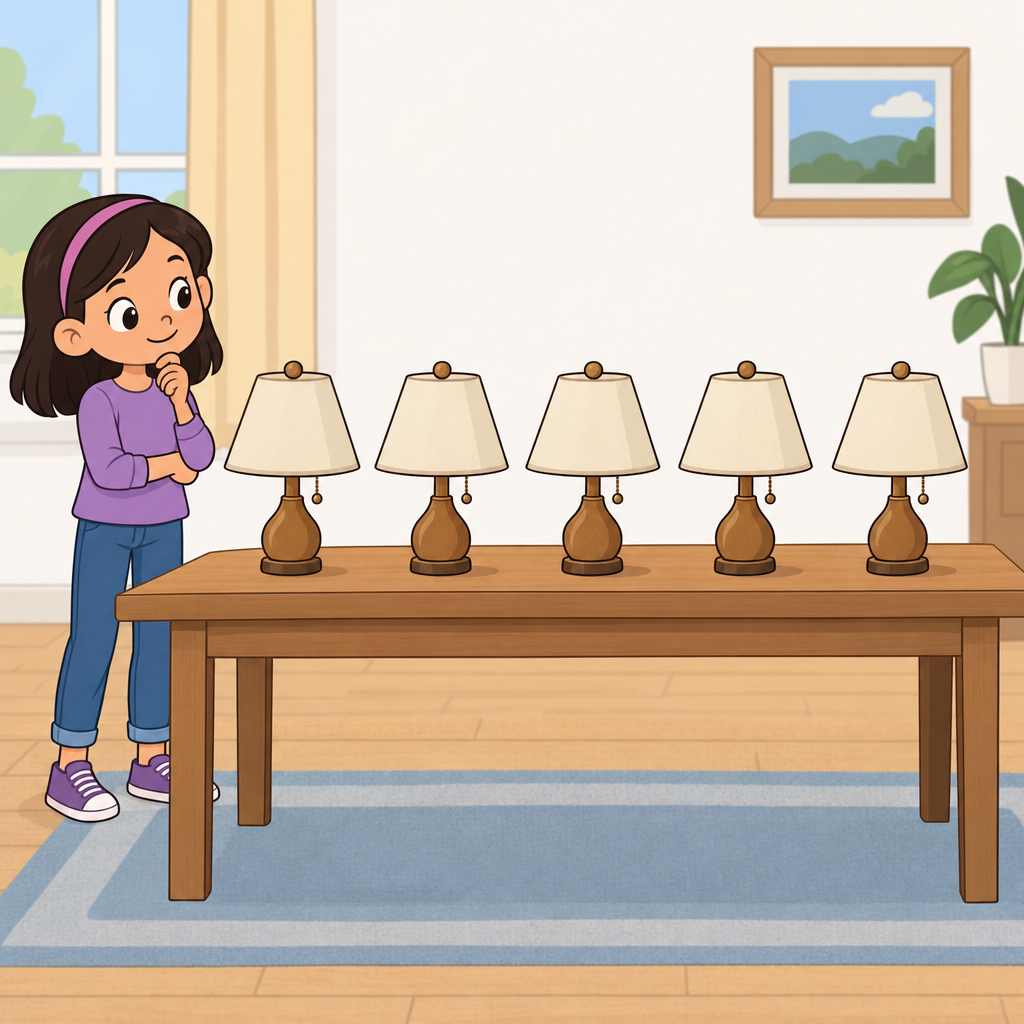
Five lamps stand in a row, all off. Bea makes exactly three moves; each move switches two neighboring lamps, turning each on lamp off and each off lamp on. Which row could she make, from left to right?
on-off-on-off-off
off-on-off-on-off
on-on-on-off-off
on-on-off-on-on
on-off-on-on-on
Show a hint
Group positions 1, 3, 5 together and positions 2, 4 together.
Each move switches one lamp in each group.
Show the answer and solution
Answer: E — on-off-on-on-on
Each move switches one lamp in each group. Since all lamps start off, after three moves each group must have an odd number of lamps on. Only on-off-on-on-on fits: positions 1, 3, 5 are on, and position 4 is on. Bea can make it by switching pairs (1, 2), then (2, 3), then (4, 5). The tempting on-off-on-off-off has two lamps on, but both are in the first group, so it cannot result from three moves.