Grade 12 math puzzles — free practice & printable teacher quizzes
Free grade 12 math puzzles that teach abstract thinking — competition and Olympiad style,
with instant hints, full solutions and a named thinking strategy for every task. Cumulative: grade 12 problems also test everything needed up to this grade.
Try each one first — the hint and the full solution open when you are ready.
Or solve them in the app with read-aloud and instant feedback.
Problem 1 · Compare squares to reveal a complex number’s real part · 3 points
A complex number z has |z| = 2, and (z + 1)² and (z − 1)² have the same real part. What is (z + i)² + (z − i)²?
−10
−6
6
10
−8
Show a hint
What does the matching real part tell you about the difference of the two squares involving 1?
Use that difference and |z| to find z² before expanding the expression you need.
Show the answer and solution
Answer: A — −10
The difference (z + 1)² − (z − 1)² equals 4z. Since the two squares have the same real part, z has real part 0. With |z| = 2, this gives z = ±2i and z² = −4. Thus (z + i)² + (z − i)² = 2z² + 2i² = −8 − 2 = −10. The tempting −6 results from using i² = 1 in the last step.
Problem 2 · Track a composition around a cycle · 3 points
Let g move each number in {0, 1, …, 2025} one step forward around a circle, wrapping from 2025 to 0. How many permutations f have no fixed points and satisfy f(g(x)) = g⁻¹(f(x)) for every x?
2026
0
2
1013
1012
Show a hint
Follow what the equation forces as you move from one number to the next around the circle.
If a = f(0), express f(x) in terms of a, then ask when f(x) could equal x.
Show the answer and solution
Answer: D — 1013
Write a = f(0). Since applying g to an input moves it forward while applying g⁻¹ to an output moves it backward, the equation forces f(x) ≡ a − x (mod 2026). Every value of a gives a permutation. A fixed point would satisfy 2x ≡ a (mod 2026), which is possible exactly when a is even. There are 1013 odd values of a, so the answer is 1013. The tempting answer 2026 counts the permutations that do have fixed points as well.
Problem 3 · Use a zero-sum identity for cyclic differences · 3 points
Real numbers a, b, and c satisfy a+b+c=4 and a²+b²+c²=14. If u=(a−b, b−c, c−a) and v=(b−c, c−a, a−b), what is u·v?
−26
0
13
−13
−21
Show a hint
Look for a relationship among the three coordinate differences before expanding the dot product.
Let x=a−b, y=b−c, and z=c−a. Use (x+y+z)² to relate their pairwise products to their squares, then use the given information to find the sum of those squares.
Show the answer and solution
Answer: D — −13
Set x=a−b, y=b−c, and z=c−a. Since x+y+z=0, the dot product is xy+yz+zx=−(x²+y²+z²)/2. Also, x²+y²+z²=3(a²+b²+c²)−(a+b+c)²=42−16=26. Thus u·v=−13. The tempting −26 comes from finding the correct sum of squares but forgetting to divide by 2.
Problem 4 · Split into regions, then verify roots · 4 points
For which positive value of a does |x² − 4x + 3| = ax have exactly three distinct real solutions?
4 + 2√3
1/2
2√3 − 3
4 − 2√3
1
Show a hint
As a changes, where could two solutions merge? The quadratic’s zeros divide the graph into regions worth considering separately.
For x > 0, compare |x² − 4x + 3|/x with a, and check that any candidate lies in the region where you found it.
Show the answer and solution
Answer: D — 4 − 2√3
Since a > 0, any solution has x > 0. On (0, 1) and (3, ∞), the equation is x² − (4 + a)x + 3 = 0. This quadratic changes sign between 0 and 1 and again between 3 and ∞, so it has exactly one root in each interval. For 1 < x < 3, the equation becomes a = 4 − x − 3/x. This expression rises from 0 to its maximum 4 − 2√3 at x = √3, then falls to 0; it equals a at exactly one point in this interval only when a = 4 − 2√3. That gives three solutions total. The tempting 4 + 2√3 also makes the middle quadratic’s discriminant zero, but its double root is −√3, outside the middle interval.
Problem 5 · Symmetrize reciprocal log products · 4 points
Let x > 1 satisfy x + 1/x = 3, and let log mean base 10. Which single logarithm equals log(x³ − 1) − log(x − 1) + log(1 + x⁻³) − log(1 + x⁻¹)?
log 8
log 9
log 7
log(1/8)
log 3
Show a hint
Try to make the expression symmetric in x and 1/x before solving for x.
Combine the logarithms, then factor the cubic expressions and look for x² + 1/x².
Show the answer and solution
Answer: A — log 8
Combining the logarithms gives log(((x³ − 1)(1 + x⁻³))/((x − 1)(1 + x⁻¹))). Factoring and cancelling reduces the argument to ((x² + x + 1)(x² − x + 1))/x² = x² + 1 + x⁻². This equals (x + 1/x)² − 1 = 8, so the answer is log 8. The tempting log 9 comes from overlooking the −1 in that final identity.
Problem 6 · Count cyclic arrangements using gaps and rotational symmetry · 4 points
A necklace has 4 black beads and 8 white beads, with no two black beads touching. How many arrangements are possible if two arrangements count as the same exactly when one is a rotation of the other?
9
10
8
35
105
Show a hint
Look at the numbers of white beads between successive black beads. What happens to that list when you choose a different black bead as your starting point?
Count the positive four-part sums, then check which lists remain unchanged when shifted by one, two, or three places.
Show the answer and solution
Answer: B — 10
The four gaps between successive black beads contain positive numbers of white beads summing to 8, giving C(7,3) = 35 ordered lists. Under cyclic shifts of a list, 35 lists are unchanged by a shift of zero places; 1 is unchanged by a shift of one place; 3, of the form (a,b,a,b) with a+b=4, are unchanged by a shift of two places; and 1 is unchanged by a shift of three places. Each distinct necklace contributes four across these fixed-list counts, so the answer is (35+1+3+1)/4 = 10. The tempting answer 35 counts the same necklace again when a different black bead is chosen as the starting point.
Split the first N positive odd integers into two nonempty consecutive blocks. If the second block sums to exactly one more than the first, what is the smallest possible N greater than 100?
577
99
239
408
578
Show a hint
Express the two block sums using the total of the first several odd integers. Then ask whether a solution could lead to a smaller one.
Once you have N² − 2k² = 1, try replacing (N, k) with (3N − 4k, 3k − 2N).
Show the answer and solution
Answer: A — 577
If the first block contains k numbers, its sum is k² and the total is N². Thus N² − 2k² = 1. Every solution with N > 3 yields a smaller nonnegative solution (3N − 4k, 3k − 2N) to the same equation; reversing this step gives the successive solutions (N, k) = (1, 0), (3, 2), (17, 12), (99, 70), (577, 408). So 577 is the first possible N above 100. The tempting 239 reverses the required difference: 239² − 2·169² = −1.
Problem 8 · Polynomial reduction and interpolation · 5 points
Let a, b, and c be the roots of x³ − 3x + 1 = 0. What is a⁸/(3a² − 3) + b⁸/(3b² − 3) + c⁸/(3c² − 3)?
-27
28
186
6
0
Show a hint
Think about how the cubic factors at each root: its other two roots give the denominator a useful meaning. The root equation can also tame the eighth powers.
Reduce x⁸ modulo the cubic to a quadratic. Then write that quadratic using its values at a, b, and c, and compare coefficients of x².
Show the answer and solution
Answer: B — 28
Write f(x) = (x − a)(x − b)(x − c). At any root r, f′(r) = 3r² − 3 is the product of r’s differences from the other two roots. Using r³ = 3r − 1 repeatedly gives r⁸ = 28r² − 27r + 6. Let R(x) = 28x² − 27x + 6. Interpolating R from its values at a, b, and c, the coefficient of x² is R(a)/f′(a) + R(b)/f′(b) + R(c)/f′(c). The requested sum is therefore 28. The tempting 186 is the sum a⁸ + b⁸ + c⁸; it ignores the denominators.
Problem 9 · Classify with modular arithmetic · 5 points
When an integer’s fourth power is divided by 65, which of these numbers cannot be the remainder?
35
56
26
16
61
Show a hint
Try checking fourth-power remainders using the prime factors of 65 rather than calculating large powers.
For a base not divisible by 13, Fermat’s little theorem tells you what its twelfth power is modulo 13.
Show the answer and solution
Answer: B — 56
The remainders 16, 26, 35, and 61 occur for bases 2, 13, 20, and 4, respectively. But if x⁴ ≡ 56 (mod 65), then x⁴ ≡ 4 (mod 13), so 13 does not divide x. Fermat’s little theorem would give 1 ≡ x¹² ≡ 4³ ≡ −1 (mod 13), a contradiction. The trap is that 4⁴ = 256 ends in 56, but its remainder modulo 65 is 61.
Problem 10 · Conditional counting by cases · 5 points
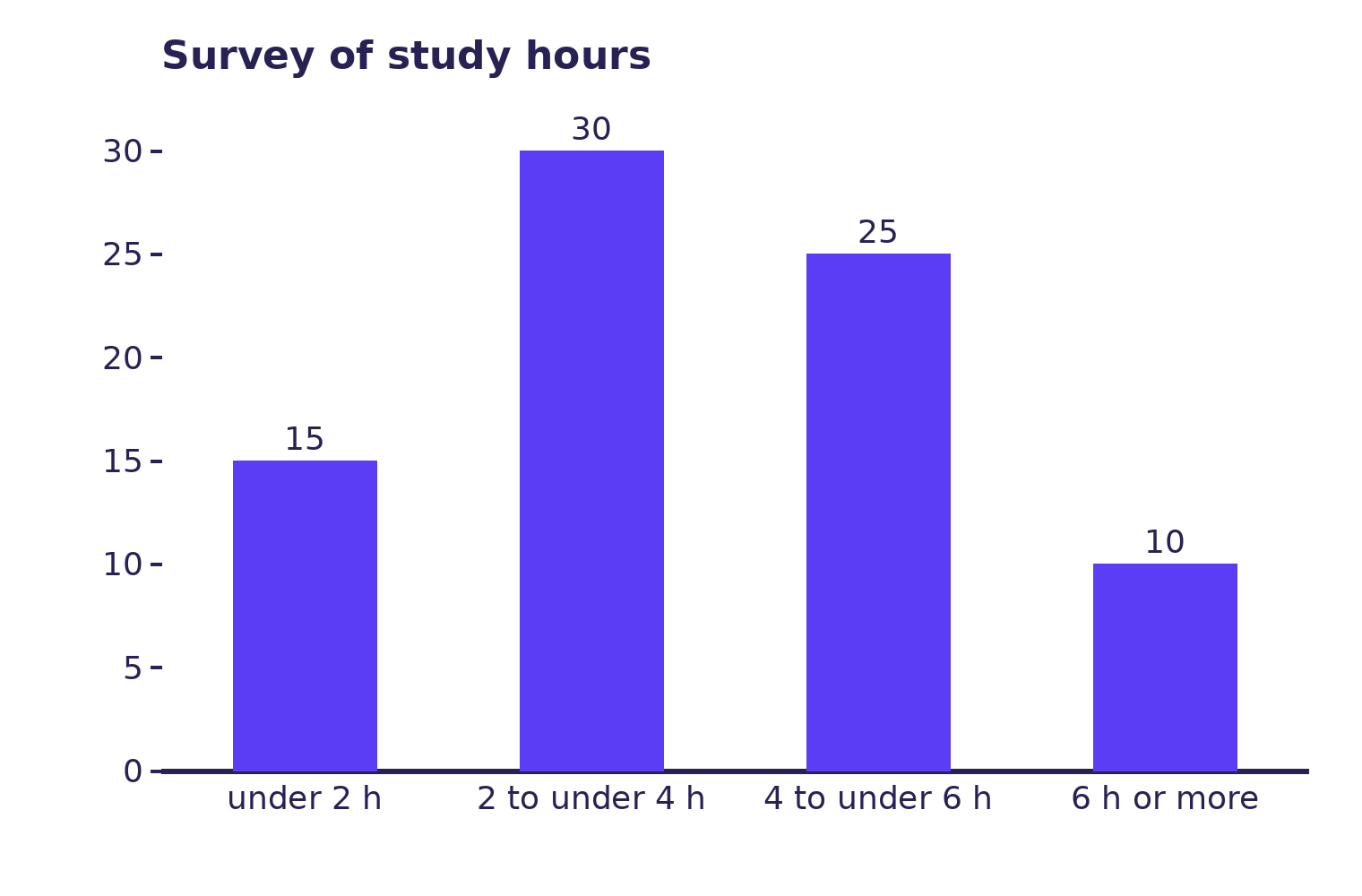
Four students are chosen at random without replacement. If their study hours fall in exactly three bars of the chart, what is the probability that the bar represented twice is 4 to under 6 hours or 6 hours or more?
303/724
23/59
8/19
1/2
7/16
Show a hint
The repeated bar is not equally likely to be any of the four bars: its size also affects which choices remain for the other two students.
For each possible repeated bar, count pairs from that bar, then choose the other two students from two different bars.
Show the answer and solution
Answer: A — 303/724
Count each four-student group once, according to its repeated bar. The numbers of valid groups when that bar is under 2 hours, 2 to under 4 hours, 4 to under 6 hours, and 6 hours or more are, respectively, 136,500; 337,125; 270,000; and 70,875. Thus the conditional probability is (270,000 + 70,875)/(136,500 + 337,125 + 270,000 + 70,875) = 303/724. The tempting 1/2 treats all four bars as equally likely to supply the repeated pair, but groups with different repeated bars occur in different numbers.
Problem 11 · Binary factorization modulo 2 · 3 points
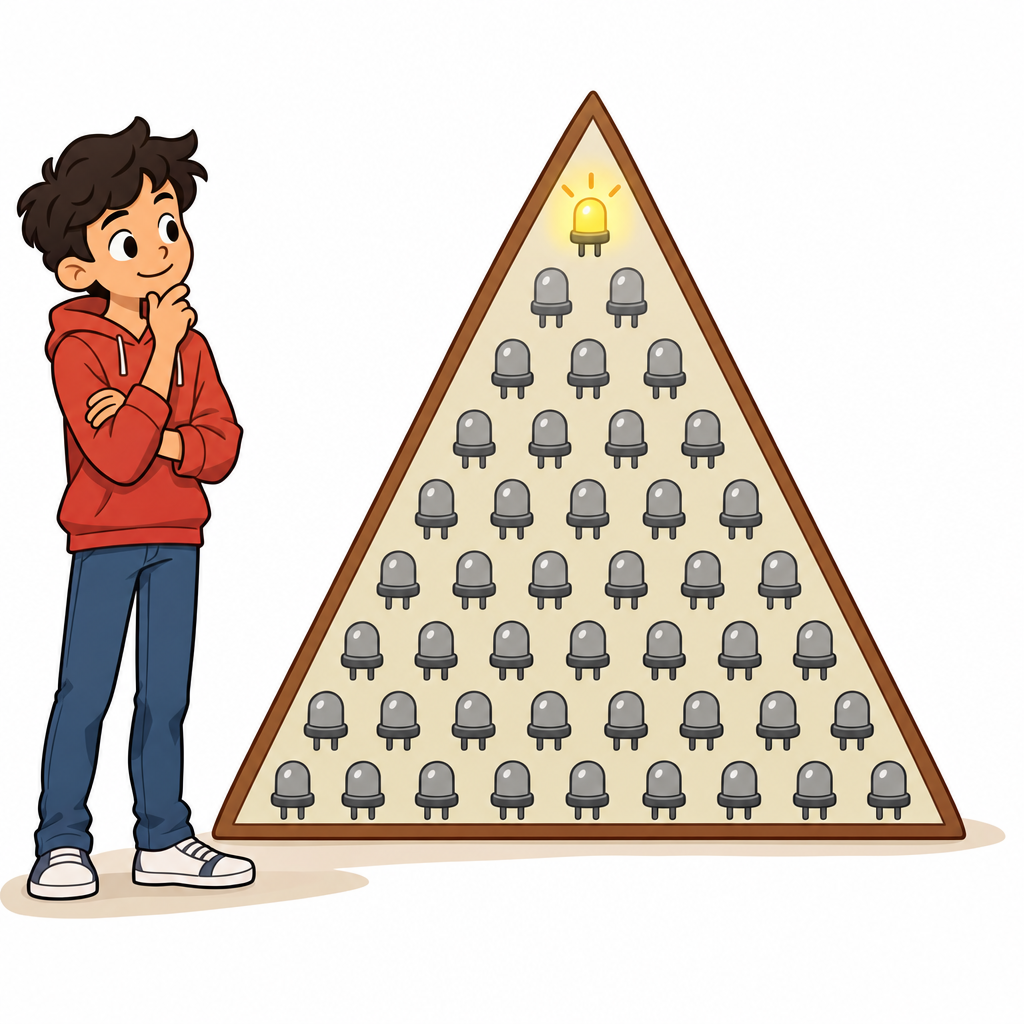
A triangular LED display starts with only its top LED lit (row 0). Each new row starts dark, and every lit LED in the preceding row toggles its two children; how many LEDs are lit in row 2026?
512
1014
256
2027
128
Show a hint
Draw a few rows, especially rows numbered by powers of two. Look for a way to skip ahead instead of building every row.
Represent the lit LEDs in a row by the nonzero coefficients of a polynomial modulo 2. Moving down one row multiplies that polynomial by 1+x.
Show the answer and solution
Answer: C — 256
The polynomial for row 2026 is (1+x)^2026, with coefficients taken modulo 2. For any power of two, (1+x)^(2^k) = 1+x^(2^k) modulo 2. Since 2026 = 1024+512+256+128+64+32+8+2, the polynomial is a product of eight such factors. Choosing one term from each factor gives 2^8 = 256 distinct exponents, so 256 LEDs are lit. The tempting 2027 counts every position in the row as lit, overlooking LEDs toggled an even number of times.
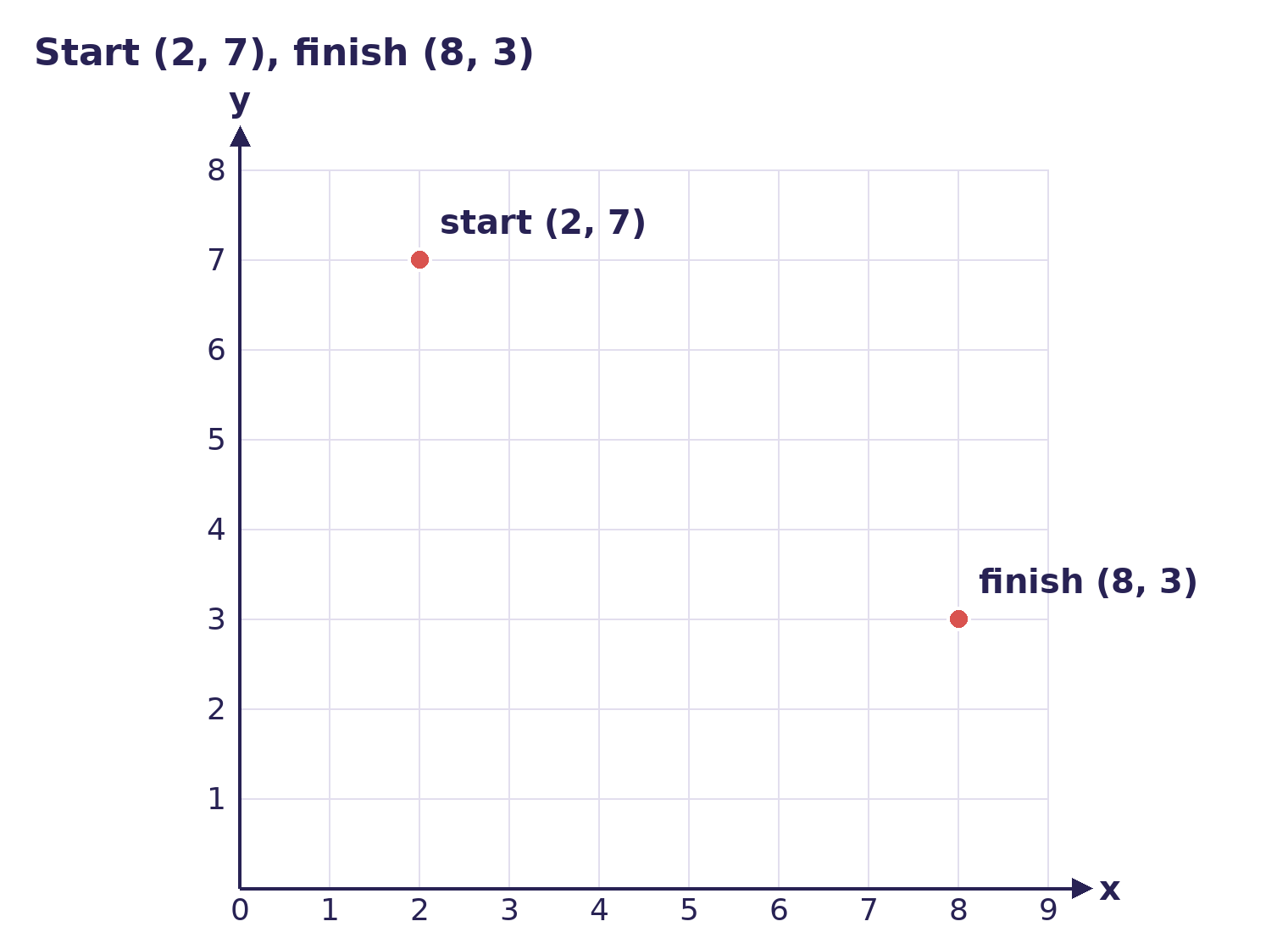
A robot travels within the closed first quadrant from (2,7) to (8,3). It must visit the y-axis and then the x-axis; what is the shortest possible distance it can travel?
2√34
2√29
√53 + √73
10√2
2√13
Show a hint
Reflecting a path across an axis can turn a bend at that axis into part of a straight-line comparison. How could this help with two required visits?
Reflect the start across the y-axis and the finish across the x-axis. Check whether the segment joining the reflected points crosses the axes in the required order.
Show the answer and solution
Answer: D — 10√2
Let P be the visit to the y-axis and Q the later visit to the x-axis. Reflecting the start to (−2,7) and the finish to (8,−3) preserves the lengths of the first and last parts of the route. The route is therefore at least as long as the straight-line distance between those reflected points: √(10² + 10²) = 10√2. The joining segment crosses the y-axis at (0,5) and then the x-axis at (5,0), so a route of length 10√2 is possible within the closed first quadrant. The value 2√29 comes from reflecting only the start across the y-axis and measuring to (8,3); that straight segment never reaches the x-axis, so it does not satisfy the second required visit.