Problem 11 · Binary factorization modulo 2 · 3 points
Made by AI and not reviewed by a real person.
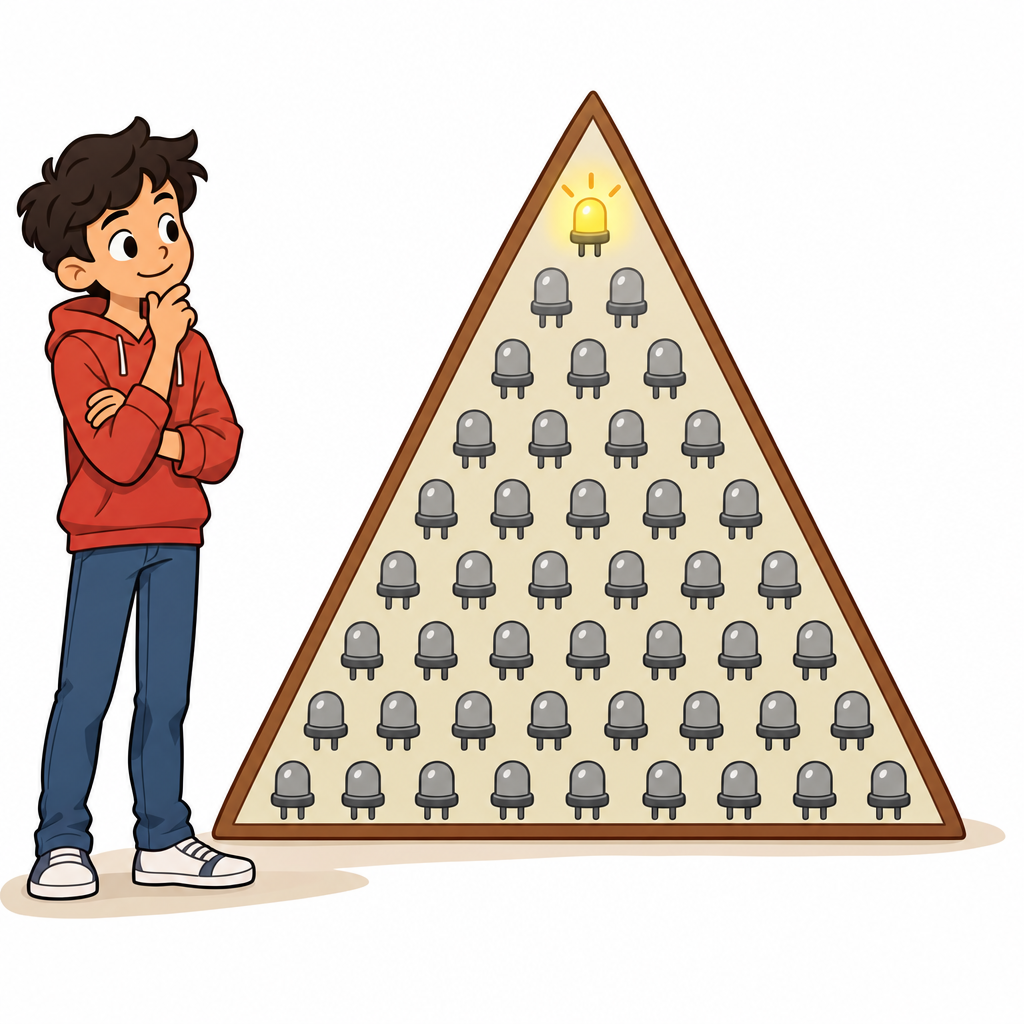
A triangular LED display starts with only its top LED lit (row 0). Each new row starts dark, and every lit LED in the preceding row toggles its two children; how many LEDs are lit in row 2026?
- 512
- 1014
- 256
- 2027
- 128
Show a hint
- Draw a few rows, especially rows numbered by powers of two. Look for a way to skip ahead instead of building every row.
- Represent the lit LEDs in a row by the nonzero coefficients of a polynomial modulo 2. Moving down one row multiplies that polynomial by 1+x.
Show the answer and solution
Answer: C — 256
The polynomial for row 2026 is (1+x)^2026, with coefficients taken modulo 2. For any power of two, (1+x)^(2^k) = 1+x^(2^k) modulo 2. Since 2026 = 1024+512+256+128+64+32+8+2, the polynomial is a product of eight such factors. Choosing one term from each factor gives 2^8 = 256 distinct exponents, so 256 LEDs are lit. The tempting 2027 counts every position in the row as lit, overlooking LEDs toggled an even number of times.